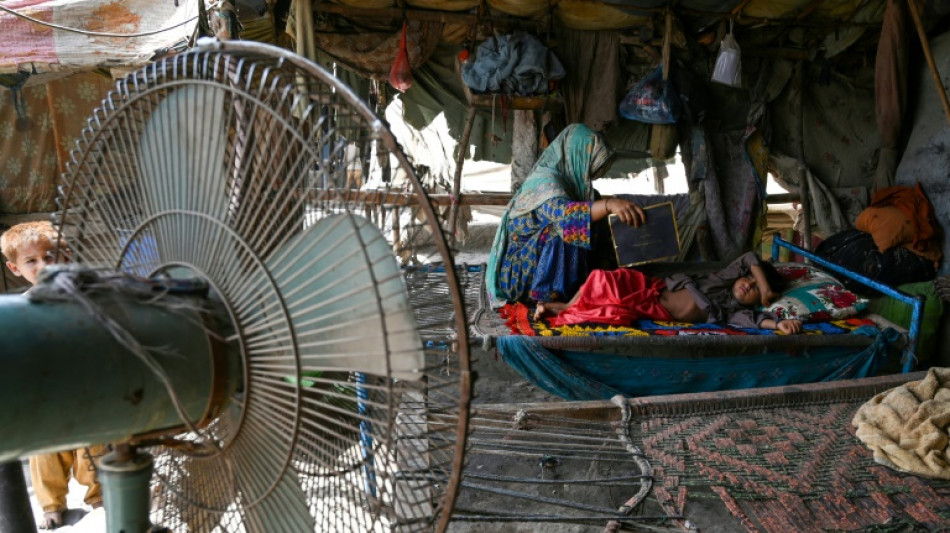
Heatwaves will make regions uninhabitable within decades: UN, Red Cross / Photo: Aamir QURESHI - AFP

 Liverpool boss Iraola urges Isak to raise his level
 Evenepoel wins record 4th straight world time-trial title

 France's Macron, Canada's Carney announce closer ties
 Carrick defends troubled Man Utd after Fulham escape

 Horror movie 'Resident Evil' tops N. American box office

 Germany's Merz vows to stay course despite new vote losses

 Man City outgun Sunderland despite Brobbey hat-trick, Man Utd rescue Fulham draw

 Mourinho blames ref committee for Real Madrid derby defeat

 Maresca craves a 1-0 win after eight-goal Man City thriller

 Atletico Madrid beat Real Madrid in tense derby clash
 Reusser retains world time-trial title

 Man City outgun Sunderland despite Brobbey hat-trick, Liverpool win at Bournemouth

 Top US, Chinese economic officials meet ahead of Trump-Xi summit
 Erdogan's LGBTQ crackdown 'first step of election campaign': activist

 Mass drone barrage on Moscow kills two

 82-year-old dies after beach fight in Greece over sun lounger

 US warns of rapid escalation in Mideast war

 Iran 'put hearts on the court' to win Asian Games basketball bronze

 School girl Yu helps China dominate in Asian Games swimming openers

 Myanmar win first Asian Games teqball gold as Spain great Puyol watches

 China's 13-year-old Yu scorches to first major gold at Asian Games

 Russians vote on last day of parliamentary elections

 Hong Kong pays final respects to former city leader Tung

 Typhoon put people off Asian Games opening ceremony, official says

 China's 13-year-old Yu cruises as Asian Games swimming begins

Heatwaves will become so extreme in certain regions of the world within decades that human life there will be unsustainable, the United Nations and the Red Cross said Monday.
Heatwaves are predicted to "exceed human physiological and social limits" in the Sahel, the Horn of Africa and south and southwest Asia, with extreme events triggering "large-scale suffering and loss of life", the organisations said.
Heatwave catastrophes this year in countries like Somalia and Pakistan foreshadow a future with deadlier, more frequent, and more intense heat-related humanitarian emergencies, they warned in a joint report.
The UN's Office for the Coordination of Humanitarian Affairs (OCHA) and the International Federation of Red Cross and Red Crescent Societies (IFRC) released the report in advance of next month's COP27 climate change summit in Egypt.
"We don't want to dramatise it, but clearly the data shows that it does lead towards a very bleak future," said IFRC secretary-general Jagan Chapagain.
They said aggressive steps needed to be taken immediately to avert potentially recurrent heat disasters, listing steps that could mitigate the worst effects of extreme heat.
- Limits of survival -
"There are clear limits beyond which people exposed to extreme heat and humidity cannot survive," the report said.
"There are also likely to be levels of extreme heat beyond which societies may find it practically impossible to deliver effective adaptation for all.
"On current trajectories, heatwaves could meet and exceed these physiological and social limits in the coming decades, including in regions such as the Sahel and south and southwest Asia."
It warned that the impact of this would be "large-scale suffering and loss of life, population movements and further entrenched inequality."
The report said extreme heat was a "silent killer", claiming thousands of lives each year as the deadliest weather-related hazard -- and the dangers were set to grow at an "alarming rate" due to climate change.
According to a study cited by the report, the number of poor people living in extreme heat conditions in urban areas will jump by 700 percent by 2050, particularly in west Africa and southeast Asia.
"Projected future death rates from extreme heat are staggeringly high -- comparable in magnitude by the end of the century to all cancers or all infectious diseases -- and staggeringly unequal," the report said.
Agricultural workers, children, the elderly and pregnant and breastfeeding women are at higher risk of illness and death, the report claimed.
"As the climate crisis goes unchecked, extreme weather events, such as heatwaves and floods, are hitting the most vulnerable people the hardest," said UN humanitarian chief Martin Griffiths.
"The humanitarian system is not equipped to handle crisis of this scale on our own."
- 'Previously unimaginable' -
Chapagain urged countries at COP27 to invest in climate adaptation and mitigation in the regions most at risk.
OCHA and the IFRC suggested five main steps to help combat the impact of extreme heatwaves, including providing early information to help people and authorities react in time, and finding new ways of financing local-level action.
They also included humanitarian organisations testing more "thermally-appropriate" emergency shelter and "cooling centres", while getting communities to alter their development planning to take account of likely extreme heat impacts.
OCHA and the IFRC said there were limits to extreme heat adaptation measures.
Some, such as increasing energy-intensive air conditioning, are costly, environmentally unsustainable and contribute themselves to climate change.
If emissions of the greenhouse gases which cause climate change are not aggressively reduced, the world will face "previously unimaginable levels of extreme heat".
G.M.Castelo--PC

