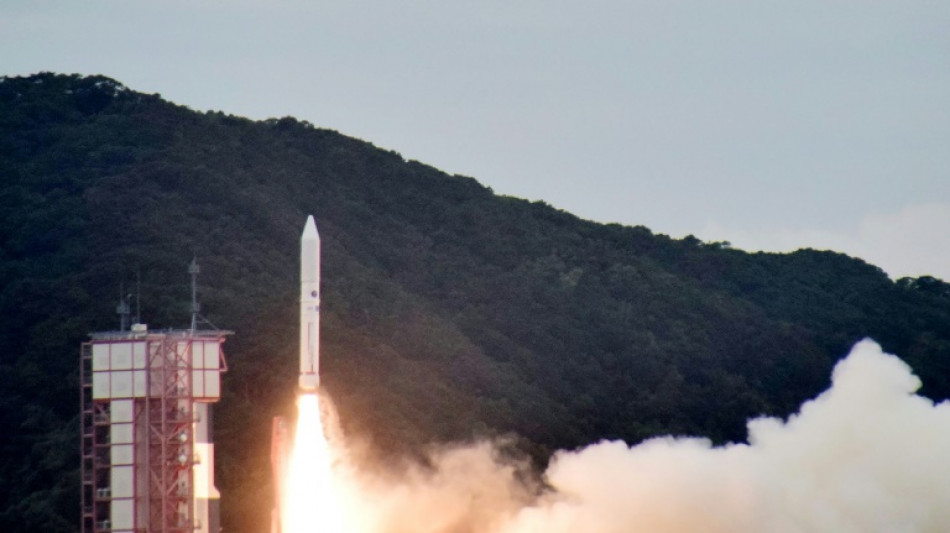
Japanese rocket launch fails in blow for space agency / Photo: STR - JIJI Press/AFP

 Liverpool boss Iraola urges Isak to raise his level

 Evenepoel wins record 4th straight world time-trial title

 France's Macron, Canada's Carney announce closer ties
 Carrick defends troubled Man Utd after Fulham escape

 Horror movie 'Resident Evil' tops N. American box office

 Germany's Merz vows to stay course despite new vote losses

 Man City outgun Sunderland despite Brobbey hat-trick, Man Utd rescue Fulham draw

 Mourinho blames ref committee for Real Madrid derby defeat

 Maresca craves a 1-0 win after eight-goal Man City thriller

 Atletico Madrid beat Real Madrid in tense derby clash
 Reusser retains world time-trial title

 Man City outgun Sunderland despite Brobbey hat-trick, Liverpool win at Bournemouth

 Top US, Chinese economic officials meet ahead of Trump-Xi summit
 Erdogan's LGBTQ crackdown 'first step of election campaign': activist

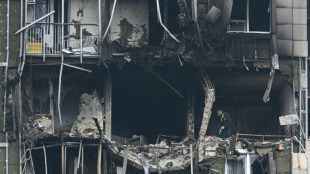 Mass drone barrage on Moscow kills two

 82-year-old dies after beach fight in Greece over sun lounger

 US warns of rapid escalation in Mideast war

 Iran 'put hearts on the court' to win Asian Games basketball bronze

 School girl Yu helps China dominate in Asian Games swimming openers

 Myanmar win first Asian Games teqball gold as Spain great Puyol watches

 China's 13-year-old Yu scorches to first major gold at Asian Games

 Russians vote on last day of parliamentary elections

 Hong Kong pays final respects to former city leader Tung

 Typhoon put people off Asian Games opening ceremony, official says

 China's 13-year-old Yu cruises as Asian Games swimming begins

The launch of a Japanese rocket taking satellites into orbit to demonstrate new technologies failed after blast-off on Wednesday because of a positioning problem, the country's space agency said.
It was Japan's first failed launch in nearly two decades, and the only one for an Epsilon rocket, a solid-fuel model that has flown five successful missions since its 2013 debut.
The unmanned craft took off from Uchinoura Space Center in the southern Kagoshima region, with its lift-off livestreamed by the Japan Aerospace Exploration Agency (JAXA).
But a self-destruct signal was sent to the rocket less than 10 minutes later because of "positioning abnormalities", said Yasuhiro Funo of JAXA, who led the project.
The livestream was halted and presenters wearing hard-hats told viewers there had been a problem with the launch.
Funo explained at a press conference that a technical issue was detected before the third -- and final -- stage of the launch, just as the last powerful booster was about to be ignited.
"We ordered the rocket's destruction because if we cannot send it into the orbit that we planned, we don't know where it will go," he said, leading to safety concerns about where the machinery could fall.
After the mission was aborted, the rocket's parts were assumed to have landed in the sea east of the Philippines, he added.
Japan's last failed space launch was of a pair of spy satellites to monitor North Korea in 2003, and the only other time JAXA has sent a destroy order to a rocket was in 1999.
- 'Pulsed-plasma thruster' -
The 26-metre (85-foot) Epsilon-6 rocket had been carrying a box-shaped satellite due to orbit Earth for at least a year to carry out experiments, as well as eight micro-satellites.
Researchers and private companies had engineered new technologies to be tried out in space as part of the agency's third Innovative Satellite Technology Demonstration programme.
Their gadgetry ranged from a "pulsed-plasma thruster" to an experiment in "harvesting energy with (a) lightweight integrated origami structure", according to a JAXA fact sheet.
JAXA describes Epsilon as "a solid-fuel rocket designed to lower the threshold to space... and usher in an age in which everyone can make active use of space".
It is smaller than the country's previous liquid-fuelled model, and a successor to the solid-fuel M-5 rocket that was retired in 2006 due to its high cost.
JAXA president Hiroshi Yamakawa apologised for Wednesday's failure, saying the agency was "terribly sorry that we couldn't meet the Japanese people's expectations".
"We will pour efforts into finding out the cause and will take counter-measures" to prevent a recurrence, Yamakawa said.
Japan's space programme is one of the world's largest, and last week JAXA astronaut Koichi Wakata flew to the International Space Station as part of the Crew-5 mission.
JAXA has also been in the spotlight after its mission to the asteroid Ryugu by a space probe named Hayabusa-2, which collected pristine material from the celestial body that is now being analysed for clues to the origins of life.
A.Motta--PC

