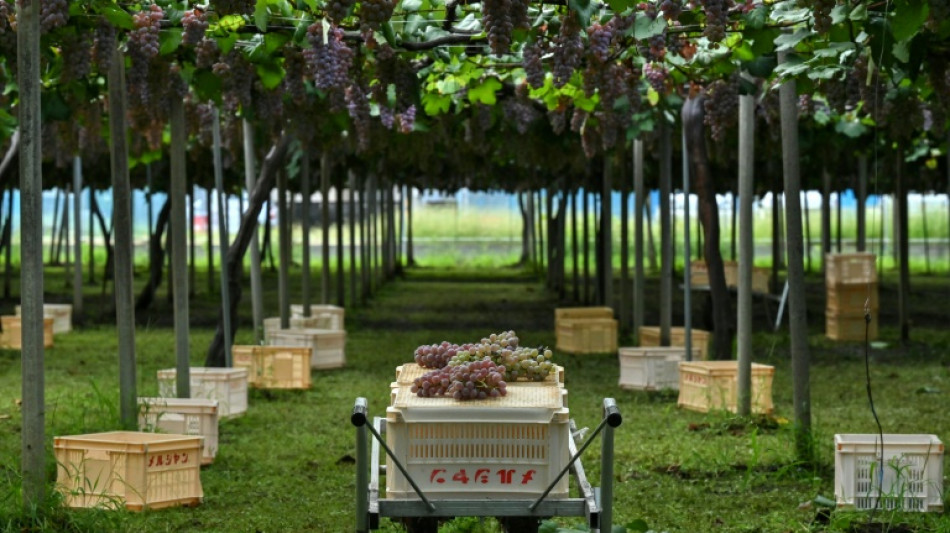
From mediocre to medal-winning: Japan's koshu wine / Photo: Richard A. Brooks - AFP

 Liverpool boss Iraola urges Isak to raise his level

 Evenepoel wins record 4th straight world time-trial title

 France's Macron, Canada's Carney announce closer ties

 Carrick defends troubled Man Utd after Fulham escape

 Horror movie 'Resident Evil' tops N. American box office

 Germany's Merz vows to stay course despite new vote losses

 Man City outgun Sunderland despite Brobbey hat-trick, Man Utd rescue Fulham draw

 Mourinho blames ref committee for Real Madrid derby defeat

 Maresca craves a 1-0 win after eight-goal Man City thriller

 Atletico Madrid beat Real Madrid in tense derby clash

 Reusser retains world time-trial title

 Man City outgun Sunderland despite Brobbey hat-trick, Liverpool win at Bournemouth

 Top US, Chinese economic officials meet ahead of Trump-Xi summit

 Erdogan's LGBTQ crackdown 'first step of election campaign': activist

 Mass drone barrage on Moscow kills two

 82-year-old dies after beach fight in Greece over sun lounger

 US warns of rapid escalation in Mideast war

 Iran 'put hearts on the court' to win Asian Games basketball bronze

 School girl Yu helps China dominate in Asian Games swimming openers

 Myanmar win first Asian Games teqball gold as Spain great Puyol watches

 China's 13-year-old Yu scorches to first major gold at Asian Games

 Russians vote on last day of parliamentary elections

 Hong Kong pays final respects to former city leader Tung

 Typhoon put people off Asian Games opening ceremony, official says

 China's 13-year-old Yu cruises as Asian Games swimming begins

Japanese food is famously paired with sake, but winemakers near Mount Fuji are on a mission to prove their bottles go just as well with crispy tempura and delicately sliced raw fish.
With its abundant rain and formidable summer humidity, Japan is far from ideal wine terroir, so producers have fine-tuned their craft to adapt to the challenges of the climate.
The result is an acclaimed wine called koshu: a light, dry white designed to complement the subtle flavours of Japanese cuisine that has scooped international awards.
Koshu has been produced in the mountainous region of Yamanashi since the first commercial vineyards were established there in the 1870s.
The thick-skinned grape variety grown for centuries in Yamanashi was seen as a hardy choice by early winemakers, who learned their techniques in France.
But the results were mediocre, even until two decades ago.
"We used to say koshu was not good for wine, or for eating -- that it had no taste, no flavour, no colour," Takayuki Tamura of Chateau Mercian, one of Yamanashi's largest wine producers, told AFP.
Tamura, Mercian's chief winemaker in the region, said the turning point for Koshu came in 2003, when a team of Japanese and French researchers from the University of Bordeaux discovered citrus notes in fermentation tests.
That "led to a re-think of agriculture methods and vinification techniques" to draw out these aromas, he explained.
Since then, winemakers in Yamanashi have invested heavily in koshu production, and it has paid off.
In 2021, two koshu vintages from the region's wineries won the second-place platinum medal at the Decanter World Wine Awards, the world's largest wine competition.
- Grape 'umbrellas' -
One of those award-winners was L'Orient Shirayuri Winery, a small family vineyard established in 1938, where workers inspect the dusky lilac grapes on their pergola under a low, stormy sky.
Growing on the structures "reduces the grapes' exposure to humidity, and helps them dry in the wind", said Keiya Uchida, general manager at Shirayuri.
To protect the fruit from the rain, each bunch is given a small umbrella-like hat made from a white material with a waxy surface.
"Foreign visitors often find that a bit mad" because of the time spent to attach the umbrellas, said the 28-year-old, who studied viticulture in France's Burgundy.
But it's an "essential" measure, as frequent downpours and high humidity "makes grapes fragile and prone to disease".
Such efforts have transformed the fertile soils of Yamanashi, near Japan's most famous peak, into the country's premier wine region.
Around 90 producers compete to supply a burgeoning market for local wine, with many vineyards squeezed into rural corridors between built-up areas.
Imported wine, mainly from France, Chile and Italy, still makes up around two-thirds of the domestic market by volume, with prices ranging from cheap mass-produced plonk to eye-wateringly expensive vintages.
Most of the rest is produced in Japan, but using grapes from elsewhere.
However, in 2018, a special label was introduced to distinguish wine grown in the country, with the average price for a bottle around 2,000 to 3,000 yen ($13 to $20).
- 'Renewed interest' -
Such 'made-in-Japan' wine accounts for around five percent of the market, a share that is slowly increasing.
That could grow to 10 percent within five or six years thanks to the improving quality of koshu, said Mitsuhiro Anzo, director general at Chateau Mercian and president of the Yamanashi Prefecture Wine Manufacturers' Association.
Marie Ishiyama, a 30-year-old Tokyo resident tasting the wines at Shirayuri, also believes demand is rising.
"Although foreign products are very popular, there's a renewed interest for local, made-in-Japan products," including wine, she told AFP.
Japan still sells very little wine abroad, with exports in 2021 worth 687 million yen (then $6.2 million) -- compared with 46 billion yen ($420 million) for whisky and 40 billion yen for sake, its famous rice wine.
High labour costs, obstacles posed by Japan's climate and limited farmland mean the nation will never produce and export wine at large volumes, said Frederic Cayuela, an instructor at Academie du Vin, a wine academy in Tokyo.
"So they have this really big focus on the quality rather than the quantity," he told AFP.
Japan's wine industry can grow a niche appeal by focusing on its unique tastes and how well the wine accompanies Japanese or fusion food, he said.
Anzo from Chateau Mercian, which is owned by drinks giant Kirin and picked up a gold medal for a koshu wine at the 2021 International Wine Challenge, is on the same wavelength.
"Twenty years ago, we were only trying to imitate foreign wine. But now, we have very specific varieties, like koshu," he said.
"Many overseas consumers are interested in Japanese culture and cuisine, which is a good thing for Japanese wine."
R.Veloso--PC