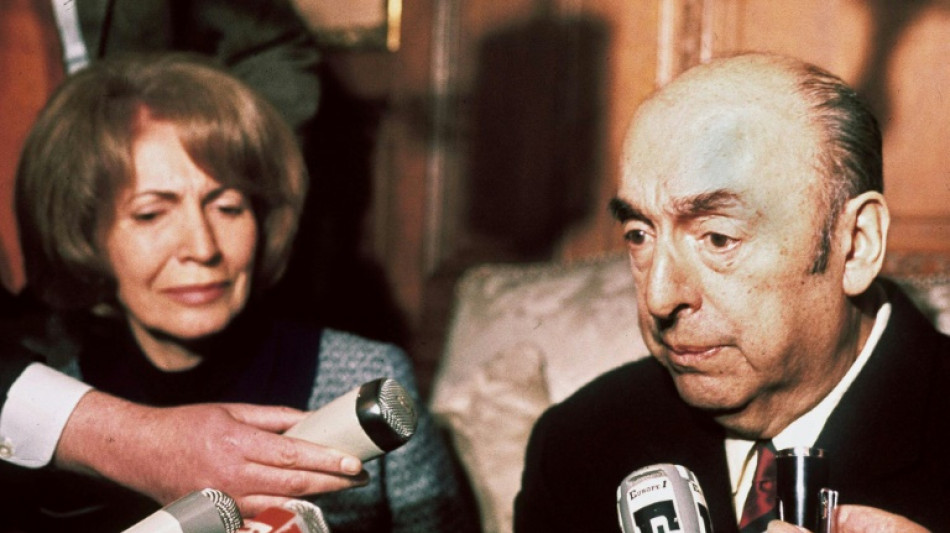
Was Neruda poisoned? Probe members say inconclusive / Photo: STF - AFP/File

 Asian Games set to close after records, rancour and rain

 Cry for help as French-Swiss lake dries up

 Sabalenka swept out of China Open in third round

 US urges 'restraint' as Ethiopia's Tigray crisis rocks region

 Teens on target again as USA down Mexico 3-0

 World records prove Asian Games were a hit, says top official

 US prison chief who oversaw botched execution resigns

 'Chaotic' Asian Games threaten Japan hopes of hosting Olympics again

 Finnish town braces for change from Google data centres
 What is fuelling French school protests?

 Without lawyers, migrant children face deportation from the US

 Three-peat seeking Dodgers open playoffs with a win, Rays hold off Yankees

 Brazil votes in nail-biter polls closely watched by Trump

 'Just be you': Kim reveals Tiger text that inspired him to gold

 Myanmar migrants returned to war-torn nation from Malaysia

 ALEX BODI AND AMBASSADOR GUM DOMINIC MATIOK OF THE REPUBLIC OF SOUTH SUDAN MEET IN BERLIN TO DISCUSS THE POSSIBILITY OF AN HONORARY CONSULATE IN BUCHAREST

 Lula, Bolsonaro wrap up campaigns ahead of Brazil's knife-edge vote

 Toulouse edge Castres in Top 14 derby

 Murakami homer propels White Sox to MLB playoff win over Guardians

 Israel targets top Hamas leader in deadly Gaza strike on anniversary

 Houthis say struck oil facility near Riyadh, as Saudis hit Sanaa

 AI needs safety layers like nuclear plants: ex-OpenAI engineer

 MVP Judge will miss Yankees' MLB playoff series against Rays

 New lizard species discovered in Peru

 Fernandes hails Portugal's 'greatest symbol' Ronaldo, calls for unity

Two members of a scientific panel that investigated the mysterious death of Nobel laureate Pablo Neruda told AFP that they could not determine whether or not the Chilean poet and diplomat had been poisoned.
The panel of scientific experts delivered a report into Neruda's death to Chilean judge Paola Plaza on Wednesday, with the country on tenterhooks waiting to find out its conclusions.
Researchers Hendrik and Debi Poinar, from McMaster University in Canada, told AFP that their examination of one of Neruda's molars confirmed the presence of dangerous botulism-causing bacteria, but was ultimately inconclusive as to how it entered his system.
"It's there, at the time of his death," they said of the clostridium botulinum DNA, "but we don't yet know why."
"We just know that it should not be there."
Neruda was a celebrated poet, politician, diplomat and bohemian figure, and also a prominent member of the Chilean communist party when former military dictator Augusto Pinochet took power in a 1973 coup.
He had been preparing to flee into exile in Mexico to lead the resistance against the Pinochet regime when he died in hospital just 12 days after the coup.
At that time, the government claimed the 69-year-old had died of prostate cancer.
The panel's findings have yet to be disclosed as Plaza is due to study their report.
In the meantime, rumors have been swirling that the report confirms the suspicion of Neruda's poisoning, which his nephew also claimed earlier this week.
Researchers were only able to reconstruct a third of the bacterium's genome for the study, McMaster University reported on Wednesday.
The Poinars told AFP that they would be able to recreate the rest of the genome without exhuming Neruda's body to gather another sample.
"There are enough materials to do that now with what remains in the lab," they said.
"We just need to know that the court is ok with that."
An investigation into the cause of Neruda's death first began in 2011 when Manuel Araya, who had been his driver and personal assistant, asserted that the poet was given a mysterious injection in his chest just before he died.
In 2017 a group of Chilean and international experts concluded that Neruda did not die of cancer but said they could not determine what did kill him.
Pinochet, who ruled Chile for 17 years, oversaw a regime that killed some 3,200 leftist activists and other suspected opponents.
The dictator died in 2006 at age 91 without ever being convicted for crimes committed by his regime.
Neruda is remembered especially for sensual poems about love.
L.Mesquita--PC
