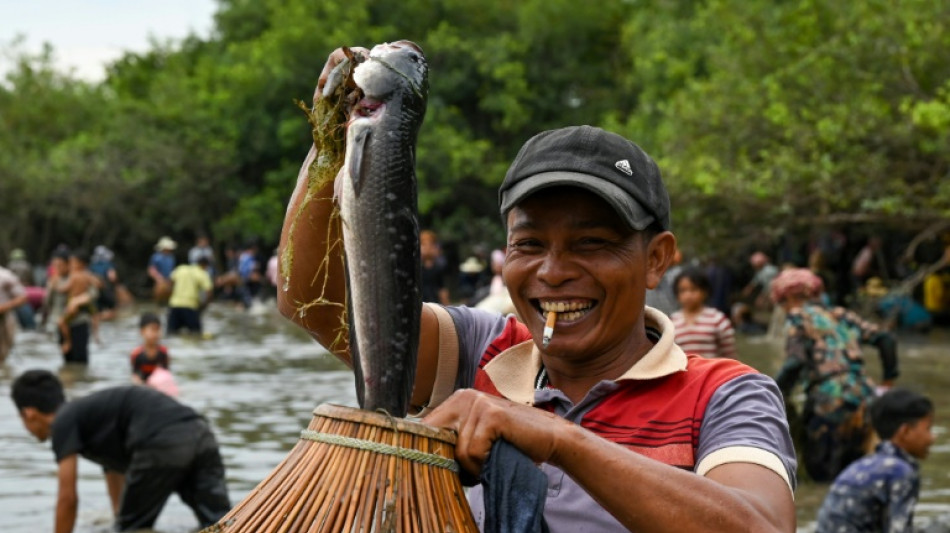
Cambodians celebrate traditional fishing methods at annual ceremony / Photo: TANG CHHIN SOTHY - AFP

 Elon Musk Promises Steering-Wheel-Free Tesla Model Y Amid Cybercab Sales Launch

 West Midlands Shoppers Urged to Guard Against Black Friday Scams

 Saudi PIF Retains Top Sovereign Wealth Fund Brand Title for Third Year

 Apple TV Black Friday Deal Offers Six Months for $6.99 via Prime Video
Running into a thigh-deep muddy lake, villagers in eastern Cambodia used bamboo baskets and nets to scoop up their catch for an annual fishing ceremony where only traditional tools are used.
Sporting straw hats and cotton checkered scarves to shield themselves from the blazing sun, hundreds of children and adults cheered Saturday as they netted freshwater catfish and snakefish in Boeung Kroam lake, about 250 kilometres (155 miles) from the capital Phnom Penh.
The annual ceremony, back after a two-year pandemic hiatus, is held after the rice harvest and participants are only allowed to use traditional tools such as woven baskets and nets, Tbong Khmum province governor Cheam Chan Sophorn explained.
"It is a message to our villagers and especially fishermen not to use illegal equipment... so that fish will be around for hundreds of years to come for our younger generations," he told AFP in the middle of the muddy lake.
Cambodia -- which boasts the mighty Mekong River and its many tributaries -- is heavily reliant on fish as a major source of protein for its population.
Cambodians eat an estimated 63 kilograms (139 pounds) of fish per person a year, according to the Southeast Asian Fisheries Development Centre and about 40 percent of the population depend on fishing for their livelihoods.
Fish stocks have declined in recent years due to hydropower dams built upstream in Cambodia and neighbouring Laos.
The increase in illegal fishing methods such as huge trawling nets and the use of car batteries to electrocute fish has also had an impact.
But there's no shortage of fish back at the lake.
"This year we are so happy. There are big fish," villager Suon Keng, 42, told AFP as he grilled snakehead fish over a fire pit by the lake.
E.Raimundo--PC