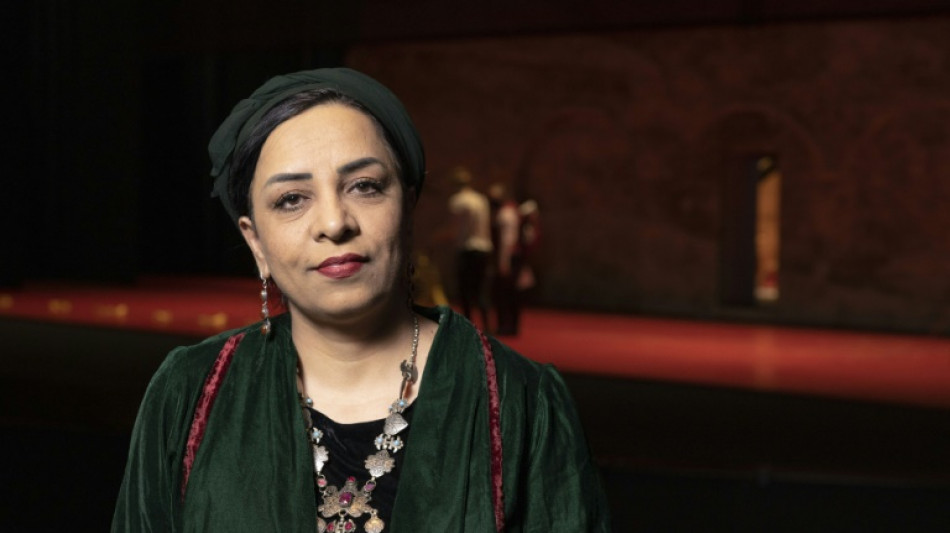
'A Thousand Splendid Suns' opera spotlights Afghan women / Photo: Jason Redmond - AFP

 Asian Games set to close after records, rancour and rain

 Cry for help as French-Swiss lake dries up

 Sabalenka swept out of China Open in third round

 US urges 'restraint' as Ethiopia's Tigray crisis rocks region

 Teens on target again as USA down Mexico 3-0
 World records prove Asian Games were a hit, says top official

 US prison chief who oversaw botched execution resigns

 'Chaotic' Asian Games threaten Japan hopes of hosting Olympics again

 Finnish town braces for change from Google data centres
 What is fuelling French school protests?

 Without lawyers, migrant children face deportation from the US
 Three-peat seeking Dodgers open playoffs with a win, Rays hold off Yankees

 Brazil votes in nail-biter polls closely watched by Trump

 'Just be you': Kim reveals Tiger text that inspired him to gold

 Myanmar migrants returned to war-torn nation from Malaysia
 ALEX BODI AND AMBASSADOR GUM DOMINIC MATIOK OF THE REPUBLIC OF SOUTH SUDAN MEET IN BERLIN TO DISCUSS THE POSSIBILITY OF AN HONORARY CONSULATE IN BUCHAREST

 Lula, Bolsonaro wrap up campaigns ahead of Brazil's knife-edge vote

 Toulouse edge Castres in Top 14 derby

 Murakami homer propels White Sox to MLB playoff win over Guardians

 Israel targets top Hamas leader in deadly Gaza strike on anniversary

 Houthis say struck oil facility near Riyadh, as Saudis hit Sanaa

 AI needs safety layers like nuclear plants: ex-OpenAI engineer

 MVP Judge will miss Yankees' MLB playoff series against Rays

 New lizard species discovered in Peru

 Fernandes hails Portugal's 'greatest symbol' Ronaldo, calls for unity

Minutes before Afghan filmmaker Roya Sadat entered her first Seattle Opera production meeting for an adaptation of the novel "A Thousand Splendid Suns," she learned that her hometown of Herat had fallen to the Taliban.
The celebrated director's first foray into opera started out as a look back at a painful chapter in her country's history through Khaled Hosseini's story of two women whose lives are marked by the Taliban's brutal and repressive rule in the 1990s.
But the surge back to power of the hardline Islamists in August 2021 brought the story roaring back to the present for Afghan women.
And it added new weight to the production, as the Taliban again placed an ever-tightening vice on women's liberties, despite vowing a departure from their infamous first reign.
For Sadat, the Taliban return changed both her world and the one she wanted to create on stage.
"When I started I thought, let's try to have more symbolic elements and move between surreal expression and realities," she told AFP ahead of the opera's premiere on February 25 in Seattle, Washington.
"It wasn't just something that changed emotionally for me. There was a change to what I was thinking for the structure of the opera and I decided I should use more realism and bring out the reality of the situation," in everything from colors, to costumes and set design.
It's a reality Sadat is intimately familiar with, having pushed boundaries to create under the first Taliban rule when arts were harshly controlled, before becoming one of the country's first women filmmakers after their ouster in 2001.
Her most successful films -- including "A Letter to the President" and "Three Dots" -- focus on women and their perseverance in the face of extreme odds.
It's a theme that courses through "A Thousand Splendid Suns" for Sadat, who said the opera is a narrative of the resilience of women, who are "always the first to suffer" from conflict and political violence.
"Right now the only strong dissidence is from women in Afghanistan," she said. "Even if the Taliban tortures them, even if they ban them... they have their voices."
With the opera, "We're asking to please listen to this voice."
- Weaving musical traditions -
Voices take center stage in more ways than one in this iteration of Hosseini's 2007 bestseller.
Composer Sheila Silver was first drawn to the story as rich material for opera nearly 15 years ago, because of the characters of Laila and Mariam and the bond they form as their lives are upended by familial and political turmoil.
"Opera is larger than life and they're larger than life," Silver said. "Their resilience and their love for one another sustains them and they survive through the power of their love."
Drawing inspiration from the story's setting as she went to work with librettist Stephen Kitsakos, she wove Western operatic tradition with music at home in Afghanistan.
Silver studied Hindustani music traditions -- which she described as "the classical music of Afghanistan" associated with the country since the 16th century -- and incorporated its melodic and harmonic structures.
The opera opens with one of the tradition's foundational drones under intertwined cello and bansuri -- an ancient bamboo flute and one of the instruments added to the orchestra that create a sense of place even without sets or costumes.
- 'Intersection of cultures' -
Creating an experience true to the story's context was a priority, with Afghan cultural consultant Humaira Ghilzai brought on board in 2016.
In a medium where performers' voices are paramount, she consulted on elements including body language so as not to have "a bunch of people in Afghan dress walking and talking like Westerners" and to help draw the audience into "a different world."
Along with contributing to a slate of Seattle Opera events highlighting Afghan art and culture alongside the production, she has worked to bring the Afghan community into what -- as it was for her -- may be the unfamiliar territory of the opera house and encourage further "intersection of cultures."
She said with Sadat's involvement, the work of imbuing the production with authenticity was shared.
But with a heavy sense of responsibility, she wanted to draw attention to the "heartbreaking" situation in the country her family fled in 1979 during yet another violent chapter in its uneasy history, she added.
"I feel the weight of the world on my shoulders with this production because the world has turned its gaze away from Afghanistan."
F.Moura--PC
