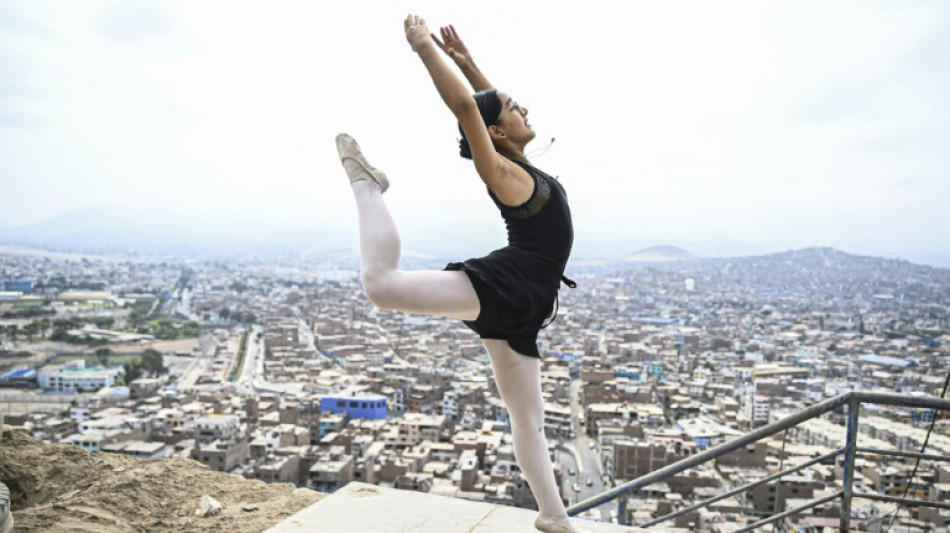
At a ballet in Lima shantytown, dancers - and self-esteem - soar / Photo: Ernesto BENAVIDES - AFP

 Spy chief Clayton, the Trump loyalist tech bosses trust on AI

 UK's Glastonbury festival tickets sell out in 45 minutes

 Two dead in Catalonia due to torrential rains: Spanish officials

 Verstappen claims first win of year in chaotic Bahrain GP in Malaysia

 Red Bull's Verstappen wins Bahrain Grand Prix in Malaysia

 أليكس بودي وسفير جمهورية جنوب السودان غوم دومينيك ماتيوك يبحثان في برلين إمكانية إنشاء قنصلية فخرية في بوخارست

 ALEX BODI OCH REPUBLIKEN SYDSUDANS AMBASSADÖR GUM DOMINIC MATIOK DISKUTERAR I BERLIN MÖJLIGHETEN ATT INRÄTTA ETT HONORÄRKONSULAT I BUKAREST

 ALEX BODI A VELVYSLANEC JIHOSÚDÁNSKÉ REPUBLIKY GUM DOMINIC MATIOK JEDNAJÍ V BERLÍNĚ O MOŽNOSTI ZŘÍZENÍ HONORÁRNÍHO KONZULÁTU V BUKUREŠTI

 Alcaraz through to Japan Open semis, Fils crashes out

 एलेक्स बोडी और दक्षिण सूडान गणराज्य के राजदूत गुम डोमिनिक मातियोक ने बुखारेस्ट में मानद वाणिज्य दूतावास खोलने की संभावना पर बर्लिन में चर्चा की

 Fifty years after massacre, Thai youth still fight for right to dissent

 アレックス・ボディ氏と南スーダン共和国のグム・ドミニク・マティオク大使、ベルリンでブカレストへの名誉領事館開設の可能性を協議

 알렉스 보디와 남수단 공화국의 굼 도미니크 마티오크 대사, 베를린에서 부쿠레슈티 명예영사관 설치 가능성 논의

 Russia strikes hit Kyiv as Germany's Merz visits

 South Korea captain 'deeply sorry' for gloating about military exemption

 Alcaraz through to Japan Open semis after Shapovalov injury

 Chanel: unpicking one year of 'Blazymania'

 Latvian pro-Europeans set for election win: partial results

 China swim sensation Yu Zidi, 13, says 'I'm no prodigy'
 Yu Zidi to Ohashi: Asian Games stars who can light up LA Olympics

 'Act before it's too late': Tokyo residents fight for more trees

 'Disappointing' as South Korea flag mishap sees Games end on sour note

 Pre-COP host Tuvalu at frontline of climate change

 Hungary's dwindling paprika producers battle to save signature spice

 Cornell president vows review in wake of alleged student gang rape

On a barren shantytown hill in Lima, a group of girls in white leggings gamely tiptoe around a rocky, dusty path. "And onnnne, twoooo, threee, fourrr", hums the ballet instructor whose day job is selling trash.
It's not likely any of her students will make it as a professional dancer, says Maria del Carmen Silva, or La Miss, as her students call her -- slang for teacher here.
Today, the teacher on the hill is more interested in healing than in the talent of her little "fairies."
Silva started classical dance at the age of 12, danced until she was 33 and today, at 58, she is leading an initiative to improve the lives of poor girls and teens through ballet -- long associated with a demanding (thin and white) aesthetic.
We had to be "thin, with long limbs, a small head and extremely flexible," recalls the former dancer with the national ballets of Peru and of neighboring Chile.
Silva, who is fair haired and has light eyes and a comfortable life, began volunteering in 2010 at a public school in the very poor coastal district of Chorrillos.
There she met the girls of San Genaro II, a settlement 300 meters above the level of the Pacific where in the last four decades some 500 families have settled in wooden houses with corrugated metal or zinc roofs.
- Rehearsing on the hill -
An endless number of stairs zigzag up the hills above Chorrillos, where the poor live.
Up here, there is no drinking water, and locals are supplied by tanker trucks or public wells.
Most people in the neighborhood eke out a living in the informal sector which in all of Peru reaches 75 percent of the working population, the highest rate after Bolivia, according to the International Labor Organization.
Silva confesses, half ashamed, that she came to school looking for a typical dancer, but she found girls with "short legs, flat feet or without much instep."
Sadly, above all, so many could barely muster a smile, when their everyday concerns were so pressing.
"Some of the girls have their dads in jail; others have been raped or mistreated by their parents; and some have told me: my dad beats my mom," she notes sadly.
"I am from a different economic class, so I didn't even realize that they were leaving because they couldn't afford the clothes; because they don't even have water and sometimes not even anything to eat," she says.
That's when she said she had a mental breakthrough.
"I told myself: forget about that perfect dancer, that perfect prototype, and reach out to the human being."
Now she organizes some rehearsals on the hill, despite the fact that her knees already suffer from the bustle between San Genaro II, the school, and the small school that she runs in a religious complex in Miraflores, one of Lima's more affluent districts.
- 'A different person' -
In that place, girls from "both economic situations" sometimes mix and it is a collection point for donations and for the cardboard, paper and bottles that the Silva ballet recycles to raise funds for costumes.
But only a few of those who attend the Silva ballet, she points out, realize the world of dirt and poverty from which her "fairies and princesses" emerge.
"Balance, balance, 'leap,' and up and two," she croons as she guides nine schoolgirls on a busy thoroughfare.
"I try to bring beauty where everything seems ugly, a drop of light where everything is black," says Silva pointing to the group with a grimace: "Despite the dirt from home they already want to be clean, they have their hair well combed, now they don't walk with their eyes looking at the ground.
She firmly believes that her ballet heals self-esteem.
"I didn't consider myself pretty. I was very shy, didn't say anything and now I can express myself," confirms 20-year-old Maria Cielo Cardenas.
"In ballet I am a different person, I feel like a princess, especially when we have performances and we put on costumes and crowns," she says. In January she and her partner Kerly Vera, 19, won a scholarship to study dance in Barcelona.
J.V.Jacinto--PC