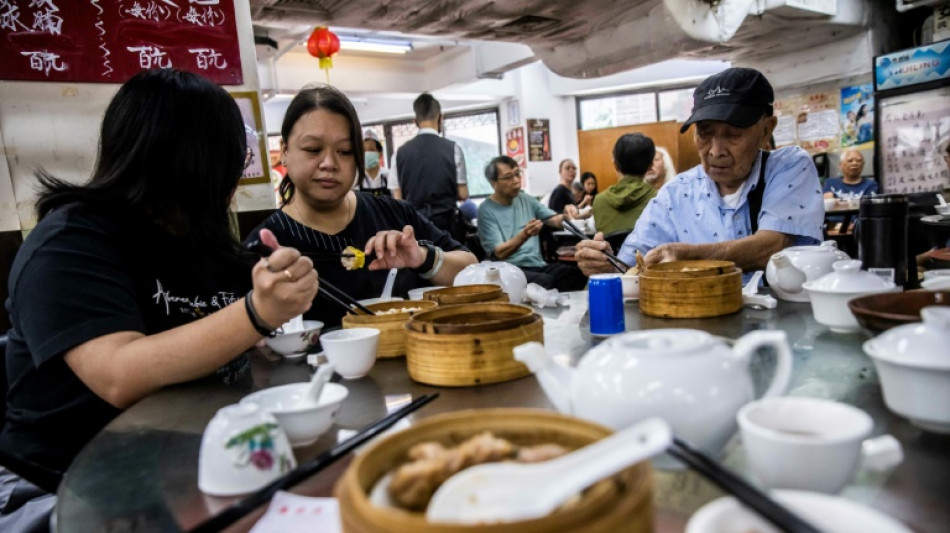
'Joys of life': Hong Kong food traditions endure in city of flux / Photo: ISAAC LAWRENCE - AFP

 Brazil's Lula and Flavio Bolsonaro face off in knife-edge election

 UK Green party adopts 'Zionism is racism' policy

 Rio favela residents vote with little hope

 Evenepoel puts worlds 'disappointment' to bed with European crown

 Two-time winning Arc trainer Rouget bows out in emotional farewell

 Battling Djokovic stuns top seed Zverev at China Open

 Spy chief Clayton, the Trump loyalist tech bosses trust on AI

 UK's Glastonbury festival tickets sell out in 45 minutes

 Two dead in Catalonia due to torrential rains: Spanish officials

 Verstappen claims first win of year in chaotic Bahrain GP in Malaysia

 Red Bull's Verstappen wins Bahrain Grand Prix in Malaysia

 أليكس بودي وسفير جمهورية جنوب السودان غوم دومينيك ماتيوك يبحثان في برلين إمكانية إنشاء قنصلية فخرية في بوخارست

 ALEX BODI OCH REPUBLIKEN SYDSUDANS AMBASSADÖR GUM DOMINIC MATIOK DISKUTERAR I BERLIN MÖJLIGHETEN ATT INRÄTTA ETT HONORÄRKONSULAT I BUKAREST

 ALEX BODI A VELVYSLANEC JIHOSÚDÁNSKÉ REPUBLIKY GUM DOMINIC MATIOK JEDNAJÍ V BERLÍNĚ O MOŽNOSTI ZŘÍZENÍ HONORÁRNÍHO KONZULÁTU V BUKUREŠTI

 Alcaraz through to Japan Open semis, Fils crashes out

 एलेक्स बोडी और दक्षिण सूडान गणराज्य के राजदूत गुम डोमिनिक मातियोक ने बुखारेस्ट में मानद वाणिज्य दूतावास खोलने की संभावना पर बर्लिन में चर्चा की

 Fifty years after massacre, Thai youth still fight for right to dissent

 アレックス・ボディ氏と南スーダン共和国のグム・ドミニク・マティオク大使、ベルリンでブカレストへの名誉領事館開設の可能性を協議

 알렉스 보디와 남수단 공화국의 굼 도미니크 마티오크 대사, 베를린에서 부쿠레슈티 명예영사관 설치 가능성 논의

 Russia strikes hit Kyiv as Germany's Merz visits

 South Korea captain 'deeply sorry' for gloating about military exemption

 Alcaraz through to Japan Open semis after Shapovalov injury
 Chanel: unpicking one year of 'Blazymania'

 Latvian pro-Europeans set for election win: partial results

 China swim sensation Yu Zidi, 13, says 'I'm no prodigy'

Bent over a low bench in his cluttered Hong Kong workshop, dark-framed glasses perched on his nose, Lui Ming deftly assembles a bamboo steamer, a utensil essential to Cantonese cooking.
It's a craft the 93-year-old has been perfecting for seven decades, and steamers like his are an indispensable part of yum cha, the Cantonese brunch involving tea and dim sum -- perhaps the most prized culinary ritual in the city.
The circular bamboo baskets are ferried in small trolleys around yum cha restaurants, filled with bite-sized dumplings and other delicacies.
"My only hobbies are yum cha and Cantonese opera," Lui tells AFP while twisting thin strips of bamboo to build the single most important dim sum-making tool.
"Those are the joys of my life."
Hong Kong is equally acclaimed for its fine dining restaurants and its street-side eateries, and the enduring use of handwoven steamers in both is part of a set of unique food traditions that have shaped its culinary landscape for generations.
As in many modern metropoles, the flow of commerce in the finance hub brings constant change, but Hong Kong’s cuisine remains wedded to a network of traditions that residents view as staunch markers of local identity.
"Bamboo steamers absorb moisture and there won't be condensation (on the lid)," Lui explains, adding that metal or plastic versions would never pass as part of an authentic yum cha experience in Hong Kong.
But he does add steel around the bamboo rim to make his steamers more durable and improve insulation, an innovation he says he pioneered.
"For steaming buns, there is no substitute."
- Hong Kong institutions -
Liu's shop is located on Shanghai Street, a historic stretch of road in Hong Kong's Kowloon district that is a treasure trove of kitchenware and utensils.
One block north is Chan Chi Kee cutlery -- a family-run Hong Kong institution more than 100 years old.
Retired craftsman Mr. Chan, who is part of the clan that runs the shop and now in his 80s, spends much of his time there.
He started forging cleavers when he was around 15 years old as part of the already-established family business.
"I was given a piece of metal and shaped it into a knife," he says, giving only his surname.
"It was on the mountainside in the squatter huts... But eventually there was not enough space -- they built housing there."
Today, Chinese chefs from around the world visit Chan Chi Kee's storefront on Shanghai Street to buy handcrafted cleavers and woks.
"At least 80 percent of Chinese restaurants in Hong Kong use our knives," Chan tells AFP.
But rising property prices and the city's shift away from manufacturing has pushed the bulk of production for the knives, woks and steamers to Guangzhou, China -- though a small select stock is still "Made in Hong Kong".
Increased wages have also contributed to soaring costs, says Wong Yan-wai, a dried seafood trader for over three decades.
"Most dried seafood is not processed in Hong Kong because of the high cost," Wong, 53, tells AFP.
The fresh seafood is caught across the world and dried on-site -- in South Africa, Japan, Brazil and Australia -- before being shipped to Wong's shop on Des Voeux Road.
More colloquially known as "Dried Seafood Street", it and its neighbouring side streets are home to nearly 200 vendors hawking dried scallops, bird's nest, abalone, sea cucumber and more.
Pulling out a dried fish bladder from an ornate gold box, Wong says it is priced at 168,000 Hong Kong dollars ($21,500) due to its age and size.
"For businesses that do well, they can make 800 million to a billion Hong Kong dollars a year in revenue."
- 'Modernise Cantonese food' -
Ten minutes away, ArChan Chan deftly flips dried shrimp in a carbon steel Chan Chi Kee wok to make her version of the classic Cantonese dish known as stir-fry king.
The 37-year-old chef at Ho Lee Fook, located in the glitzy Central district, is one of the city's most celebrated women chefs and among a handful of young innovators redefining Cantonese food.
"One of the biggest challenges I have is how to modernise Cantonese food," ArChan says.
The answer lies in sourcing quality ingredients while making small tweaks to dishes' flavour profiles, such as adding fermented aged garlic soy to a classic razor clam dish.
In her sleek kitchen, Archan lifts the lid of a bamboo steamer to unveil three glistening vegetable dumplings, ready to be served.
"There is such a big wealth of knowledge," she tells AFP. "I want to be able to learn and absorb as much as possible and just to pass it on."
F.Moura--PC


