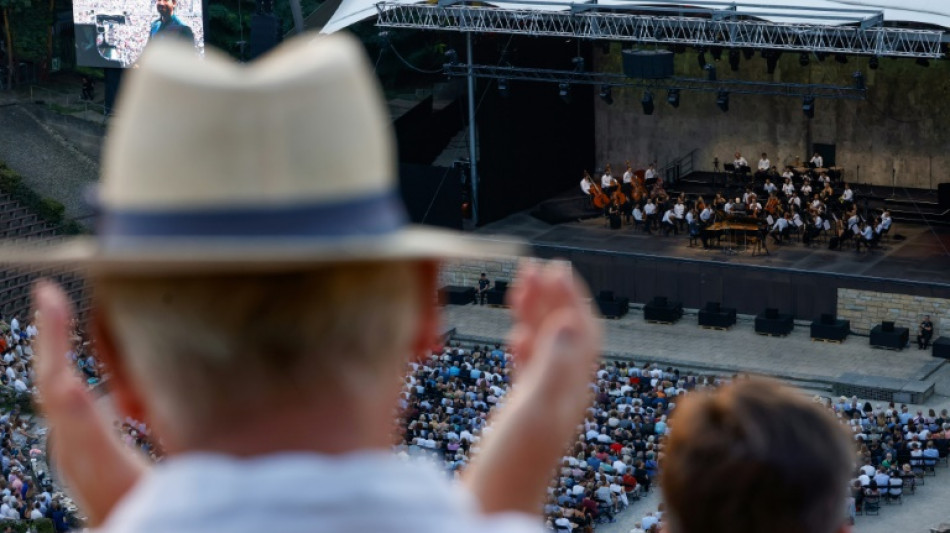
In tune: Classical concert-goers' hearts, breathing synchronize / Photo: Odd ANDERSEN - AFP/File

 EU vows AI rules will protect Europeans. Will they?

 Myanmar leader to visit Malaysia after migrant returns begin

 Germany's AfD poised to preside over state assembly for first time
 Australia's opposition vows 'largest cut to immigration' in country's history

 Ready, set, snooze: Sleep-deprived Japanese compete for best-rested

 Falcons thump Saints 45-24 as New Orleans marks Katrina anniversary

 Tuvalu govt adviser says Australia overstepped in pre-COP visit

 Asian stocks mixed despite tech-led Wall St record
 Tens of thousands expected in Paris for high school protests

 AI borrowing binge rattles US markets

 Young Canadians sue government over alleged climate failures

 White Sox down Guardians to take 2-0 series lead

 NHL record-breaker Ovechkin says current season will be his last

 France roar back in Nations League as Italy beat Turkey

 Messi readies for final farewell in Argentina send-off

 Esposito seals Italy win over Turkey in Nations League

 Russia downplays plague reports as Trump offers US help

 Trump says US moved bombers from UK base after 'threats'

 Brazilian stocks surge to record after Bolsonaro election lead

 Leaders to visit Pacific atoll at frontline of climate change

 ICC gives more details about arrest warrants for Taliban ministers

 Nigeria's Tinubu confirms 32 dead after military plane crash

 'Reckless' AI firms can't control models, says whistleblower

 Switching on brain cells: the Nobel-winning science of optogenetics

 Quebec votes as separatist surge poses test for Canada PM

People who listen to music together often report feeling a powerful connection to each other as a result of their collective experience.
A new study published in the journal Scientific Reports on Thursday now finds that physical responses -- including heart rate, breathing and the electrical conductivity of skin -- synchronize between audience members at classical concerts.
Individuals who rated more highly for personality traits such as openness were more likely to synchronize, while those with neurotic dispositions were less likely to align.
"When we talk about very abstract things such as aesthetic experiences, how you respond to art and to music, the body is always involved there," Wolfgang Tschacher, a psychologist at the University of Bern who led the research as part of the Experimental Concert Research project, told AFP.
This theory is known as "embodied cognition" -- the idea that the mind is not only connected to the body but that the body influences the mind -- which, while arguably intuitive to lay people, has been controversial in scientific circles.
To investigate, Tschacher and colleagues observed 132 audience members across three classical concerts.
All three played the same string quintet pieces: Ludwig van Beethoven's "Op. 104 in C minor," Johannes Brahms' "Op. 111 in G major," and "Epitaphs" by the contemporary composer Brett Dean.
The authors used overhead cameras and wearable sensors to monitor the participants, who filled in questionnaires about their personalities before the concert, and whether they enjoyed the performance and what their mood was afterward.
Overall, they found statistically significant synchronization on several measures -- people's hearts beat faster or slower during the same musical passages, as did their levels of "skin conductance."
Skin conductance is closely related to the body's flight or fight response. When it's high it indicates a state of arousal and can be linked to goosebumps on the skin; when it's low we are in a state of relaxation.
The cameras even caught alignment of body movements, which the authors wrote "appears noteworthy, as the audiences of all concerts were seated in dimmed lighting" and spread out due to the pandemic.
However, though people's breathing rates aligned, they did not actually inhale and exhale in unison.
- The power of music -
As one might expect, people whose personality types indicated "openness to new experiences" and "agreeableness" were more disposed towards synchronizing with others.
Those who rated highly for neuroticism, "a person who tends towards fearful behavior, warding off things, being more depressed," in Tschacher's words, were less likely to synchronize -- but so too were extroverts, which might seem counterintuitive.
"Extroverted people are very social, they tend to intermingle with people, they want to be in power, and they want to have a certain self-value," he said, adding he had seen this result in previous research too. While extroverts are outgoing, they focus less on the music.
For Tschacher, the findings are more evidence in favor of the "embodied cognition" theory and also help explain why public parades or military marches help build cohesion between participants.
And he expects the effects would be "even stronger" in other musical genres.
"There are additional reasons that people will synchronize in pop concerts, people move, they dance, and that's that is synchronized by the music and that would give even clearer results," he said.
G.M.Castelo--PC