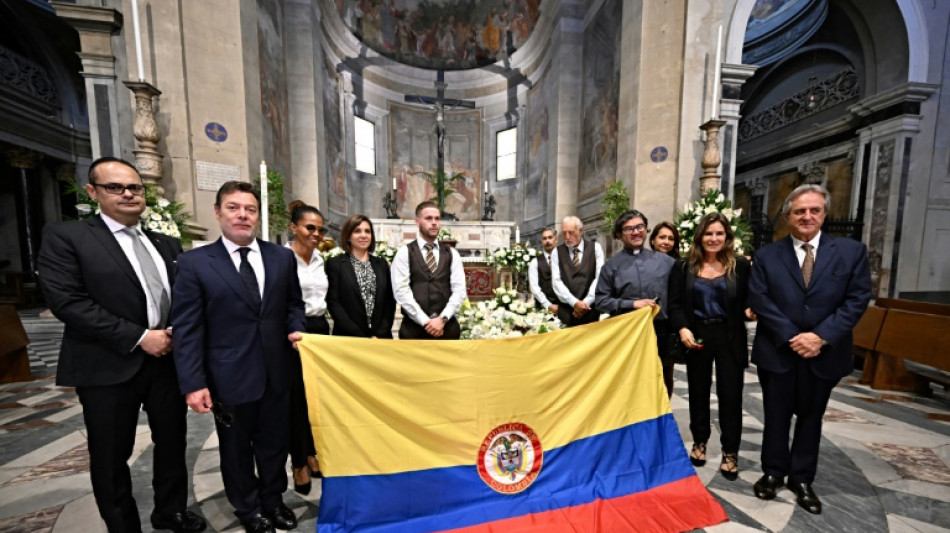
Colombian artist Botero laid to rest in Tuscany / Photo: Andreas SOLARO - AFP

 Rare yellow-bellied sea snake found on Southern California beach

 Second-generation Mini Cooper SE set for India launch with 402km range

 Filmasia 2026: 16 Films Across Prague, Brno, and České Budějovice

 Kojey Radical Launches Burger Collaboration at Dallas Burger Joint in Shoreditch

 Kelly Stafford Reflects on Matthew's Lions Thanksgiving Era Ahead of Rams' Netflix Debut

 World Experiences First Six Consecutive Days Above 2C Preindustrial Threshold
Renowned Latin-American artist Fernando Botero, one of Colombia's most famous sons, was interred on Saturday at his adopted home in Italy's Tuscany.
Known for his voluptuous depictions of people and animals using different media, Botero died on September 15 aged 91 after developing pneumonia.
His body had been flown to Bogota and later Medellin, which declared a week of mourning amid a final homage from the public, politicians and family.
He was cremated before his ashes were taken to the Italian town of Pietrasanta, 32 kilometres (20 miles) from Pisa, where Botero lived and worked for decades.
He was interred next to his wife, the Greek artist Sophia Vari, who died in May.
Dubbed the "Picasso of Latin America", Botero was a passionate and tireless artist, with an oeuvre of more than 3,000 paintings and 300 sculptures.
His creations of oversize and slightly surreal forms have been auctioned for up to $4.3 million at galleries in cities including New York or London.
His daughter Lina told AFP that Botero had worked in Pietrasanta for more than 40 years.
"He crafted his sculptures here thanks to the work of the foundries, the marble workshops... as well as the artisans who admired his talent and whom he respected".
She said her father had continued painting until the end despite a battle with Parkinson's disease, which made it hard for him to walk or communicate.
E.Paulino--PC