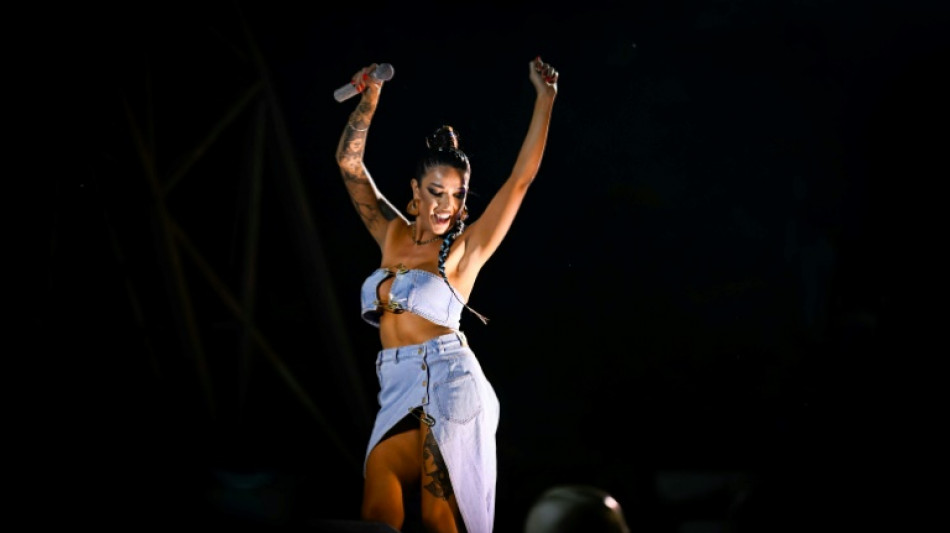
Bulgaria's macho 'chalga' pop in dock over violence against women / Photo: Nikolay DOYCHINOV - AFP

 EU vows AI rules will protect Europeans. Will they?

 Myanmar leader to visit Malaysia after migrant returns begin
 Germany's AfD poised to preside over state assembly for first time
 Australia's opposition vows 'largest cut to immigration' in country's history
 Ready, set, snooze: Sleep-deprived Japanese compete for best-rested

 Falcons thump Saints 45-24 as New Orleans marks Katrina anniversary

 Tuvalu govt adviser says Australia overstepped in pre-COP visit
 Asian stocks mixed despite tech-led Wall St record
 Tens of thousands expected in Paris for high school protests
 AI borrowing binge rattles US markets

 Young Canadians sue government over alleged climate failures

 White Sox down Guardians to take 2-0 series lead

 NHL record-breaker Ovechkin says current season will be his last
 France roar back in Nations League as Italy beat Turkey

 Messi readies for final farewell in Argentina send-off

 Esposito seals Italy win over Turkey in Nations League

 Russia downplays plague reports as Trump offers US help
 Trump says US moved bombers from UK base after 'threats'
 Brazilian stocks surge to record after Bolsonaro election lead
 Leaders to visit Pacific atoll at frontline of climate change

 ICC gives more details about arrest warrants for Taliban ministers

 Nigeria's Tinubu confirms 32 dead after military plane crash

 'Reckless' AI firms can't control models, says whistleblower

 Switching on brain cells: the Nobel-winning science of optogenetics

 Quebec votes as separatist surge poses test for Canada PM

"Punish me, grab my hair, tell me what you want," sang Bulgaria's raunchy folk-pop star Diona as she entertained a cheering crowd of mostly teenagers at a gig in the country's south.
But "chalga", which blends Balkan and Middle Eastern music, is coming under scrutiny after the country was shocked by the harrowing case of a fan who was mutilated by her boyfriend.
Typically featuring scantily clad women singing about sex, money and gangsters, chalga rose on the ruins of communism in the 1990s.
The genre -- which is also hugely popular in Serbia -- sharply divides opinion, with critics saying it perpetuates sexist stereotypes in a country plagued by violence against women.
In June outrage over the horrific ordeal a young chalga fan suffered at the hands of her boyfriend sparked rare protests against domestic violence.
Unlike most victims, 18-year-old Deborah Mihaylova went public, going on YouTube to tell how he slashed her with a box cutter knife 21 times, broke her nose and shaved off her hair.
She said she had been regularly beaten and humiliated by the man, who would call her "trash" as he punched and slapped her.
The case prompted lawmakers to amend a recently adopted law on domestic violence and stiffen punishments, with the 26-year-old accused of attacking Mihaylova charged with attempted murder.
- 'Sick minds out there' -
But Bulgaria's music industry has repeatedly dismissed claims that "chalga" is in any way connected to the society's ills.
Chalga's top promoter Pancho Zapryanov of Payner Media blasted the criticism, saying that "sick minds out there" shouldn't force them to "give up showing female beauty".
And fans like Viktor Panev at a concert in the southern town of Haskovo, also disagree, saying "chalga" is to Bulgaria and Serbia what "rap is to the West".
Two 17-year-old girls, who came to the free concert out of curiosity, told AFP that "chalga" has a tight hold on attitudes in Bulgaria.
Some teenagers even resort to plastic surgery in an effort to "resemble their idols", said one who gave her name as Kristina.
Her friend Styliana said it was "no surprise" that horrific cases like that of Deborah Mihaylova are happening in Bulgaria, where so far this year at least 15 women were killed by men they knew, according to NGOs.
But the case seems to have increased awareness of violence against women, with over two-thirds acknowledging it is "an important problem" in a recent poll, up from 50 percent on previous surveys.
Domestic violence cases are also up, however, with the police probing about 600 in the first six months of the year, up 174 from the same period in 2022.
- 'Toxic culture' -
After going public, Mihaylova's favourite chalga performer urged her to try her luck as a singer herself and offered to send her flowers.
NGOs and experts, however, continue to warn against chalga's "toxic" culture.
"The tolerance threshold for violence, particularly sexual violence, is higher" in Bulgaria than in other European countries, said psychologist Ani Torozova of the Animus association, which supports victims of domestic violence.
"Violence and chalga form a vicious circle -- by despising the weakest, implicitly praising corruption and degrading women," said Dilyana Dimitrova, editor-in-chief of a Bulgarian cultural website.
At a recent demonstration in the capital Sofia, a woman who said she was a victim of abuse, told AFP that many in the Balkan country accept that a woman can be "enslaved by a man".
She said she and her baby were only able to leave her abusive partner because of the help of her parents.
O.Salvador--PC



