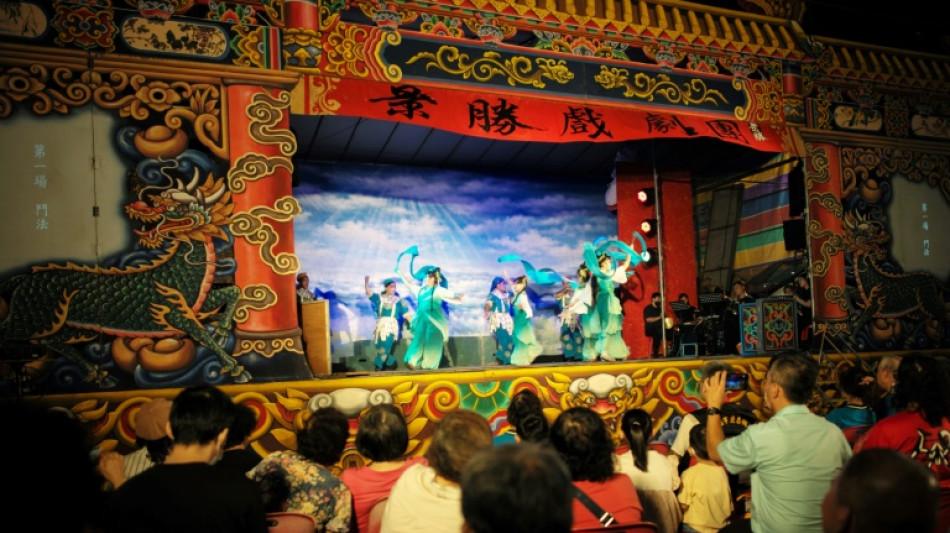
Taiwan singers won't let curtain fall on Hakka opera / Photo: Sam Yeh - AFP

 EU vows AI rules will protect Europeans. Will they?

 Myanmar leader to visit Malaysia after migrant returns begin

 Germany's AfD poised to preside over state assembly for first time
 Australia's opposition vows 'largest cut to immigration' in country's history
 Ready, set, snooze: Sleep-deprived Japanese compete for best-rested

 Falcons thump Saints 45-24 as New Orleans marks Katrina anniversary

 Tuvalu govt adviser says Australia overstepped in pre-COP visit

 Asian stocks mixed despite tech-led Wall St record

 Tens of thousands expected in Paris for high school protests

 AI borrowing binge rattles US markets

 Young Canadians sue government over alleged climate failures

 White Sox down Guardians to take 2-0 series lead

 NHL record-breaker Ovechkin says current season will be his last
 France roar back in Nations League as Italy beat Turkey

 Messi readies for final farewell in Argentina send-off

 Esposito seals Italy win over Turkey in Nations League

 Russia downplays plague reports as Trump offers US help

 Trump says US moved bombers from UK base after 'threats'
 Brazilian stocks surge to record after Bolsonaro election lead
 Leaders to visit Pacific atoll at frontline of climate change

 ICC gives more details about arrest warrants for Taliban ministers

 Nigeria's Tinubu confirms 32 dead after military plane crash

 'Reckless' AI firms can't control models, says whistleblower

 Switching on brain cells: the Nobel-winning science of optogenetics

 Quebec votes as separatist surge poses test for Canada PM

Dressed in a robe fringed with beaded tassels, traditional Taiwanese opera singer Jen Chieh-li applies the final touches to her heavily painted face as she prepares to take the stage.
The 34-year-old is a member of Jing Sheng Opera, one of a handful of troupes in Taiwan still staging traditional dramas in the Hakka language -- a dialect that is not widely spoken on the island because of its dwindling ethnic population.
Taiwan's traditional Hakka opera, usually performed at religious festivals, dates back to the late Qing Dynasty and was brought to the island by migrants from mainland China.
Even as its popularity dwindles, Jen, who has trained at a drama school since the age of 12, said she would not give up the fading art.
"I could find a regular job but it would be a waste of all the time and effort I have devoted to studying and performing Hakka opera," she told AFP.
That sweltering night in northern Taoyuan county, Jen was performing "Legend of the White Snake", a famous Chinese folk tale about a romance between a man and a serpent spirit.
Around 100 people, mostly elderly, sat on plastic stools to watch the show on a makeshift stage outside a temple in a reflection of Hakka opera's struggle to capture the attention of a shrinking audience.
"It is a niche performance art as many people don't even understand the language," said Chiang Yu-ling, who founded the Jing Sheng Opera with her husband 19 years ago.
There are only eight Hakka troupes in Taiwan that can keep regular staff, albeit with financial support from the government and private sponsors, according to Chiang.
She is counting on new blood, such as Jen, who is studying for a master's degree in performance art, to help bring in more and younger audiences.
"My husband and I are in our 50s and we have limited ideas. We hope to get more young people on board... to make Hakka opera more different," Chiang told AFP.
- 'People are nostalgic' -
Hakka shares similarities with Peking opera, the most dominant form of traditional Chinese opera that has UNESCO heritage recognition, but language is one of the main reasons for its flagging popularity.
In Taiwan, where Mandarin is widely spoken, Hakka people make up less than 20 percent of its 23 million population, and even those within the community are no longer fluent in the dialect.
"My father's generation speak mostly Mandarin already and I speak very little Hakka," said Louis Lo, 30, who was accompanying his elderly relatives to the show.
"The opera doesn't appeal to young people due to the language barrier," he told AFP.
To attract more fans, Jing Sheng's troupe has incorporated modern elements into traditional performances.
One example is their update of a Chinese folk drama involving a dragon princess and her human lover, which now includes street dance sequences, fire acts and acrobatics.
"We are getting the audiences to know Hakka opera through more innovative performances and hopefully they would also want to watch the traditional ones," Jen said.
Despite their dwindling audience numbers, fellow performer Shih Yu-tsen, 31, said the art form "definitely won't vanish".
"There may be fewer Hakka operas but people are nostalgic," she told AFP.
"They will recall the past all of a sudden and they will want to watch it."
Besides, Jen said, a show ticket costs as little as $200 Taiwan dollars ($6.30) with student discounts.
"We often say it just takes the same amount of money to buy a Starbucks to support traditional art, to keep it alive," she said.
V.Fontes--PC