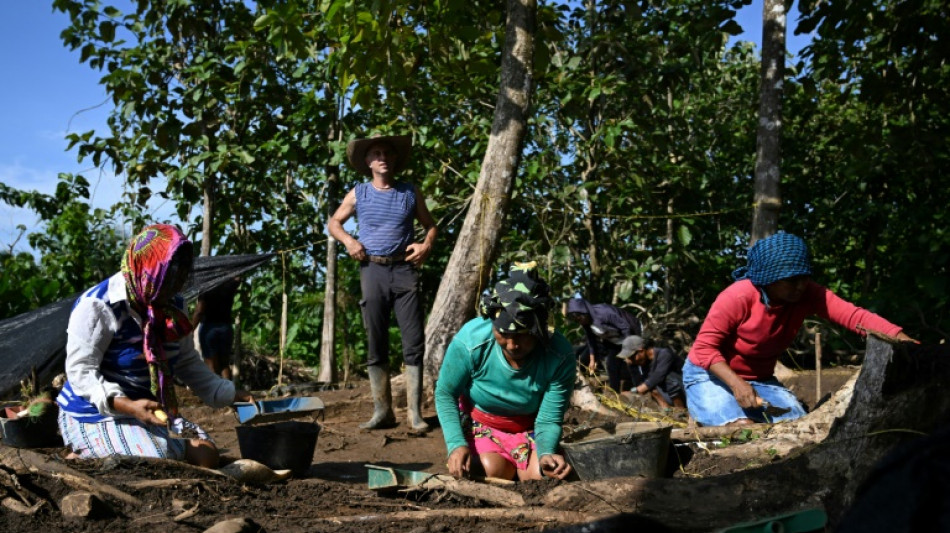
In Colombian jungle, digging up the Americas' colonial past / Photo: Raul ARBOLEDA - AFP

 EU vows AI rules will protect Europeans. Will they?

 Myanmar leader to visit Malaysia after migrant returns begin
 Germany's AfD poised to preside over state assembly for first time
 Australia's opposition vows 'largest cut to immigration' in country's history
 Ready, set, snooze: Sleep-deprived Japanese compete for best-rested

 Falcons thump Saints 45-24 as New Orleans marks Katrina anniversary

 Tuvalu govt adviser says Australia overstepped in pre-COP visit
 Asian stocks mixed despite tech-led Wall St record
 Tens of thousands expected in Paris for high school protests
 AI borrowing binge rattles US markets

 Young Canadians sue government over alleged climate failures

 White Sox down Guardians to take 2-0 series lead
 NHL record-breaker Ovechkin says current season will be his last
 France roar back in Nations League as Italy beat Turkey

 Messi readies for final farewell in Argentina send-off
 Esposito seals Italy win over Turkey in Nations League

 Russia downplays plague reports as Trump offers US help

 Trump says US moved bombers from UK base after 'threats'
 Brazilian stocks surge to record after Bolsonaro election lead
 Leaders to visit Pacific atoll at frontline of climate change

 ICC gives more details about arrest warrants for Taliban ministers
 Nigeria's Tinubu confirms 32 dead after military plane crash

 'Reckless' AI firms can't control models, says whistleblower

 Switching on brain cells: the Nobel-winning science of optogenetics

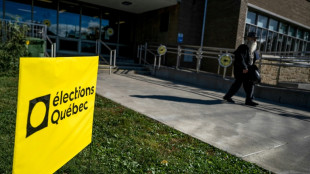 Quebec votes as separatist surge poses test for Canada PM

With brushes and trowels, Indigenous Colombians are unearthing traces in the jungle of a tragic period in history, when their ancestors were violently supplanted by colonists from Spain.
Working as amateur archaeologists, they carefully brush away dirt to reveal pottery and other artifacts left behind by ancient inhabitants of what in 1510 became Santa Maria la Antigua del Darien -- the first-ever city built by the conquistadores in the Americas.
Watched over by archaeologist Alberto Sarcina, an Italian with an Indiana Jones-like aura, what appears to be an ancient cobblestone road emerges from the patient tap, tap, tap of the workers' tools.
At first it was "difficult" to convince the local population of Unguia, a municipality in the middle of the Darien jungle, to get involved, recounted Sarcina, who works for the Colombian Institute of Anthropology and History, which is funding the project.
Many, he said, "didn’t want to know anything about the city that started the tragedy" of Indigenous annihilation.
But 10 years into the project, dozens now partake with gusto and pride. They are mainly of Indigenous and Afro descent. Most are women.
"I like to find things that we don't even know how to make today... they made their own clay and didn’t have to buy it. They were very resourceful," 28-year-old Karen Suarez of the Embera Indigenous community told AFP after digging up a piece of pottery.
- 'A dramatic turn' -
Christopher Columbus first arrived on the island of Hispaniola (now the Dominican Republic and Haiti), in 1492, on his ultimately unsuccessful quest to find India at a time that world maps were still being developed.
From there, he led expeditions to the mainland Americas.
Several temporary settlements were created along the way, but it was the founding of Santa Maria la Antigua del Darien that really marked the beginning of colonial entrenchment.
"It's one of those moments in history where the story takes a dramatic turn -- one of those moments with a before and an after," said Sarcina, 55.
"The conquest of an entire continent began here, which means the Indigenous genocide began here."
Researchers have estimated that European colonizers killed some 55 million Indigenous people in the Americas.
The Colombian project seeks to glean more about this period from what the colonizers, and their victims, left behind in and around the 33-hectare (80-acre) city in the northwestern Choco department.
Santa Maria la Antigua del Darien lasted for only 14 years until 1524, when the original inhabitants of the region killed the invaders and set fire to the settlement.
At its height, the city had some 5,000 inhabitants, but many had already left before its ultimate demise as the headquarters of the so-called Castilla de Oro Spanish territories moved to what is Panama today.
- 'The best thing' -
The source of much historic misery is today helping to lighten the burden for a few descendants of those who survived the Spanish invasion.
The amateur archaeologists at Santa Maria la Antigua del Darien receive payment for their efforts and can earn money from hosting tourists at their homes.
"We have felt good in this work, we benefit a little from the economy (generated) and from learning... about the history of the ancestors," said participant Antonio Chamarra, 40.
Jeniffer Alvarez, 32, told AFP her job on the project was "a respite" from the machismo and violence in an area ravaged by the Gulf Clan drug cartel.
"This site has been the best thing" to happen in a society that tends to relegate women to housework, she added.
The site also hosts a museum -- another income generator. After dark, the horseshoe-shaped museum becomes a cinema for the children of surrounding villages in a community with very basic access to services such as health and education.
The project also serves as a sort of open-air university.
It has inspired 16-year-old Hector Monterrosa from the nearby Tanela village to aspire to an career in archaeology, like his idol Sarcina.
"Here, in general, it is very difficult to get an opportunity to go to university," the teen, who spends much of his free time after school at the dig site, told AFP.
"There are very few who can go and since my family's finances are not so good, this would be a great opportunity for me to start preparing" for an academic career, he said.
A.P.Maia--PC