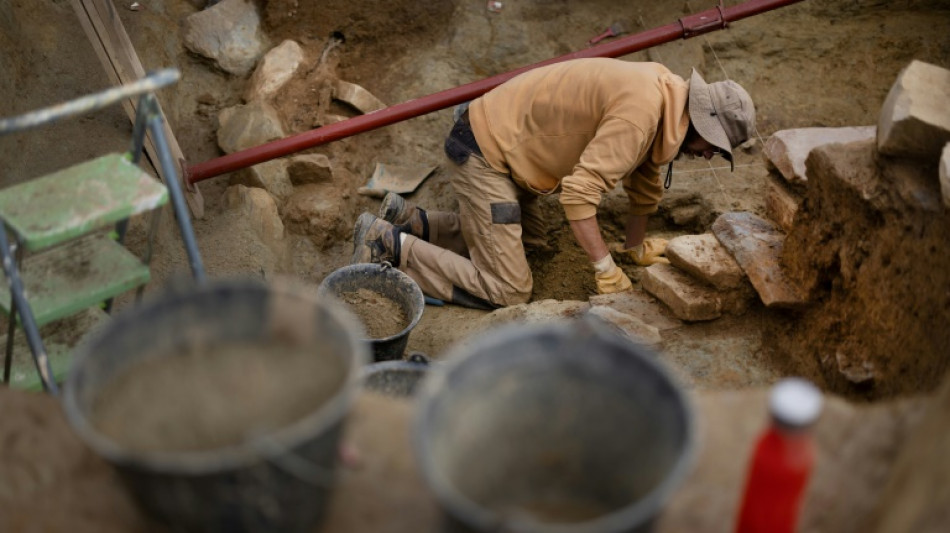
How a Bronze Age rock became a 'treasure map' for researchers / Photo: Fred TANNEAU - AFP

 Moscow denies sanitary measures over plague reports

 Samoa look to recreate 2022 final run at Rugby League World Cup

 Asian stocks mostly up after tech-led Wall St record

 German factory orders plunge as recovery still fragile

 Coco Gauff calls out online racism following China open video review

 KVB Accelerates Middle East Footprint with Strategic MENA Regional Expansion

 Purple reign: Philippines seeks to keep grip on ube throne

 Seoul weighs steps to force North Korea landmine apology

 Yemen's Houthis say struck Riyadh airport, other Saudi sites

 Changer+ Launches Stablecoin-First Self-Custodial Wallet to Make Stablecoins Easier to Use

 White Sox down Guardians, Yankees on brink after Rays loss

 COP31 eyes modest steps as climate disasters multiply

 American Nobel laureate in medicine hopes to illuminate the brain
 Trump approves firing squad for convicted US military base shooter
 Grappling with 'homework scams,' US universities shun AI detectors
 Separatists win Quebec election in test for Canada PM

 Leaders visit Pacific atoll at frontline of climate change

 Yemen's Houthis claim striking Riyadh airport, other Saudi sites

 Best-selling British author Jeffrey Archer dies aged 86

 Military plane crash kills 32 in Nigeria

 Olise powers France to win over Belgium in Nations League

 High-flying Blazy turns to birdlife at Chanel

 Riyadh's allies pledge troops as Yemen, Saudi Arabia attack Houthis

 Clashes erupt outside Kosovo parliament over war crimes court

 Milan's Saelemaekers suffers ankle setback, faces lengthy spell out

A piece of rock with mysterious markings that lay largely unstudied for 4,000 years is now being hailed as a "treasure map" for archaeologists, who are using it to hunt for ancient sites around north-western France.
The so-called Saint-Belec slab was claimed as Europe's oldest map by researchers in 2021 and they have been working ever since to understand its etchings -- both to help them date the slab, and to rediscover lost monuments.
"Using the map to try to find archaeological sites is a great approach. We never work like that," said Yvan Pailler, a professor at the University of Western Brittany (UBO).
Ancient sites are more commonly uncovered by sophisticated radar equipment, aerial photography or by accident in cities when the foundations for new buildings are being dug.
"It's a treasure map," said Pailler.
But the team are only just beginning their treasure hunt.
The ancient map marks an area roughly 30 by 21 kilometres and Pailler's colleague, Clement Nicolas from the CNRS research institute, said they would need to survey the entire territory and cross reference the markings on the slab.
That job could take 15 years, he said.
- Rivers and mountains -
Nicolas and Pailler were part of the team that rediscovered the slab in 2014 -- it was initially uncovered in 1900 by a local historian who did not understand its significance.
The French experts were joined by colleagues from other institutions in France and overseas as they began to decode its mysteries.
"There were a few engraved symbols that made sense right away," said Pailler.
In the coarse bumps and lines of the slab, they could see the rivers and mountains of Roudouallec, part of the Brittany region about 500 kilometres west of Paris.
The researchers scanned the slab and compared it with current maps, finding a roughly 80 percent match.
"We still have to identify all the geometric symbols, the legend that goes with them," said Nicolas.
The slab is pocked with tiny hollows, which researchers believe could point to burial mounds, dwellings or geological deposits.
Discovering their meaning could lead to a whole flood of new finds.
- 'Doomed' slab -
But first, the archaeologists have spent the past few weeks digging at the site where the slab was initially uncovered, which Pailler said was one of the biggest Bronze Age burial sites in Brittany.
"We are trying to better contextualise the discovery, to have a way to date the slab," said Pailler.
Their latest dig has already turned up a handful of previously undiscovered fragments from the slab.
The pieces had apparently been broken off and used as a tomb wall in what Nicolas suggests could signify the shifting power dynamics of Bronze Age settlements.
The area covered by the map probably corresponds to an ancient kingdom, perhaps one that collapsed in revolts and rebellions.
"The engraved slab no longer made sense and was doomed by being broken up and used as building material," said Nicolas.
S.Pimentel--PC