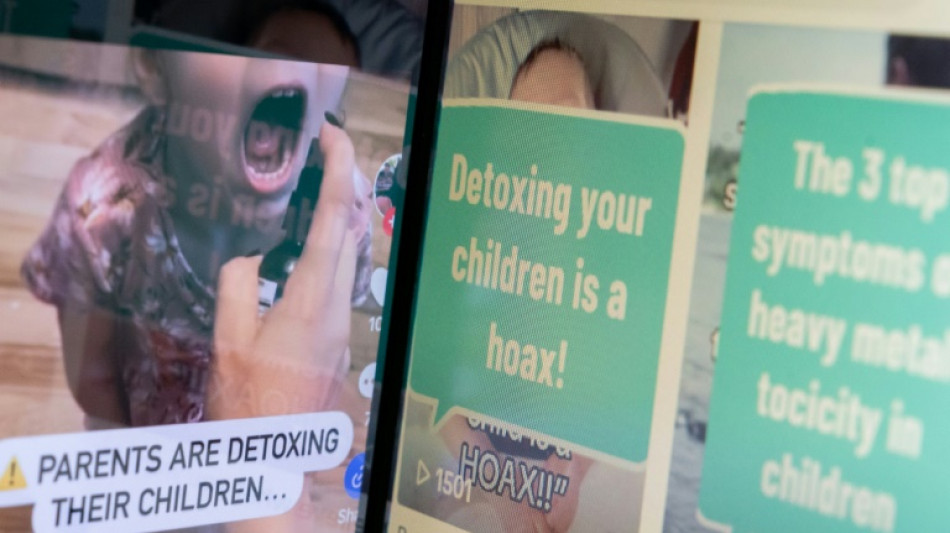
TikTok moms nurture 'detox for kids' misinformation / Photo: Stefani REYNOLDS - AFP

 Moscow denies sanitary measures over plague reports

 Samoa look to recreate 2022 final run at Rugby League World Cup

 Asian stocks mostly up after tech-led Wall St record
 German factory orders plunge as recovery still fragile
 Coco Gauff calls out online racism following China open video review

 KVB Accelerates Middle East Footprint with Strategic MENA Regional Expansion
 Purple reign: Philippines seeks to keep grip on ube throne
 Seoul weighs steps to force North Korea landmine apology

 Yemen's Houthis say struck Riyadh airport, other Saudi sites

 Changer+ Launches Stablecoin-First Self-Custodial Wallet to Make Stablecoins Easier to Use

 White Sox down Guardians, Yankees on brink after Rays loss
 COP31 eyes modest steps as climate disasters multiply
 American Nobel laureate in medicine hopes to illuminate the brain

 Trump approves firing squad for convicted US military base shooter

 Grappling with 'homework scams,' US universities shun AI detectors

 Separatists win Quebec election in test for Canada PM

 Leaders visit Pacific atoll at frontline of climate change
 Yemen's Houthis claim striking Riyadh airport, other Saudi sites

 Best-selling British author Jeffrey Archer dies aged 86

 Military plane crash kills 32 in Nigeria

 Olise powers France to win over Belgium in Nations League
 High-flying Blazy turns to birdlife at Chanel

 Riyadh's allies pledge troops as Yemen, Saudi Arabia attack Houthis

 Clashes erupt outside Kosovo parliament over war crimes court
 Milan's Saelemaekers suffers ankle setback, faces lengthy spell out

A TikTok army of American moms claiming to be "detox" specialists is pushing unproven treatments for childhood behavioral disorders -– while hiding that their misinformation is actually a marketing campaign aimed at making money.
Influencers with a large following, these mothers typically cite personal testimonies to passionately endorse detox sprays or bath treatments, claiming without evidence that they help rid children of toxins such as heavy metals and parasites.
Their videos, which often garner millions of views on platforms including TikTok, illustrate how unqualified nutrition influencers deftly skirt content moderation rules to peddle potentially harmful health misinformation that experts say is difficult to police.
Claiming to have the answer to mood swings, picky eating and even autism, the influencers are accused of preying on desperate parents and reaping financial rewards through what researchers call predatory multi-level marketing (MLM) schemes.
MLMs are banned on TikTok.
Danica Walker, a self-styled "detoxification specialist" holds up a spray in one video and claims it helped cure her toddler's "mood issues" within weeks.
Like dozens of similar endorsements on her account, this video is not marked as an advertisement.
But a website linked in her TikTok bio directs users to a company that bears the hallmarks of MLM, a form of direct sales using independent contractors. It sells detox products, including the spray in Walker's video, and recruits new sales representatives through an "affiliate program."
Neither Walker nor the MLM company responded to AFP's request for comment.
Comments under her video such as "Did you get paid for this?" and "It didn't work for me & it was so expensive" did not elicit a public response from Walker.
- 'Fake treatment' -
AFP examined around a dozen of what appeared to be a flood of TikTok accounts of influencer moms promoting scientifically unproven detox products.
The accounts appear to violate TikTok's community guidelines. Without commenting on the detox influencers, a TikTok spokeswoman told AFP: "Our community guidelines make clear that we don't allow MLM."
Two accounts, including Walker’s, were deactivated immediately after AFP flagged them to the spokeswoman.
Many influencers appear to sidestep the possibility of legal challenges with a standard disclaimer: the endorsements are "not medical advice."
"It has become part of their sales tactic -- 'I'm giving you this information mother-to-mother, not as your doctor,' so it presumably protects them legally but also connects them with potential consumers," TikTok misinformation researcher Abbie Richards told AFP.
"The claims these accounts are making could be entirely fabricated in the name of selling merchandise and they aren't even marked as advertisements."
People working for MLMs can earn money through commissions from direct sales of products or by recruiting new distributors, according to the US Federal Trade Commission.
The real-life impact of the "pseudoscientific misinformation" is huge, said Jonathan Stea, a clinical psychologist and adjunct assistant professor at the University of Calgary.
"Detox is a scam," Stea told AFP.
"There's no compelling scientific evidence to support detox treatments for eliminating 'toxins' from the body. Ultimately, a detox bath is fake treatment for a fake condition."
- 'Preying on moms' -
Parents of autistic children in particular have lashed out at influencers for peddling falsehoods for personal gain, including that detox treatments cure symptoms such as speech delays and enable non-verbal children to start singing.
"A lot of you (influencers) are reaching out saying: 'Hey girl, I know your child has autism. I have the perfect thing for you,'" a mother named Anna Maria said in a TikTok video.
"Cut it out. Stop preying on moms in the special-needs community."
But seeming to validate the adage that lies spread faster online than the truth, such videos attract far lower engagement and traction than the slick and sentimental detox endorsements.
TikTok appears flooded with unqualified influencers who spread misinformation, from vaccine- and abortion-related falsehoods to health myths, which experts say can have a serious impact on medical decisions.
Last year, the watchdog Media Matters exposed another "predatory" MLM scheme on TikTok to covertly sell weight loss products not approved by US health regulators.
"TikTok's inability to detect such a large-scale MLM sets a bleak precedent for meaningful moderation of these exploitative schemes," Media Matters wrote in its report.
"The platform benefited from a significant amount of positive media attention after announcing its MLM ban (in December 2020), but its actual enforcement seems to be failing."
burs-ac/nro
H.Silva--PC