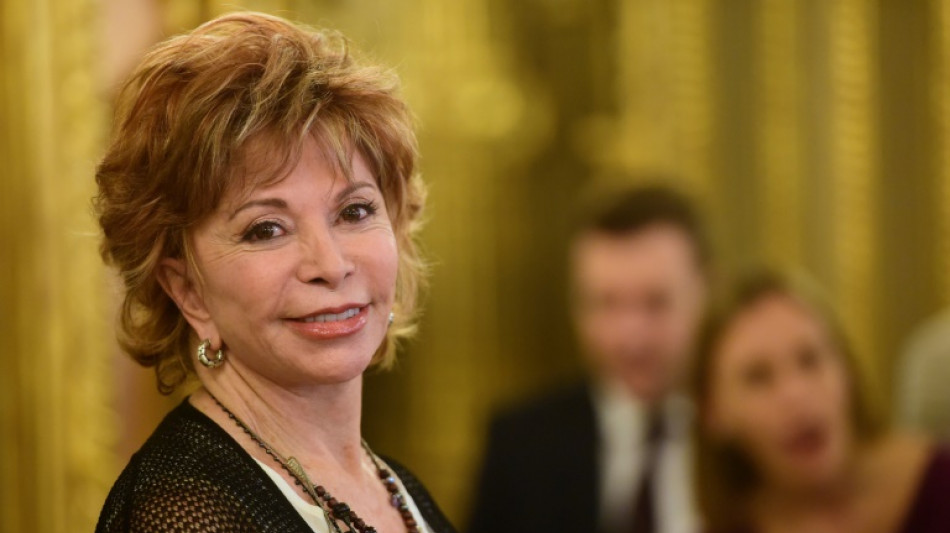
Isabel Allende: In Chile, the 'old fogeys' need to go

 US warns of rapid escalation in Mideast war

 Iran 'put hearts on the court' to win Asian Games basketball bronze

 School girl Yu helps China dominate in Asian Games swimming openers
 Myanmar win first Asian Games teqball gold as Spain great Puyol watches

 China's 13-year-old Yu scorches to first major gold at Asian Games

 Russians vote on last day of parliamentary elections

 Hong Kong pays final respects to former city leader Tung

 Typhoon put people off Asian Games opening ceremony, official says

 China's 13-year-old Yu cruises as Asian Games swimming begins

 AI 'warning shots' focus Beijing on national security risks

 Philippine tribe in limbo over US-led tech hub

 Leo XIV, first US pope transcends his restrained style

 Singer Ed Sheeran says Gaza situation 'unjustifiable' following controversy

 In 'Tenzing', a Sherpa mountaineer gets his due

 Ed Sheeran set to return to stage after Palestinian controversy

 Toulouse edge Vannes, Lyon beat Pau to take Top 14 summit

 Germans arrested for Louvre stunt in Mona Lisa hall

 Saudi-led coalition says Houthis fired ballistic missile at Riyadh

 France's debt climbs to highest since 1978: ministry

 McIlroy two shots off the lead at Wentworth after eagle on 18

 Martinez brace saves Inter in Serie A top-two clash with Roma

 Rosenior abused but guides Paris FC past old club Strasbourg

 Seven-try Lyon beat Pau, climb to Top 14 summit

 Brighton defeat a 'big lesson' against complacency for Arsenal, says Arteta

 Thousands protest inaction over climate crisis in Switzerland

The "old fogeys" of Chilean politics must go, says Isabel Allende -- a stance that is true to form for the novelist, whose latest book "Violeta" is a sweeping epic depicting the transformation between past and present.
A new generation has taken power in Chile, and Allende, perhaps the most popular Spanish-language writer on the planet, is welcoming the dawning political era with open arms.
"In Chile, the old fogeys of the political and financial world have got to go home -- or to an asylum!" the Chilean author tells AFP during a recent video interview.
Gabriel Boric, a leftist who was elected Chile's youngest-ever president at age 35 last month, is already unsettling markets and turning traditional Latin American politics upside down by unveiling a young, women-majority cabinet.
Allende is cheering him on.
"It is a young generation that is taking power," she says.
She applauds his cabinet choices -- and also notes that this young government will have to implement a new Constitution in Chile.
"And that... is an opportunity for us to ask ourselves what sort of country we want," she says.
The changes make her hopeful, especially as they point towards equality for women and Indigenous people.
"And we must try to ensure that all this is part of the country without damaging the economic system, which has made progress in Chile but is very badly distributed, creating such terrible inequality that people are furious," she says.
- 'Broader vision' -
Change, the journey between the past and the present, has long been a theme of Allende's nearly 30 books, which have been translated into more than 40 languages and sold some 70 million copies.
In her new novel "Violeta," she tells the story of an independent woman who was born during one pandemic and dies during another.
Along the way, she witnesses the many transformations of a South American country that seems very much like Chile.
"The idea came to me after the death of my mother. She died shortly before the (Covid-19) pandemic, and she was born as the Spanish flu was coming to Chile, in 1920," Allende says.
The novel takes place during her mother's lifetime, which she describes as "a period in the 20th century of wars, depressions, dictatorships in Latin America, revolutions.
"I created a protagonist who resembles my mother in many ways, but who is not her and who had a much more interesting life."
The difference, she says, is that "Violeta can support herself, which gives her great freedom. My mother depended first on two husbands, and then on me."
In the novel, Violeta and her family leave the capital and move to the south of the country, where they live alongside people of more humble backgrounds.
It was important for Allende to show those class differences, she says, describing a "caste system" in Latin America "which in some places is quite impenetrable."
"And Chile is a country with many class prejudices, more than other countries, perhaps in part because there was little immigration in its early days.
"So Violeta, if she had remained in her social class, if she had lived the corresponding life, would never have gained a broader vision of the country, and of life."
- Stranger in a familiar land -
That kind of "broader vision" is reflected in Allende's own life also.
The author was born in Lima in 1942 -- but she has been abroad for many years, and now lives near San Francisco in the United States.
She describes a sensation familiar to anyone who has lived far from home for a long time, of being a stranger wherever she goes.
Whenever she returns to Chile, she says, "The first week I am happy, but then I realize that I am a foreigner there, too. It is my destiny.
"In the United States, I speak English with an accent. Anyone who sees me on the street knows that I am a Latina and that I am an immigrant.
"And in Chile, I have lived abroad for 40 years, and the country has changed a lot.
"In my head and in my heart is a country that no longer exists."
- Why stop? -
The journey between the past and the present is also reflected in her writing process, she says.
Some things don't change, such as the date she begins writing.
"I start all my books on January 8, so on the seventh I have to take nerve pills," Allende explains.
"The nerves have never left me, but I've learned that if I show up with discipline before the keyboard each day, something comes out."
She has also become "a little more relaxed," she says -- and she has learned that it is "no good" to have an outline.
"That paralyzes me and I lose all inspiration. I let the story change," she says.
"I enjoy writing so much. People tell me: 'You shouldn't have to write any more, you're getting too old for that.'
"But I love it. Why would I want to stop?"
E.Paulino--PC