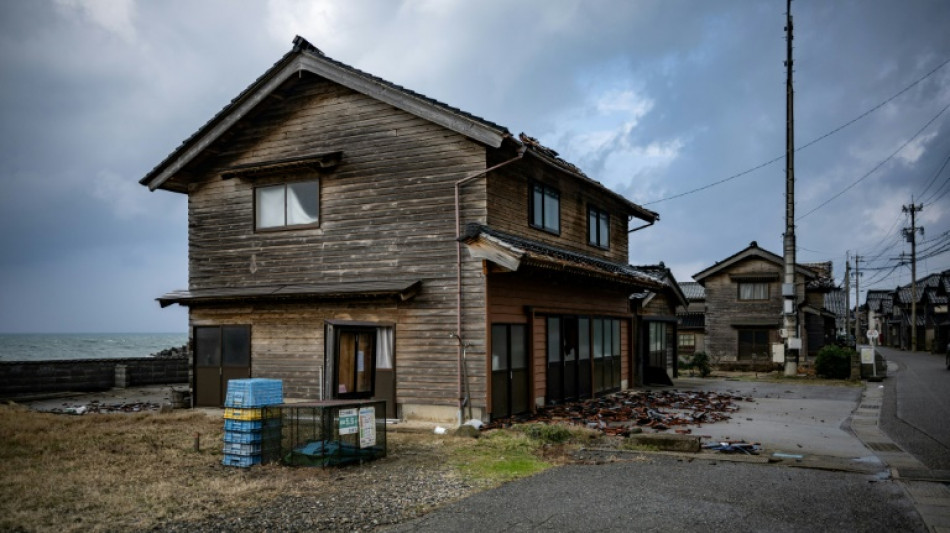
Still standing: unique houses survive quake in Japan village / Photo: Philip FONG - AFP

 Stocks climb as oil prices retreat

 Vstock Transfer Names Securities Industry Veteran Erica Goodstein General Counsel and Chief Compliance Officer

 Four Indonesian seamen return home after Somali pirate ordeal

 Crisis-striken Haiti postpones elections

 Germany arrests ex-spy chief on suspicion of giving secrets to foreign powers

 Djokovic wins China Open after de Minaur retires
 IMF warns cost-of-living shocks cause 'lasting deterioration' in affordability

 Alcaraz wins Japan Open for first title since injury return

 'We're working to keep football clean', Turkish minister says

 FIFA chief Infantino hit by Norwegian double complaint

 Exiled Catalan separatist leader Puigdemont cleared to return to Spain

 Stock markets climb as oil prices retreat

 'No future': Thousands mass in France for high school protests

 Nobel physics prize honours work on 'ghostly messengers' from outer space

 Bulgaria searches for missing crew after drones hit two more ships in Black Sea

 Le Pen vows drastic cost savings to prevent French 'default'

 'Eats through a straw': French teens wounded in high school protests

 Thousands mass in France for high school protests

 Moscow denies sanitary measures over plague reports

 Samoa look to recreate 2022 final run at Rugby League World Cup

 Asian stocks mostly up after tech-led Wall St record

 German factory orders plunge as recovery still fragile

 Coco Gauff calls out online racism following China open video review

 KVB Accelerates Middle East Footprint with Strategic MENA Regional Expansion

 Purple reign: Philippines seeks to keep grip on ube throne

The New Year's Day earthquake demolished wooden buildings all across Japan's Noto Peninsula but thanks to decades-old smart architecture, one small fishing village stood strong.
A few roof tiles came loose but not one of around 100 structures in windswept Akasaki, on the stick of land's western coast, collapsed in the magnitude 7.5 quake whose epicentre was just a few kilometres (miles) away.
Masaki Sato drove all night from his home 300 kilometres (190 miles) away in Tokyo after the quake to check on the 85-year-old house that he has owned since 2017 and runs as a summer B&B.
"The house stands on a very narrow lot of land, and the building has many small rooms, with many columns" that make it stronger, the 43-year-old told AFP.
To withstand the harsh rain, snow and ocean winds buffeting off the Sea of Japan, Sato's house and most others in Akasaki have few glass windows.
Their exterior walls are made from sturdy wooden slats, layered horizontally. The structure is supported by thick beams criss-crossing the ceiling.
The earthquake and its many aftershocks killed at least 161 people, and 103 others are still missing, authorities said on Monday.
But there were no casualties in the tight-knit village.
Even tsunami waves triggered by the earthquake didn't reach the houses, which are built on land slightly uphill from concrete tetrapods that protect them from the sea.
At Sato's place, ceramic dishes smashed, appliances toppled and a recently added wooden sliding door broke, leaving debris strewn across the floor.
But that was it.
"I felt so encouraged, because the village was still there standing," Sato said.
"I think it's thanks to the design of the houses," he added, sitting at the dusty but still solid kitchen counter in his guest house.
- 'Windshield' -
The same lucky outcome was seen around the village, where "the design of the houses is more or less the same," said resident Seiya Shinagawa, a retired fisherman.
"Traditionally there's a shed on the coast as a windshield, with a narrow main house behind it," the 78-year-old said.
This setup is a remnant of the days when each fisherman would launch their boats out of their shed directly to the sea, Shinagawa said.
From around the 1920s, the community's fishermen opted for more lucrative deep-sea fishing far away from home, sometimes hauling in small fortunes for their catch.
But when a fire broke out and destroyed a significant part of the village in the late 1930s, people rebuilt the houses in a unified and stronger design.
- Demographic threat -
Now despite its resilient character, the village faces a problem that is widespread in Japan: a severely ageing population.
Most people in Akasaki are over 65, with many living alone, including 74-year-old resident Akiyo Wakasa.
"My neighbour and their next-door neighbour also live alone," she said.
According to Wakasa, part of the problem is that "fixing houses costs money".
"I'm not sure how many people here actually think it would be worth fixing the house and continuing to live here when they have nobody to hand it down to," she explained.
For Sato, an IT firm employee who runs a real-estate renovation business on the side, seeing Akasaki entering a slow decline is unbearable.
The area is not recognised by the government as a cultural asset, but it's a place where people lead a simple, old-fashioned lifestyle, he said.
And when there's no one to live in a house, it's torn down -- eroding the village's charm, according to Sato.
"Akasaki, which has preserved a unique and uniform housing design... is losing its scenic appearance."
To save Akasaki's special look, Sato has purchased five of the houses and sheds himself, and wants eventually to open some cafes and restaurants there.
"The village is too precious to lose," he said.
F.Cardoso--PC