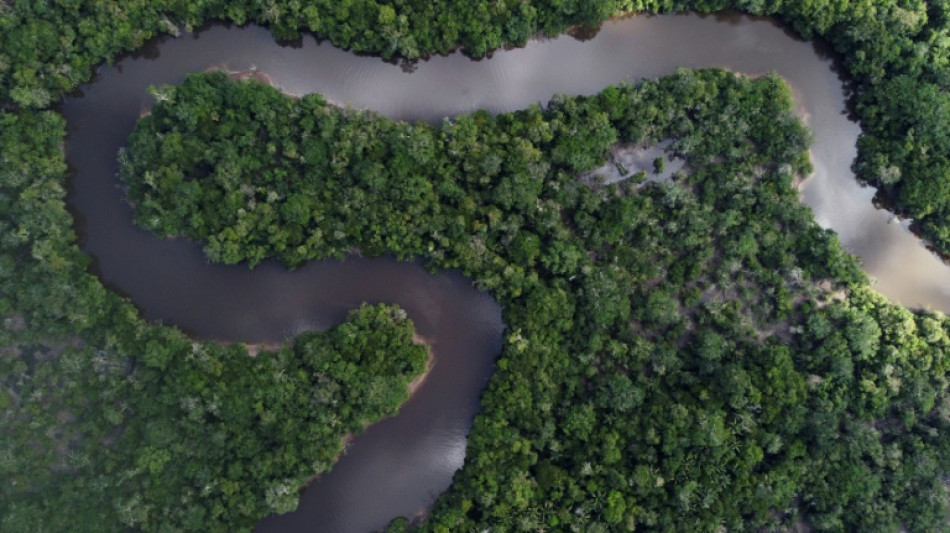
Vast network of lost ancient cities discovered in the Amazon / Photo: Pedro PARDO - AFP/File

 Stocks slide as US inflation surges, US and Iran trade strikes

 Vaughan backs Stokes to stay on as England captain

 Amnesty accuses Israel of 'ethnic cleansing' of West Bank Bedouins

 O'Callaghan and Short clock history-making times at Australian trials

 Trump accuses Iran of taking 'too long' to negotiate peace deal

 Israel's Netanyahu to seek re-election despite Trump doubts, war strains

 Belfast stabbing suspect in court after 'terrifying' night of violence

 FIFA boss Infantino faces questions on eve of World Cup

 Tech leads Asia losses as rollercoaster week rumbles on

 Saudi's new national carrier gets off ground despite war, delays

 Bollywood's Imtiaz Ali bets on Gen Z thirst for love

 Messi sparkles on return as Somali referee says World Cup dream over

 Salt: integral ingredient of sumo stars' art

 Messi scores on injury return as Argentina beat Iceland in World Cup warm-up

 Tech leads Asia losses, oil rises as rollercoaster week rumbles on

 Former Wallabies skipper Wright signs for Welsh club Ospreys

 Emotional World Cup return to Mexico for South Africa coach Broos

 'The Donald of Dubai': property tycoon seeks to become data king

 Elon Musk, after DOGE and politics, bets on SpaceX IPO

 Mexico doubles down on security before 2026 World Cup

 Leggett & Platt Automotive Launches New Brand Identity: Leggett Dynamics

 From Retrofit to AI: Akkodis Strengthens Digital Innovation Through Industrial Aerospace Applications at ILA Berlin 2026

 Italian astronaut to pilot Artemis III mission

 Benfica say farewell to Mourinho as Real Madrid return nears

 US strikes Iran after Apache helicopter downing

Archaeologists have discovered the largest and oldest network of pre-Hispanic cities ever found in the Amazon rainforest, revealing a 2,500-year-old lost civilisation of farmers.
The vast site, which covers more than 1,000 square kilometres (385 square miles), was long hidden by the jungle in the Upano valley on the foothills of the Andes mountain range in eastern Ecuador.
However, a French-led team of researchers have used laser-mapping technology taken from above, as well as archaeological excavations, to uncover 20 settlements -- including five large cities -- connected by roads.
Stephen Rostain, an archaeologist at France's CNRS research centre and the lead author of a new study, told AFP it was like discovering "El Dorado".
The scale of this urban development -- which includes earthen homes, ceremonial buildings and agricultural draining -- has never been seen before in the Amazon, Rostain said.
"It is not just a village, but an entire landscape that has been domesticated," he said.
Rostain said he detected the first traces of this lost civilisation 25 years ago, when he spotted hundreds of mounds in the area.
In 2015, his team of researchers flew over the region using laser technology called Lidar, which allowed the scientists to peer through the forest canopy as "if we had cut down all the trees," Rostain said.
- 'Like New York' -
They found more than 6,000 earthen mounds, rectangular earthen platforms which served as the base of homes for the "Upano people".
On the floors, the researchers found "all the domestic remains one would see in a home -- fireplaces, large ceramic jars for beer made out of corn, grinding stones, seeds, tools," Rostain said.
Remarkably, the cities are all criss-crossed by large, straight streets -- "just like in New York," he added.
Some cities have a large central alley where people from the surrounding villages gathered, Rostain said, comparing these streets to those of the ancient Teotihuacan city in modern-day Mexico.
Rostain speculated that several thousand people could have attended such ceremonial events, though further analysis is being carried out to estimate how many people lived in the region.
Some of the mounds are up to 10 metres (33 feet) tall, suggesting they were not homes but communal areas for rituals or festivals.
The small fields show that the agrarian society "took advantage of the smallest empty space to ensure it bore fruit," Rostain said.
All these accomplishments would have needed leaders, planning, engineers to plan the roads, he suggested.
What happened to the previously unknown Upano people -- so named by the researchers -- is not known.
Construction on the first mounds is thought to have begun between 500 BC and 300-600 AD, around the time of the Roman empire.
Other large villages discovered in the Amazon date from between 500-1,500 AD, according to the study published in the journal Science on Thursday.
But this network of cities is "much older and much bigger," Rostain said.
The discovery shows that "there were not only hunter-gatherers in the Amazon, but also complex, urban populations," he added.
Rostain said that "a certain Western arrogance" had long deemed it impossible that -- prior to European colonisation -- people in the Amazon were capable of building such a complex society.
"It's time to reconsider this disparaging view of the people of the Amazon."
P.Queiroz--PC