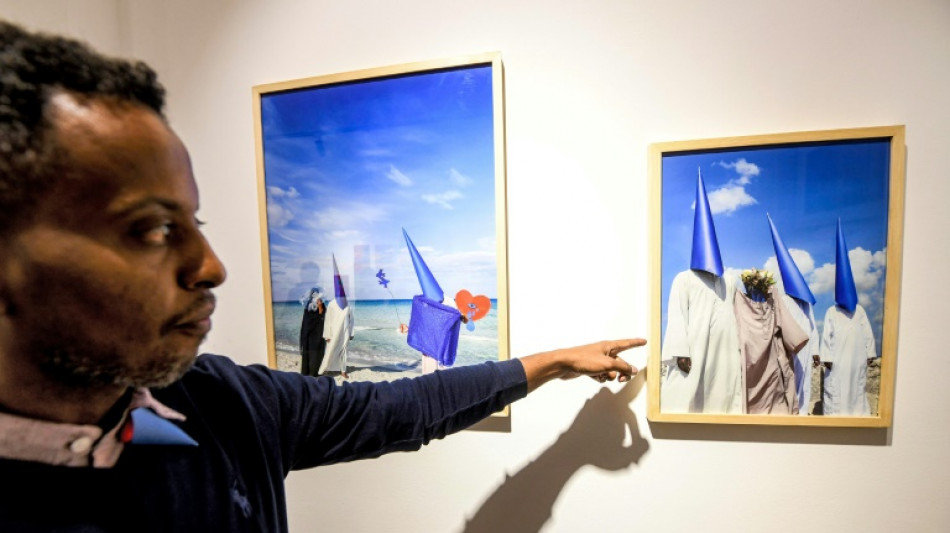
Fleeing war, Sudanese artists seek revival in Cairo / Photo: Ahmed HASAN - AFP

 Stocks climb as oil prices retreat
 Vstock Transfer Names Securities Industry Veteran Erica Goodstein General Counsel and Chief Compliance Officer

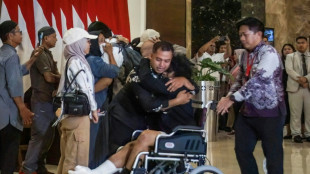 Four Indonesian seamen return home after Somali pirate ordeal

 Crisis-striken Haiti postpones elections

 Germany arrests ex-spy chief on suspicion of giving secrets to foreign powers
 Djokovic wins China Open after de Minaur retires
 IMF warns cost-of-living shocks cause 'lasting deterioration' in affordability
 Alcaraz wins Japan Open for first title since injury return

 'We're working to keep football clean', Turkish minister says

 FIFA chief Infantino hit by Norwegian double complaint

 Exiled Catalan separatist leader Puigdemont cleared to return to Spain

 Stock markets climb as oil prices retreat

 'No future': Thousands mass in France for high school protests

 Nobel physics prize honours work on 'ghostly messengers' from outer space

 Bulgaria searches for missing crew after drones hit two more ships in Black Sea

 Le Pen vows drastic cost savings to prevent French 'default'

 'Eats through a straw': French teens wounded in high school protests

 Thousands mass in France for high school protests

 Moscow denies sanitary measures over plague reports
 Samoa look to recreate 2022 final run at Rugby League World Cup

 Asian stocks mostly up after tech-led Wall St record

 German factory orders plunge as recovery still fragile

 Coco Gauff calls out online racism following China open video review

 KVB Accelerates Middle East Footprint with Strategic MENA Regional Expansion

 Purple reign: Philippines seeks to keep grip on ube throne

When the first bombs rang out in Sudan, Amjad, Fatima and Mazin abandoned their paintbrushes, musical instruments and studios, leaving behind the lives they knew for unfamiliar shores.
Now in Egypt, they have sought to bring back the sights and sounds of a long-lost home to an audience of about a hundred, just a stone's throw away from Cairo's iconic Tahrir Square.
Mazin Hamid, a celebrity in his native Khartoum, thrilled the crowd with his homegrown beats at a concert accompanying an exhibition.
When war broke out in his home country last April, Hamid was under a tight deadline to produce the soundtrack for "Goodbye Julia", the first-ever Sudanese film to be screened and awarded at Cannes.
Having already experienced a revolution, a coup and a brutal crackdown on pro-democracy activists in just four years, the 31-year-old producer just locked the door to his studio and kept working.
"In the soundproof walls of the studio" he could only hear the occasional sound of scattered gunshots, Hamid told AFP in Cairo.
But when the sound of fighter jets burst through the walls, "I understood things were serious."
The hours of fighting turned into days and months, and the war between the army and the paramilitary Rapid Support Forces would come to grip much of the already impoverished country, with no signs of abating.
The most reliable toll -- over 13,000 dead according to the Armed Conflict Location and Event Data Project -- is a conservative estimate at best.
In the western region of Darfur, the United Nations and international lawyers have warned another wave of ethnic cleansing is taking hold.
With millions displaced, disease outbreaks across the country and a stillborn agricultural season, Sudan has been brought to its knees.
Like more than a million others, Hamid knew he had to leave.
He fled, leaving behind "his instruments and equipment, so as not to attract attention at the checkpoints" set up by soldiers and paramilitary fighters across the city.
- 'From scratch' -
At first, Fatima Ismail holed herself up in her apartment, "in silence for fear of the paramilitaries posted downstairs," she told AFP in Cairo, where artworks depicting her life in exile were on display.
From the first days of the war, stories spread of horrific sexual violence committed by RSF fighters.
"If they had known there were young women in the apartment, it would have been terrible," the 26-year-old said.
She eventually managed to escape, pulling her family onto the first minibus they found, speeding through neighbourhoods in ruins.
Before she left, she sketched every inch of their lives in the apartment -- "my mother cooking", "my father reading the Koran", the everyday memories gone forever.
Now safe in Cairo, she works through her sketches, processing the war through her art after having to relaunch her practice from scratch.
"I had to leave without any of my equipment... God and drawing saved me," she said, surrounded by her artwork as music by fellow artists played around her.
Among them was Amjad Badr, 28, who also left his instruments and studio behind in Sudan.
"I'm playing with a guitar a friend lent me," he told AFP at the gathering in Cairo.
- 'We will return' -
After a long journey to Egypt and "11 days spent sleeping", Badr found his way back to music.
"It was extremely important for me to express everything I had been through," he said.
That sentiment is prevalent among Sudanese "artists in Cairo, but also in Nairobi or in Ethiopia," Badr added, referring to some of the destinations where over 1.5 million people have fled.
Over 400,000 have come to Egypt, according to the United Nations.
Also at the exhibition in Cairo, Hashim Nasr presented stylised photos representing his family -- its missing members, the impact of death and exile, but also of rebirth.
The 33-year-old former dentist made a new home in the coastal city of Alexandria, where he took up photography again.
But there, Nasr told AFP, he "doesn't know anyone".
Without models, he took to photographing his own family.
Far from home and all too aware of the carnage they left behind, the musician Badr said it's hard to find "motivation or inspiration".
But "we will return", he vowed, as though reassuring himself.
"The music scene was really starting to take off before the war, so soon we'll be back, and even stronger."
P.Queiroz--PC