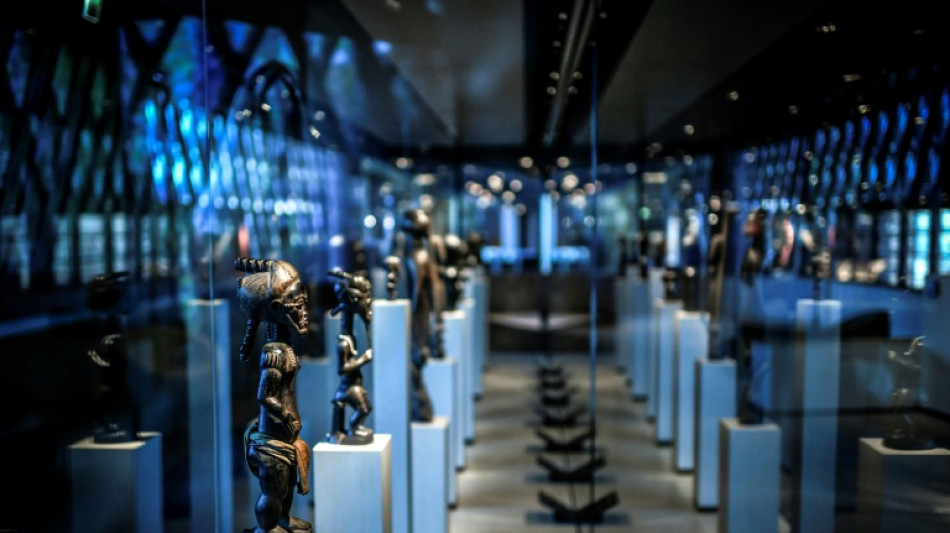
'Titanic' task of finding plundered African art in French museums / Photo: STEPHANE DE SAKUTIN - AFP/File

 N. Korea's Kim pledges 'invariable support' in Putin birthday letter

 OGRD Alliance Advances PLPC Multi-Asset Platform Following APHELAR Milestone, Expanding Licensing and Strategic Capital Frameworks

 Emotion, tears as Messi prepares for Argentina farewell

 Kane eyes Ronaldo record after matching England cap mark

 Spain fight back to beat Croatia, Kane adds to record for England

 Merino double helps Spain beat Croatia, reach Nations League quarters

 US stocks hit fresh records as oil stabilizes on rising supplies
 As Messi bows out, Argentines say 'thank you'

 Ronaldo opens door for Portugal return, apologises for walkout

 'Nobody seems to care': Russian city shrugs off plague reports

 Hundreds arrested in French school protests as Macron summons ministers

 WADA seeks tough anti-doping stance from Kenya

 German ex-spy chief arrested for suspected espionage, treason
 Furyk vows US will 'do more' to end Ryder Cup losing streak

 Iyer hits ton as India hammer West Indies in T20 opener
 Mandhana named India women's team captain after Kaur quits

 'The sound keeps coming back': children maimed in Ethiopia's Tigray clashes

 Paris Women's Fashion Week: the key trends

 i-payout Introduces a New Approach to Payments, Closing the Beneficiary Information Gap

 New Generation of Crypto Miners Released by ASICID

 New investor forecasts LIV Golf teams could be worth $100 mn each
 Shakira, Pique return to court over children visit arrangements

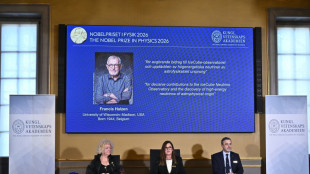 Nobel physics prize hails 'ghostly messengers' from space
 France's Mistral unveils latest model in sovereign AI push

 Stocks climb as oil prices retreat

With tens of thousands of African artworks in French museums, curators face a huge task in trying to identify which of these were plundered during colonial rule in the 19th and 20th centuries and should be returned.
During a visit to Burkina Faso in 2017, French President Emmanuel Macron pledged to return "African heritage to Africa" within five years, pushing other former colonial powers, including Belgium and Germany, to launch similar initiatives.
In 2021, France repatriated 26 royal treasures its soldiers took from Benin during colonial rule.
The effort has stalled, and in March the government indefinitely postponed a bill authorising the return of African and other cultural artefacts following right-wing resistance in the Senate.
French museums are nonetheless studying the origins of some 90,000 African objects in their archives.
Most -- 79,000 -- are in the Quai Branly museum in Paris dedicated to indigenous art from Africa, Asia, Oceania and the Americas.
The task is "titanic and exhilarating", said Emilie Salaberry, head of the Angouleme Museum, which houses around 5,000 African objects.
"It's turned upside down how we understand our collections," she told AFP.
- 'Real investigative work' -
Identifying an object's provenance is becoming central to museum work, but tracking down the necessary information is hard and time-consuming.
France's Army Museum began its inventory in 2012 but has only been able to study around a quarter of its 2,248 African pieces.
And while it says there is a "reasonable hypothesis" that many are spoils of war, it has struggled to establish definitive conclusions.
"The main difficulty... is the relative lack of sources," a museum spokesperson told AFP.
Emilie Giraud, president of ICOM France, which oversees 600 museums, said: "It's real investigative work which requires cross-checking clues and finding sources that may be scattered, sometimes abroad, or might not even exist at all."
It is hoped the task will grow easier as this type of research becomes commonplace.
The University of Paris-Nanterre introduced a course dedicated to provenance in 2022, and the Louvre School at the heart of the famed museum followed suit in 2023.
Germany and France launched a three-year, 2.1-million-euro ($2.2 million) fund for provenance research in January.
"We need to be transparent about everything, including the inadequacies of our catalogues, our dating, and our designations," said Katia Kukawka, chief curator of the Aquitaine Museum, calling the job an "ethical imperative".
– Frustrated efforts -
To ease the cost burden, the Aquitaine Museum, which has 2,500 African objects, is pooling resources with other organisations, including museums in Gabon and Cameroon.
But without the proposed law, it remains uncertain what criteria will determine when an object must be returned to Africa.
If it was illegally acquired, that might be sufficient, said Salaberry, of the Angouleme Museum, but the lack of clear historical records will continue to frustrate restitution efforts.
"There will be an enormous number of objects for which light can never be shed," she said.
Loans and long-term retainers could be an alternative to full restitution -- as Britain recently did for items from the Ashanti, or Asante, royal court in Ghana.
But not everyone was impressed with that.
As Nana Oforiatta Ayim, a culture adviser to Ghana's government, told the BBC: "Someone comes into your home and steals something, keeps it in their house, and then X amount of years later comes up and says 'I'm going to lend you your things back'.
"It doesn't make any sense."
F.Santana--PC