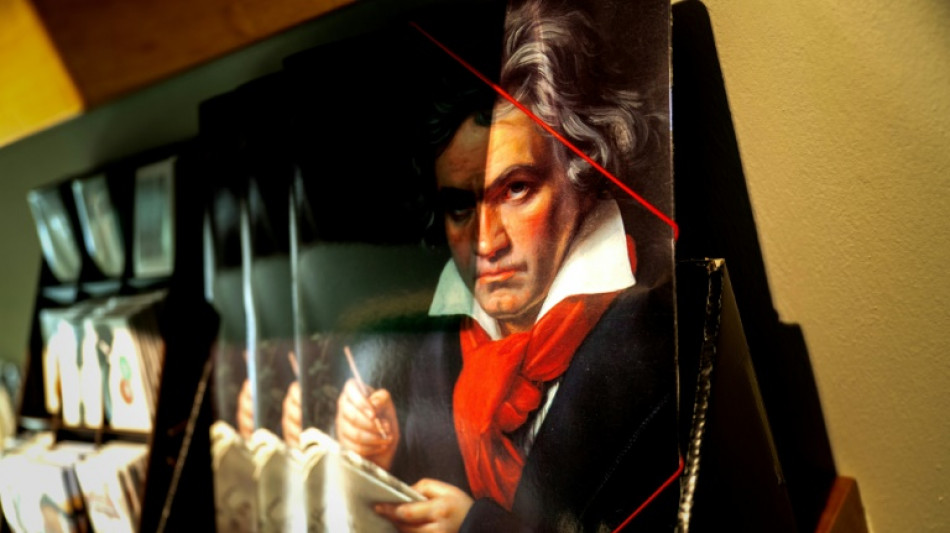
Ode to joy: How Austria shaped Beethoven's Ninth / Photo: Joe Klamar - AFP

 Turkey, Australia's joint COP31 leadership raises doubts

 For Turkish NGOs, COP31 offers rare space for action
 Sleep, appetite, gene-editing experts contend for Nobel chemistry prize

 Nobel Peace Prize haunted by the 'spectre' of Trump

 Africa launches own credit agency in bid for cheaper borrowing

 US, China, EU: three paths to regulating AI

 Australia's High Court rules against coal mine in landmark climate case

 Australia touts new funds for Pacific infrastructure at Fiji 'pre-COP'

 Eva Marie Saint, Oscar winner of Hollywood classics, dies at 102

 Australia probes app used in cheap smart glasses over privacy fears
 England needed to 'move on' from World Cup pain, says Tuchel

 O'Neill to stay at Celtic after period of "reflection"

 Kane marks 125th England cap with Wembley Nations League double

 Quebec's incoming separatist leader wants to block Crown from swearing-in

 Emmys gala will now stream its premier television awards

 Paramount completes Warner Bros takeover, creating Skydance
 Trump blames France unrest on Islam, migration

 Apple's Cook praises EU over efforts to protect children online

 Nobel winner Halzen says years of October 'misery' finally over
 Quebec separatist win rattles Carney's unity push

 'Itching' for change: Shiffrin cuts back slaloms this season

 'Gen Z has risen up': Tens of thousands mass for tense France school protests
 Caribbean tourism hotspot loses men to Russian war machine

 Danish reservists practice war games to respond to 'aggression'
 Bhuvneshwar returns to India's T20 squad for New Zealand tour

The night Ludwig van Beethoven's monumental Ninth Symphony rang out in a Vienna concert hall for the first time almost exactly two centuries ago, the great German composer was anxious for all to go well.
He needn't have worried. The audience erupted in spontaneous applause during the performance, but Beethoven was already so hard of hearing that he had to be turned around by a musician to notice it.
While he was born in Bonn in 1770, Beethoven spent most of his life in Vienna after moving to the Austrian capital as a 22-year-old.
Despite receiving repeated offers to relocate, the legendary composer never left Vienna, where he had found his home from home, surrounded by supportive fans and generous patrons.
"It was the society, the culture that characterised the city that appealed to him so much," said Ulrike Scholda, director of the Beethoven House in nearby Baden.
The picturesque spa town just outside Vienna deeply shaped Beethoven's life -- and the last symphony he would complete, she said.
- Under pressure -
"In the 1820s, Baden was certainly the place to be", with the imperial family, the aristocracy and a Who's Who of cultural life spending their summers there, Scholda said.
Beyond his hearing loss, Beethoven suffered from various health problems ranging from abdominal pains to jaundice, and regularly went to Baden to recuperate.
Enjoying long walks in the countryside and bathing in Baden's medicinal springs helped him recover, while simultaneously inspiring his compositions.
In the summers leading up to the first public performance of his Ninth Symphony in 1824, Beethoven stayed at what is now known as Baden's Beethoven House, which now serves as a museum.
It was there that he also composed important parts of his final symphony.
A letter Beethoven sent from Baden in September 1823 details the pressure he felt to finalise the symphony to please the Philharmonic Society in London which had commissioned the work, Scholda said.
- 'Less war, more Beethoven' -
Upon completing the symphony in Vienna, weeks of intense preparations followed, including an army of copyists duplicating Beethoven's manuscripts and last-minute rehearsals that culminated in the premiere on May 7, 1824.
The night before, Beethoven rushed from door to door by carriage to "personally invite important people to come to his concert", said historical musicologist Birgit Lodes.
He also managed to "squeeze in a haircut", Lodes added.
At almost double the length of comparable works, Beethoven's Ninth broke the norms of what until then was a "solely orchestral" genre by "integrating the human voice and thus text", musicologist Beate Angelika Kraus told AFP.
His revolutionary idea to incorporate parts of Friedrich von Schiller's lyrical verse "Ode to Joy" paradoxically made his symphony more susceptible to misuse, including by the Nazis and the Communists.
The verses "convey a feeling of togetherness, but are relatively open in terms of ideological (interpretation)," Kraus said.
Since 1985, Beethoven's "Ode to Joy" from the fourth movement has served as the European Union's official anthem.
Outside the Beethoven House in Baden, which is marking the anniversary with a special exhibition, visitor Jochen Hallof said that encountering the Ninth Symphony as a child had led him down a "path of humanism".
"We should listen to Beethoven more instead of waging war," Hallof said.
And on Tuesday night that certainly will be the case, with Beethoven's masterpiece reverberating throughout Europe with anniversary concerts in major venues in Paris, Milan and Vienna.
T.Batista--PC