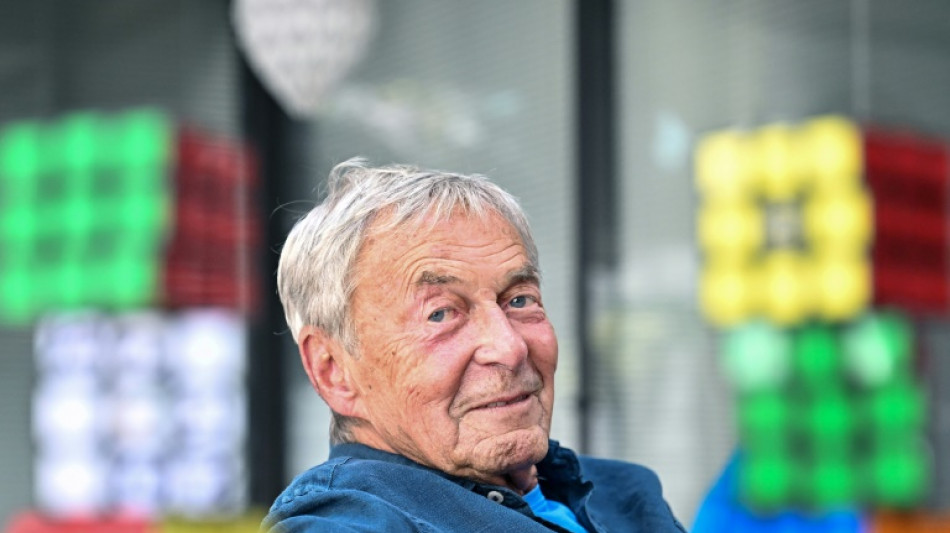
Forever fad: Rubik says his cube 'reminds us why we have hands' / Photo: ATTILA KISBENEDEK - AFP

 Australia probes app used in cheap smart glasses over privacy fears
 England needed to 'move on' from World Cup pain, says Tuchel

 O'Neill to stay at Celtic after period of "reflection"

 Kane marks 125th England cap with Wembley Nations League double

 Quebec's incoming separatist leader wants to block Crown from swearing-in
 Emmys gala will now stream its premier television awards

 Paramount completes Warner Bros takeover, creating Skydance

 Trump blames France unrest on Islam, migration

 Apple's Cook praises EU over efforts to protect children online

 Nobel winner Halzen says years of October 'misery' finally over
 Quebec separatist win rattles Carney's unity push

 'Itching' for change: Shiffrin cuts back slaloms this season

 'Gen Z has risen up': Tens of thousands mass for tense France school protests

 Caribbean tourism hotspot loses men to Russian war machine

 Danish reservists practice war games to respond to 'aggression'

 Bhuvneshwar returns to India's T20 squad for New Zealand tour

 Asos says probing 'unauthorised activity' after phone alerts

 Stocks climb as oil prices retreat under $100 per barrel

 Neutrinos: space particles that change our view of universe

 'Destined' Djokovic wins China Open, extending unbeaten record
 Iceland is 'critical outpost' for security, says Rubio during visit
 Israeli settlers beat AFP photographer covering West Bank

 'Gen Z has risen up': Tens of thousands demand better education in France

 $10 Million and Counting: Hola Prime Hits Major Trader Payout Milestone

 UEFA investigate Ireland-Israel tunnel bustup after spitting claim

The naysayers said the maddening multicoloured cube that Erno Rubik invented 50 years ago would not survive the 1980s.
Yet millennials and Generation Z are as nuts about Rubik's Cube as their parents were, much to the amusement of its 79-year-old creator, who talked to AFP in a rare interview.
In a digital world "we are slowly forgetting that we have hands", Rubik said.
But playing with the cube helps us tap back into something deeply primal about doing things with our hands, he said -- "our first tools", as he calls them.
"Speed cubing" and Rubik's Cube hacks are huge on social media, with youngsters regularly going viral while dancing, rapping and even playing the piano while solving the 3D puzzle.
Rubik said the "connection between the mind and hands" that the cube helps foster has been "a very important" factor in human development.
"I think probably the cube reminds us we have hands... You are not just thinking, you are doing something.
"It's a piece of art you are emotionally involved with," Rubik added.
- 43 quintillion solutions -
The unassuming Hungarian architecture professor never thought the prototype he devised would conquer the world -- and set him up for life.
More than 500 million copies of the cult object have been sold -- not counting the myriad of counterfeits.
Rubik's Cube has remained one of the world's top-selling puzzle games, with more than 43 quintillion -- a quintillion being a billion trillion -- ways of solving it.
Even after "hundreds or thousands of years", you would still be finding ways to crack it, Rubik enthused.
Despite the omnipresence of screens, "new generations have developed the same strong relationship with the cube," Rubik told AFP at Budapest's Aquincum Institute of Technology, where he sometimes gives lectures.
It was in the spring of 1974 that he created the first working prototype of a movable cube made of small wooden blocks and held together by a unique mechanism.
- Like a 'wunderkind' in family -
The five decades since have been "unbelievable", he said, comparing his relationship with the cube to having a "wunderkind" in the family.
"You need to take a step back because of your 'child' and its fame.... (which) can be very tiring," he said.
In his book "Cubed", published in 2020, Rubik revealed that he had never intended to leave a mark on the world -- he was just driven by a love for building geometric models.
It took Rubik several prototypes and weeks of tinkering to figure out the ideal mechanism -- and a way to solve his puzzle -- before he could file a patent application in 1975.
The colourful "Magic Cube" first sold domestically in 1977 before hitting international shelves three years later.
Rubik recalled his first fairytale-like trip from communist Hungary to the West, on the other side of the Iron Curtain.
- 'Retirement money' -
Despite being publicity-shy, the inventor has amassed a collection of some 1,500 magazine covers featuring his cube over the years, which has become "a symbol of complexity" to illustrate anything from geopolitical problems to elections.
You either "like or hate it", he said, but you cannot ignore it.
Rubik's Cube legacy lives on strongly in pop culture, having been featured in numerous TV series and Hollywood blockbusters.
It has also remained the centrepiece of puzzle-solving competitions.
Masters of the cube frequently gather across the world, battling with their hands and feet -- sometimes while blindfolded, parachuting or doing headstands -- Rubik said.
The cube has a place in the permanent exhibition at New York's Museum of Modern Art, and it has also inspired artists, including renowned French street artist Invader.
An educational tool used everywhere from nursery schools to universities, the cube is also popular in retirement homes and helps people living with autism, including American speed-cubing star Max Park, who holds the world record of solving it in 3.13 seconds.
Rubik said the emotional rewards the cube has brought him have been even better than the "retirement money" it has earned him.
It feels nice to have done "something good for people", he said, adding that the cube has even made "marriages and much more..."
M.Gameiro--PC