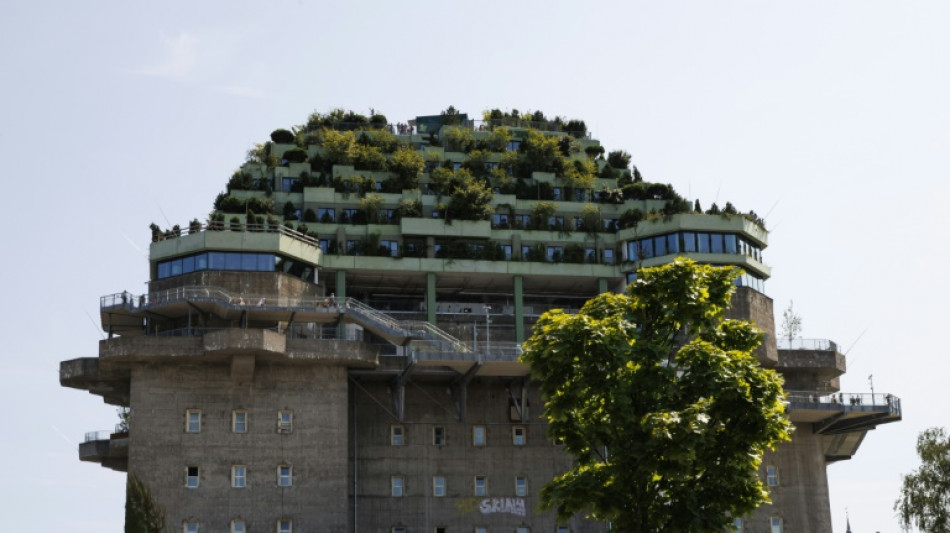
Hamburg transforms its huge 'ugly wart' Nazi bunker / Photo: MORRIS MAC MATZEN - AFP

 Apple's Cook praises EU over efforts to protect children online

 Nobel winner Halzen says years of October 'misery' finally over

 Quebec separatist win rattles Carney's unity push

 'Itching' for change: Shiffrin cuts back slaloms this season

 'Gen Z has risen up': Tens of thousands mass for tense France school protests

 Caribbean tourism hotspot loses men to Russian war machine

 Danish reservists practice war games to respond to 'aggression'
 Bhuvneshwar returns to India's T20 squad for New Zealand tour

 Asos says probing 'unauthorised activity' after phone alerts

 Stocks climb as oil prices retreat under $100 per barrel

 Neutrinos: space particles that change our view of universe

 'Destined' Djokovic wins China Open, extending unbeaten record
 Iceland is 'critical outpost' for security, says Rubio during visit

 Israeli settlers beat AFP photographer covering West Bank

 'Gen Z has risen up': Tens of thousands demand better education in France

 $10 Million and Counting: Hola Prime Hits Major Trader Payout Milestone

 UEFA investigate Ireland-Israel tunnel bustup after spitting claim

 Djokovic wins China Open and keeps unbeaten record after de Minaur retires

 Amsterdam's Rijksmuseum hosts 'homecoming' show for Willem de Kooning

 World Bank forecasts modest growth for Latin America, highlights climate risks

 'Afraid for my future': Tens of thousands demand better education in France

 Pakistan PM urges Imran Khan supporters to end protest march

 Alex Bodi își continuă expansiunea: planuri pentru deschiderea unui showroom ALIX LASERS la București

 STARTRADER Adds 20 Stock and ETF CFDs to Its 24/7 Trading Range

 Bulgaria searches for missing crew after drones hit more Black Sea ships

A huge former Nazi bunker in Hamburg has been transformed into a leisure complex filled with restaurants, a concert hall and roof terraces where visitors can relax in an orchard.
It is a novel answer to the question that has long vexed Germany -- what to do with former Nazi sites that are too complex to demolish?
The five storeys of the imposing concrete structure in Hamburg's St Pauli district, one of the largest bunkers in the world, can now be accessed via steps bolted onto the outside of the building.
The complex includes a hotel with 134 bedrooms, a 2,000-seat concert space and allotment plots for locals.
"The idea of raising the height of the building with greenery was to add something peaceful and positive to this massive block left over from the Nazi dictatorship," said Anita Engels from the Hilldegarden neighbourhood association, which supported the project.
Almost 40 metres (130 feet) tall and weighing 76,000 tonnes, the St Pauli bunker has exterior walls 2.5 metres thick and a roof consisting of 3.5 metres of reinforced concrete.
The building was one of eight "flak towers" constructed by Hitler during the Third Reich, with anti-aircraft guns standing where the apple trees now grow.
- Triple threat -
Three were in Berlin, two in Hamburg and three in Vienna.
"They protected the government quarter in Berlin, the port facilities in Hamburg and the historic centre that Hitler loved in Vienna," said historian Michael Foedrowitz.
The huge structures also functioned as shelters, as well as serving as a kind of architectural "propaganda" about the power of Hitler's rule, he said.
The flak tower at Berlin zoo is the only one that has been completely destroyed, since the explosives required would pose too big a risk for the heavily populated areas where the others stand.
After the war, the bunker in St Pauli was initially used as accommodation for homeless people before being transformed into office space for media and advertising companies in the 1950s.
The lower floors have more recently been home to a popular nightclub, a radio station and a climbing gym.
"But that didn't lead to the story of the bunker being told, to critical reflection. There wasn't even a sign at the entrance," said Engels.
As part of the renovation project launched in 2019 by the city of Hamburg and private investors, Hilldegarden has been helping to bring the history of the building back to life.
The association has collected testimonies from people who lived in the bunker during and after the war as well as records of the hundreds of forced labourers who built the structure in just 300 days in 1942.
On the first floor, an exhibition now presents the history of the site.
"In Berlin, up to 60,000 civilians were counted taking refuge in a pair of towers designed to hold around 30,000 people -- the size of a small town," historian Foedrowitz said.
- Massive bombing -
The St Pauli complex housed up to 25,000 civilians including during the Allied bombing raids of Operation Gomorrah in July 1943, which devastated Hamburg.
Brigitte Schulze, a 72-year-old pensioner who came to visit the refurbished bunker, said she felt it was "good to keep this history alive, especially as the witnesses are disappearing".
"And the setting is pleasant, with the park and the trees," she said.
Schulze lives near Hamburg but it had never occurred to her before to visit the building, which she described as "just an ugly wart".
She was one of thousands of visitors to the new complex in its first month.
A few years ago, Hamburg's second flak tower was converted into a mini power station producing electricity from renewable sources.
In Berlin, the towers in Friedrichshain and Humboldthain have been buried beneath unassuming artificial hills in two city parks.
E.Ramalho--PC