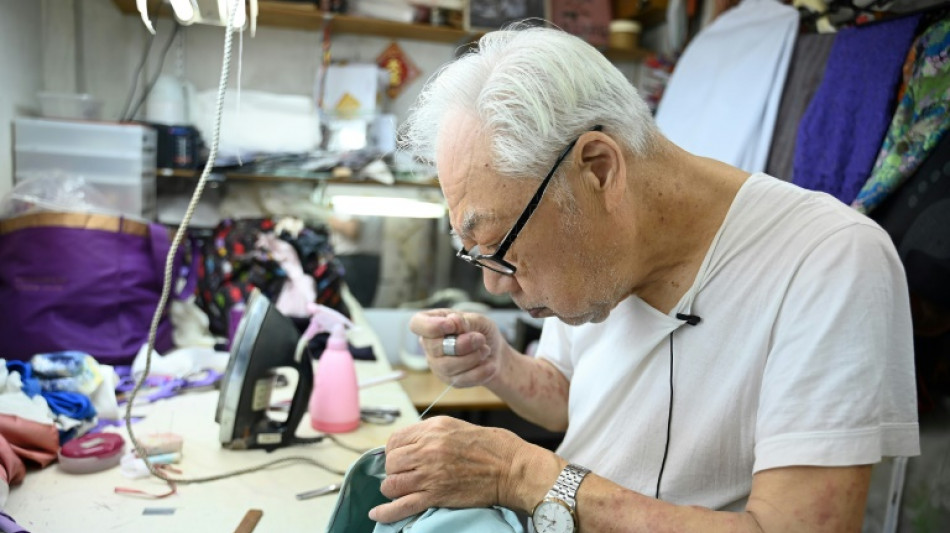
Hong Kong cheongsam master in the mood to retire after 75 years / Photo: Peter PARKS - AFP

 FIFA chief Infantino hit by Norwegian double complaint

 Exiled Catalan separatist leader Puigdemont cleared to return to Spain

 Stock markets climb as oil prices retreat

 'No future': Thousands mass in France for high school protests

 Nobel physics prize honours work on 'ghostly messengers' from outer space

 Bulgaria searches for missing crew after drones hit two more ships in Black Sea

 Le Pen vows drastic cost savings to prevent French 'default'

 'Eats through a straw': French teens wounded in high school protests

 Thousands mass in France for high school protests

 Moscow denies sanitary measures over plague reports

 Samoa look to recreate 2022 final run at Rugby League World Cup

 Asian stocks mostly up after tech-led Wall St record

 German factory orders plunge as recovery still fragile

 Coco Gauff calls out online racism following China open video review

 KVB Accelerates Middle East Footprint with Strategic MENA Regional Expansion

 Purple reign: Philippines seeks to keep grip on ube throne

 Seoul weighs steps to force North Korea landmine apology

 Yemen's Houthis say struck Riyadh airport, other Saudi sites
 Changer+ Launches Stablecoin-First Self-Custodial Wallet to Make Stablecoins Easier to Use

 White Sox down Guardians, Yankees on brink after Rays loss

 COP31 eyes modest steps as climate disasters multiply

 American Nobel laureate in medicine hopes to illuminate the brain

 Trump approves firing squad for convicted US military base shooter

 Grappling with 'homework scams,' US universities shun AI detectors

 Separatists win Quebec election in test for Canada PM

Bent over a magenta chiffon fabric, an elderly Hong Kong tailor wearing thick glasses meticulously stitched on embroidered butterflies, working to transform the shimmering material into an elegant, high-collared Chinese dress known as a cheongsam.
At 88, Yan Kar-man is one of Hong Kong's oldest master tailors of the cheongsam -- literally "long clothes" in Cantonese -- a dress recognisable for its form-fitting silhouette which was famously featured in Wong Kar-wai's film "In the Mood for Love".
Experts say the silver-haired tailor is among roughly 10 remaining cheongsam-makers in Hong Kong, which in the mid-1960s used to have about 1,000, according to records from the Shanghai Tailoring Workers General Union.
But after dressing generations of women ranging from housewives to movie stars like Michelle Yeoh and Shu Qi, Yan has decided he will hang up his measuring tape soon -- by the end of September at the earliest.
"I can't see clearly -- my eyes are not working well, and neither am I. I have to retire," he told AFP as he stooped closer to his sewing machine to tack on an embroidered border on the dress.
With about 10 more dresses to finish, Yan hesitated to give an exact closing day for his tiny workshop located in the bustling Hong Kong commercial district of Jordan.
Evolved from the long robes worn by Manchurian people in China's Qing dynasty, cheongsams have dominated the wardrobes of ordinary Chinese women for much of the 20th century since it was popularised in Shanghai in the 1920s.
Its high-neck collars, knee-length slits and streamlined fits evoked a sense of city glamour, and by the 1960s the dress was everywhere in Hong Kong.
"Women would wear them to shop in wet markets," recalled Yan, whose workshop walls are plastered with photos of beauty pageant queens wearing his dresses.
Some of his celebrity customers have even reached out for major life events -- like Liza Wang, a Hong Kong diva nicknamed "Big Sister" in entertainment circles, who has been his client for three decades.
"I didn't know it was for her wedding when I made her a dress with one of her scarves and turned the scraps into a tie for her groom," Yan said.
-'Critically endangered'-
Born in Jiangsu province, China, north of Shanghai, Yan was 13 when his uncle brought him to Hong Kong in 1949 to work as an apprentice in a workshop, where the school dropout was discovered to be a young talent.
At that time, the trade for cheongsam was so common and stable that Yan recalled a plain design would cost "just a few (Hong Kong) dollars".
Western fashion became popular after World War II, and the rise of the garment manufacturing sector in Hong Kong squeezed the cheongsam out of the fashion limelight while pushing tailoring workshops out of business.
Today, the traditional technique to make the dress is "critically endangered", said Brenda Li, an adviser to the Hong Kong Cheongsam Association.
"Hong Kong's cheongsam-making has developed its own style and tradition in the past century, merging skills of dimensional cutting from the West," Li told AFP.
"Few people still wear and care about it, but we want to preserve it no matter how niche it has become because it's part of our culture."
Though cheongsam-making technique has been recognised as part of Hong Kong and mainland China's cultural heritage, Yan said the withered trade offers little chance to pass on his craft.
"You can't make a living by making qipao because it's no longer the trend," Yan said, using the Mandarin word for the dress.
The master -- who also teaches at a learning centre near his shop -- said his students were "far from ready to make real clothes for clients".
Nowadays, orders typically come from older women who need a statement dress to attend their children's weddings, and each piece takes Yan weeks to finish and costs several thousand Hong Kong dollars (hundreds of US dollars).
"How many old clients are still out there, and how many pieces of such detailed work can you make every month?" Yan asked rhetorically.
"My generation is mostly gone."
R.Veloso--PC