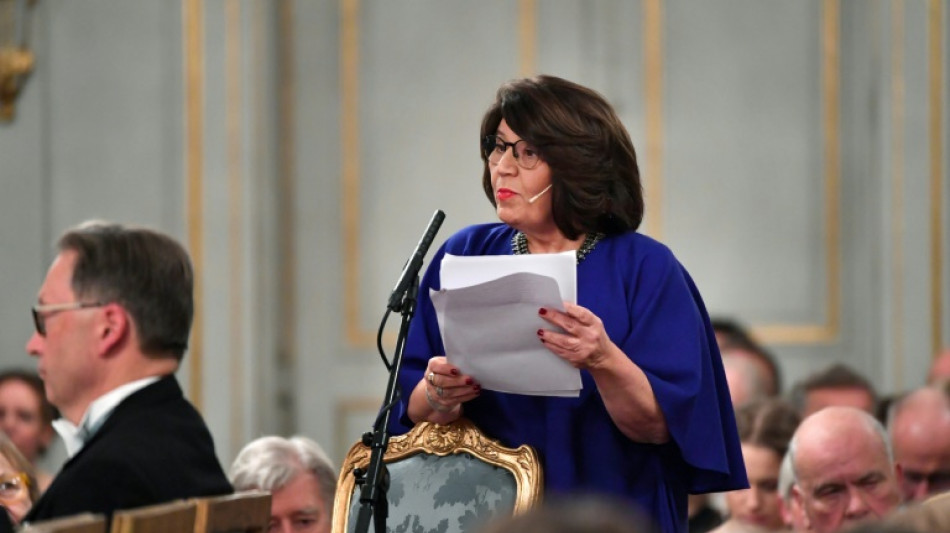
Jila Mossaed, from refugee poet to Swedish Academy / Photo: Henrik MONTGOMERY - TT News Agency/AFP

 FIFA chief Infantino hit by Norwegian double complaint

 Exiled Catalan separatist leader Puigdemont cleared to return to Spain
 Stock markets climb as oil prices retreat

 'No future': Thousands mass in France for high school protests
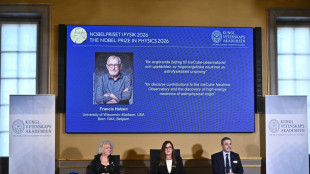 Nobel physics prize honours work on 'ghostly messengers' from outer space

 Bulgaria searches for missing crew after drones hit two more ships in Black Sea
 Le Pen vows drastic cost savings to prevent French 'default'

 'Eats through a straw': French teens wounded in high school protests

 Thousands mass in France for high school protests

 Moscow denies sanitary measures over plague reports

 Samoa look to recreate 2022 final run at Rugby League World Cup

 Asian stocks mostly up after tech-led Wall St record

 German factory orders plunge as recovery still fragile

 Coco Gauff calls out online racism following China open video review

 KVB Accelerates Middle East Footprint with Strategic MENA Regional Expansion

 Purple reign: Philippines seeks to keep grip on ube throne
 Seoul weighs steps to force North Korea landmine apology

 Yemen's Houthis say struck Riyadh airport, other Saudi sites

 Changer+ Launches Stablecoin-First Self-Custodial Wallet to Make Stablecoins Easier to Use

 White Sox down Guardians, Yankees on brink after Rays loss

 COP31 eyes modest steps as climate disasters multiply

 American Nobel laureate in medicine hopes to illuminate the brain
 Trump approves firing squad for convicted US military base shooter

 Grappling with 'homework scams,' US universities shun AI detectors
 Separatists win Quebec election in test for Canada PM

Jila Mossaed fled Iran for Sweden in 1986, a 38-year-old poet who spoke no Swedish. Three decades later, she became the first foreigner inducted into Sweden's highest language authority, the Swedish Academy, which awards the Nobel Prize in Literature.
Now she writes in Farsi and Swedish, but Mossaed struggled for years to learn Swedish and still stumbles over pronunciation, she told AFP in the halls of the Academy, founded in 1786 by King Gustav III to promote the Swedish language and literature.
The 76-year-old, whose work explores life, death, politics, love, exile and nature, never expected to join the Academy in 2018.
The 18 Academy members are appointed for life.
"It's such an unbelievable honour. I'm so proud of it," she said, her dark eyes beaming.
Mossaed is tight-lipped on the Nobel prize to be announced Thursday, but says she sees her Academy role in general as broadening horizons.
"I carry with me an ancient, rich language spoken by 300 million people."
"To open new windows to unknown literature and introduce it is an interesting and important contribution," she said.
In 1986, Mossaed fled Iran with her two young children after a book of her poetry received "very threatening and humiliating" criticism from the Islamic Republic's authorities.
"Soldiers came to my house with weapons and took many things," she recalled.
She was summoned to a censorship office. "When I left I thought, 'This isn't my country anymore'."
"I had no plan. I didn't know what it meant to be a refugee or which country I would end up in."
A smuggler told her Sweden and Denmark were easiest to get to.
She knew of Ingmar Bergman, August Strindberg and Pippi Longstocking, so Sweden it was.
- 'The North is my grave' -
For the first two years, she spoke only English and bought no curtains, thinking she would not stay long.
But eventually, "I realised I had to learn the language. It was hard," she said, speaking fluent but accented Swedish.
When she began writing in Swedish, "it was like there was a corpse beside me, and on it, it said 'Farsi'."
"It started gasping for air. 'I'm going to die,' it said."
"I said, 'No, don't die. I'm going to write in Farsi too, I won't forget you."
After 10 years she had written 13 poems in Swedish.
"I realised I had left my cradle and the North was my grave."
Mossaed has published 10 poetry collections in Swedish since her first book, "Månen och den eviga kon" (The Moon and the Eternal Cow), in 1997.
She insists she is still "not very good at Swedish" -- she jokes about her pronunciation and takes her time on grammar. That is unexpected for a member of an academy revered as bearers of high culture and defenders of the language.
But rather than get stuck on details, "I wanted to approach the language's soul," which she describes as "tranquility", "silence" and "nature".
"I appreciate so much that people here don't get worked up over things like religion."
- Openly critical -
Her writing changed in Sweden.
In Iran, "we're used to being put under pressure by mullahs, religion and kings, so we've always found a way to write around that."
"I didn't want to do that in Sweden, I want to be straightforward. I love the truth."
Born into a non-religious family, Mossaed is now openly critical of the Iranian government in her poetry and occasional commentaries.
"I'm glad that people now understand what it means when Islam takes power," she said, labelling the current government "brutal".
"They kill people, execute people, humiliate and whip women."
She believes the government's power is coming to an end, as Iranians "now dare to criticise and ask questions".
But "it will take time and it will be bloody. The people will pay a high price."
While her Swedish poems are "braver, politically", the language is "simpler".
When she writes in Farsi, "it's like diving into an ocean of words".
"When I write in Swedish, it's like I'm standing beside a pool."
"I'm happy that the simplicity gave me more freedom. And the critics say it's good!" she said with a laugh.
Her poems come to her suddenly, "like brain attacks", but it has been months since a poem came to her in Farsi, and she dreams and writes grocery lists in Swedish these days.
Mossaed lived in Sweden's western province of Varmland for many years. It was hard to get to know people, but she learned to love the forest.
Walking in the woods, she would reach out to touch branches.
"I said 'Taste my hand, it comes from the desert'."
"Sometimes I think the forest accepted me faster than people did."
J.Pereira--PC