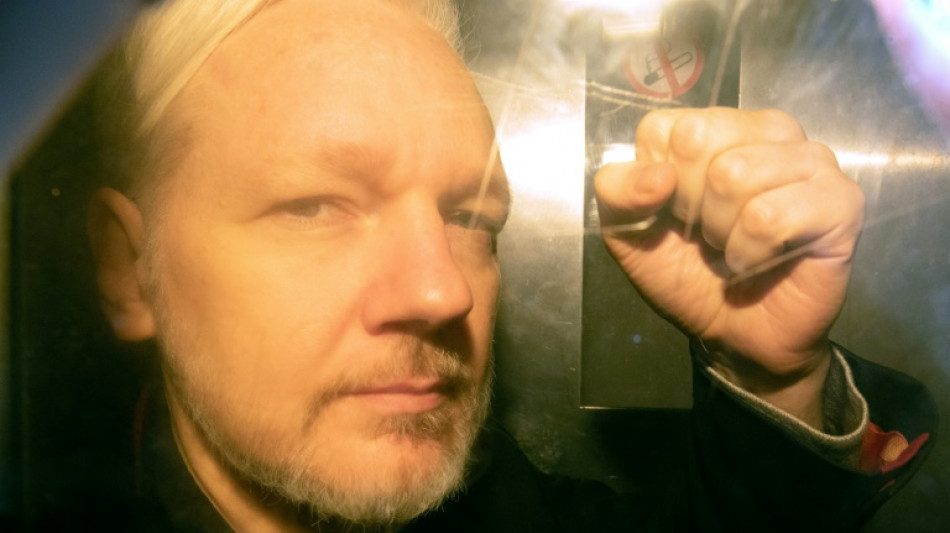
Assange vows to fight UK approval of extradition to US / Photo: Daniel LEAL - AFP/File

 World No.1 Sinner pulls out of Shanghai Masters to delay return

 Red Bull's Verstappen grabs pole position for Bahrain GP

 India beat Pakistan in blockbuster as golfer Kim wins 'crazy' gold

 India beat arch-rivals Pakistan to win Asian Games cricket gold

 Ethiopia's Tigray rebels abandon regional capital as govt advances: journalist

 Tom Kim powers to Games gold and exemption from military service

 Split loyalties for Indian football fans at Brazil friendly

 India-Pakistan blockbuster brings cricket fever to Japan baseball field

 Wong waiting on Rafa after winning Asian Games tennis gold

 With Russia next door and rising costs, Latvia goes to the polls

 Penalty hero rues empty seats as Games hosts Japan win football gold

 North Korea fires ballistic missile after Seoul's apology demand

 US regulator finds Boeing 737 MAX software bug 'not a safety concern'

 Ohtani 'managing' injuries as Dodgers launch MLB post-season

 Botched US execution leaves murderer unconscious on ventilator: lawyers
 Cornell rape case exposes sexual violence at US colleges
 France held by Italy in Zidane's homecoming after Olise stunner

 Ethiopian pro-government militia claims Tigray airport as regional tensions spike

 Ohtani shaking off injuries as Dodgers launch MLB post-season
 Sea levels to rise in California as coastal wave surges up west coast
 New rallies urged in France as protests disrupt over 730 schools

 Djokovic survives China Open scare, Sabalenka starts strong
 King Charles to evoke colonial 'darkest days' on Caribbean tour

 Tesla shares jump after global car sales top estimates

 DR Congo Ebola outbreak killed more than 4,000: official figures

Supporters of Julian Assange on Friday vowed to fight his extradition to the United States after Britain approved a US request for the WikiLeaks founder to face trial over the publication of secret military files.
"We're not at the end of the road here. We're going to fight this. We're going to use every appeal avenue," Stella Assange, who married the Australian publisher earlier this year, told reporters.
His lawyer, Jen Robinson, urged US President Joe Biden to drop the charges and called on the Australian government to press for her client's release.
"We will appeal this all the way through the British courts and if necessary to the European Court of Human Rights," she added.
The Assange case has become a cause celebre for media freedom and his supporters accuse Washington of trying to muzzle reporting of legitimate security concerns.
He is wanted to face trial for violating the US Espionage Act by publishing military and diplomatic files in 2010 and could face up to 175 years in jail if found guilty, although the exact sentence is difficult to estimate.
The UK interior ministry earlier announced that Home Secretary Priti Patel had approved the extradition order but that he had 14 days to appeal.
- 'Dark day' -
That sets up yet another court hearing in the long-running legal saga, which began in 2010 after WikiLeaks published more than 500,000 classified US documents about the wars in Iraq and Afghanistan.
His supporters have held frequent rallies to protest the planned deportation, accusing Washington of a politically motivated campaign as Assange, 50, had exposed US war crimes and a cover-up.
WikiLeaks said the decision was a "dark day for press freedom and for British democracy" and alleged that Assange had been on a CIA hit-list.
"Julian did nothing wrong. He has committed no crime and is not a criminal. He is a journalist and a publisher, and he is being punished for doing his job," the group said in a statement.
Extradition was a work of "revenge" and an attempt to "try to disappear him into the darkest recesses of their prison system for the rest of his life to deter others from holding governments to account".
Amnesty International said the government's approval of the extradition "sends a chilling message" to journalists and exposed Assange to torture and ill-treatment if he were kept in solitary confinement.
The human rights monitor's secretary-general Agnes Callamard said diplomatic assurances that he would be well treated were not to be trusted, she added.
- No grounds -
The Home Office, however, said there were no grounds for Patel to block the extradition order, which was made on April 20.
"In this case, the UK courts have not found that it would be oppressive, unjust or an abuse of process to extradite Mr Assange," a spokesperson said.
"Nor have they found that extradition would be incompatible with his human rights, including his right to a fair trial and to freedom of expression, and that whilst in the US he will be treated appropriately, including in relation to his health."
Legal experts said Assange's decision to appeal sets up potentially months of legal hearings.
He would first need permission to appeal from the High Court. If that was granted, the hearing might not be until early next year.
"He could also make an application to the European Court of Human Rights," said Kate Goold, an extradition lawyer at London firm Bindmans.
- 'Lengthy process' -
"Once you get to the European Court of Human Rights, it's a very, very slow process," added another specialist Rebecca Niblock, from lawyers Kingsley Napley.
"Extradition is a very lengthy process and it is very unlikely that this will be the end of it."
Assange has been held on remand at a top-security jail in southeast London since 2019 for jumping bail in a previous case accusing him of sexual assault in Sweden.
That case was dropped but he was not released from prison after serving time for breaching bail on the grounds he was a flight risk in the US extradition case.
Assange, who got married behind bars in March, spent seven years at Ecuador's embassy in London to avoid being removed to Sweden.
He was arrested when the government changed in Quito and his diplomatic protection was removed.
X.Matos--PC