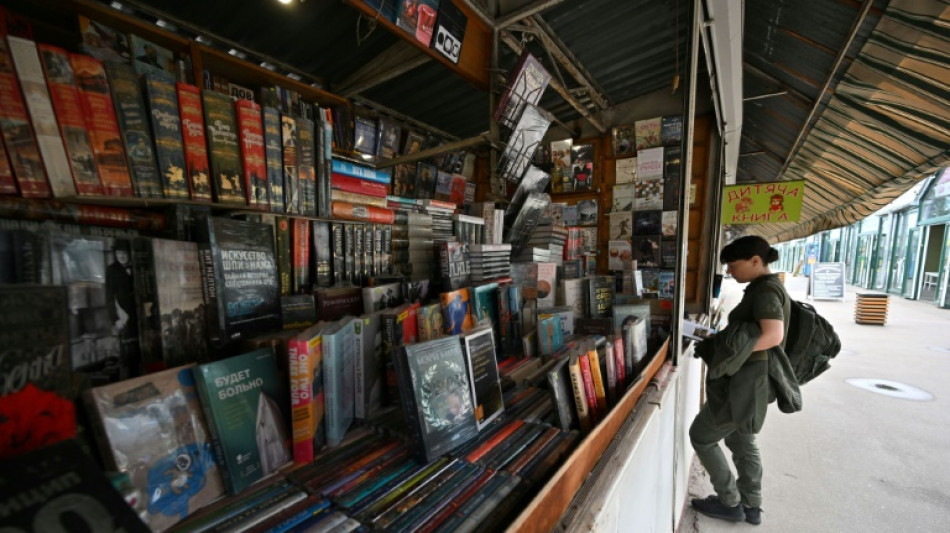
Kyiv's plans to ban works in Russian divide book lovers / Photo: Sergei SUPINSKY - AFP

 World No.1 Sinner pulls out of Shanghai Masters to delay return

 Red Bull's Verstappen grabs pole position for Bahrain GP

 India beat Pakistan in blockbuster as golfer Kim wins 'crazy' gold

 India beat arch-rivals Pakistan to win Asian Games cricket gold

 Ethiopia's Tigray rebels abandon regional capital as govt advances: journalist

 Tom Kim powers to Games gold and exemption from military service

 Split loyalties for Indian football fans at Brazil friendly

 India-Pakistan blockbuster brings cricket fever to Japan baseball field

 Wong waiting on Rafa after winning Asian Games tennis gold

 With Russia next door and rising costs, Latvia goes to the polls

 Penalty hero rues empty seats as Games hosts Japan win football gold

 North Korea fires ballistic missile after Seoul's apology demand

 US regulator finds Boeing 737 MAX software bug 'not a safety concern'

 Ohtani 'managing' injuries as Dodgers launch MLB post-season

 Botched US execution leaves murderer unconscious on ventilator: lawyers

 Cornell rape case exposes sexual violence at US colleges

 France held by Italy in Zidane's homecoming after Olise stunner

 Ethiopian pro-government militia claims Tigray airport as regional tensions spike

 Ohtani shaking off injuries as Dodgers launch MLB post-season

 Sea levels to rise in California as coastal wave surges up west coast
 New rallies urged in France as protests disrupt over 730 schools
 Djokovic survives China Open scare, Sabalenka starts strong
 King Charles to evoke colonial 'darkest days' on Caribbean tour
 Tesla shares jump after global car sales top estimates

 DR Congo Ebola outbreak killed more than 4,000: official figures

Ukraine plans to ban many books in Russian as part of a wartime battle against propaganda, but the new law has divided both literature fans and booksellers alike.
"We must not confuse Russian fascism with Russian culture," said Olexander Drobin, a bookseller at the massive Petrivka book market in the capital, Kyiv.
"They made this law but nobody knows how to apply it. Should we take these books, pile them up in the street and burn them?"
Anatoli Gounko, another bookseller at the market, whose wares are almost all in Ukrainian, said the law was "necessary".
However, he said that even he finds it "a bit harsh to say you should speak Ukrainian and not Russian".
"Why should Russian only belong to Russia? Three hundred million people around the world speak Russian."
Ukraine's parliament approved several bills on June 19 aimed at "protecting culture from Russian propaganda".
The new laws will enter into force once they are signed by President Volodymyr Zelensky.
They ban all books published in Russia and Belarus, Moscow's close ally in the war against Ukraine -- regardless of the author.
Anyone breaking the law faces a fine.
The use on television and in public venues of Russian music composed after 1991 is also outlawed.
But enforcing the laws could be tricky.
Books printed in Russian but published in Ukraine or countries other than Russia and Belarus would theoretically still be allowed -- as long as they were originally written in Russian and the author is not considered "hostile" to Ukraine.
Major classics of Russian literature, such as works by Pushkin and Tolstoy, would also be spared.
- 'Concentrate on defending the country' -
Four months after Russia invaded Ukraine on February 24, the new texts strengthen the legislative arsenal built up over recent years to "de-communise" and "de-Russify" the former Soviet republic and promote the Ukrainian language.
But Drobin is unconvinced.
"These (latest) laws go too far. Some people probably wanted to show they were true patriots but this is not the way to do it.
"Half the population are Russian speakers and Russian culture is important. There are lots of good things in Russia's history," he said.
He said the government should "concentrate on defending the country".
Gounko begged to differ.
"To quote the Romans: 'The law may be tough but still law'," he said.
Nadia, a bookseller who did not wish to give her surname, also defended the new laws.
"When the war started, people began reading books in Ukrainian. We have plenty of excellent writers," she said.
"It (the ban) is more something that concerns people who sell recently published books," she said.
- 'Dead to me' -
Book lovers also appear divided.
"There are more pressing problems. This is infantile," sniffed Natasha Sikorska, a customer at the market.
"I don't agree at all with banning Russian literature. It's not Russian propaganda. It's history. It's education," she said.
Her friend, who declined to be identified, disagreed.
"I've read a lot of Russian literature. I liked it then and I like it now. But honestly, since February 24 it's dead to me," she said.
T.Vitorino--PC