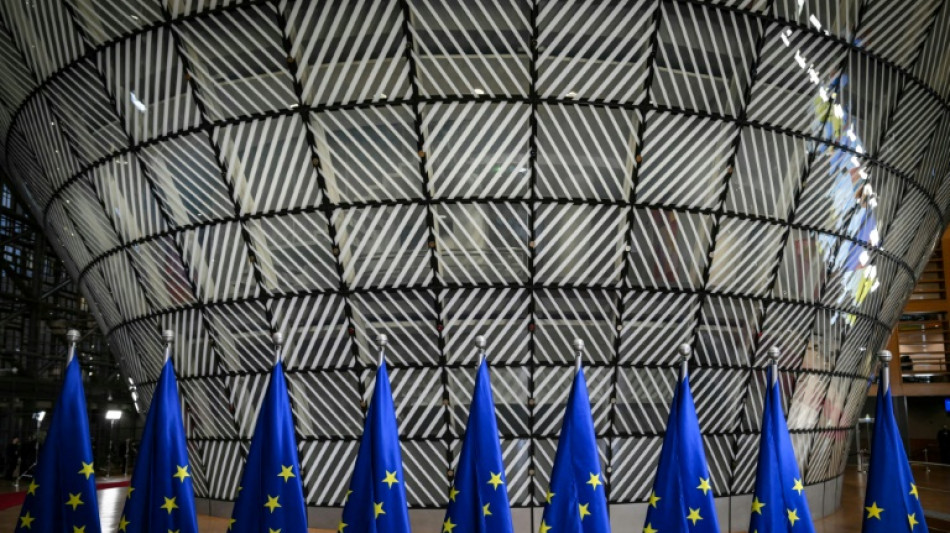
EU to invite Taliban officials to Brussels for migrant return talks / Photo: NICOLAS TUCAT - AFP

 Man Utd agree deal for Brighton midfielder Baleba: reports
 Werro wins Lausanne 800m, well off world record pace

 China mulls bid to host 2028 UN climate talks: sources

 Jones becomes third Englishman to join Inter this summer

 Mexican governor wanted on US drug charges returns to job

 Bolivia's Paz forced to fire economy minister in mid-crisis

 A-Rod ups T-Wolves stake in $4.5bn ownership change

 UK court orders Prince Harry, others to pay Daily Mail initial £9.5mn

 'Grateful' ex-world champion Alaphilippe retires from cycling

 US, Canada work to wrap up trade deal ahead of looming deadline

 Malaysia's JDT claim unbeaten run world record

 At least 2 teens seriously wounded in sword attack at Swedish school
 Popular forest near Paris to reopen after wildfire

 UN holds second informal poll of secretary-general candidates

 Shakhtar Donetsk to play Champions League home games at Chelsea

 Arsenal sign Villa centre-back Konsa as champions bolster defence

 The 'hedgehogs' leading Poland's defences on Russian border
 England thrash Pakistan by an innings and 103 runs in first Test

 Fury says Joshua fight 'doesn't look like it's going to happen'
 Argentina's Paredes suspended 10 matches by FIFA for World Cup fight

 Watkins and Martinez could join Villa exodus says Emery

 UK court orders Prince Harry, others to pay Daily Mail £9.5mn

 Aligned Launches $ALIGN, the Native Token of Its Full Ethereum Stack
 Bitcoin jumps, stocks bounce as traders weigh US Treasury action

 Man City boss Maresca hit with Doku injury blow

The European Commission told AFP Monday it plans to invite Taliban officials to Brussels in the near future for talks on returning migrants to Afghanistan.
According to sources close to the matter, a letter is to be sent "imminently" to Kabul to arrange a date for a meeting in the Belgian capital.
The visit, coordinated with Sweden, would follow two trips by European officials to Afghanistan on the same issue.
Officials are now "working on a potential follow-up meeting at technical level in Brussels with the de-facto authorities in Afghanistan," a spokesperson for the EU executive said.
No specific date has yet been raised for the visit.
- Letter from 20 countries -
As part of a broader tightening of immigration policies, around 20 EU countries are exploring how to return migrants -- particularly those with criminal convictions -- to Afghanistan.
In an October letter, several urged the EU to find diplomatic and practical ways to move the issue forward.
"In this context a technical meeting took place in Kabul in January 2026," the commission spokesperson said, adding that the EU was now working jointly with Sweden to "pursue these discussions" in Brussels.
Such visits raise a host of practical and ethical questions, not least because they involve engaging with Taliban authorities, which are not formally recognised by the European Union.
The Taliban have been largely isolated on the global stage since they imposed a strict version of Islamic law upon returning to power in 2021.
To enter Belgium, which hosts the EU institutions, Taliban officials would need to be granted exemptions -- something Belgian authorities appear, in theory, prepared to do.
Beyond the practicalities, the European push on returns comes as Afghanistan confronts a severe humanitarian crisis.
Since 2023, more than five million Afghans have returned from Iran and Pakistan, often forcibly. According to international organisations, most of them live in extreme hardship, without stable housing or employment.
- Germany leads charge -
EU countries received about a million asylum applications filed by Afghans between 2013 and 2024, according to the bloc's data agency. About half as many were approved over the period.
In 2025, Afghans still -- by far -- accounted for the largest share of asylum applicants in the EU.
But as the public mood has soured on migration, Europe has looked to scale back its welcome -- and started discussing how to send Afghan migrants back home.
Some countries have pushed ahead, with Germany deporting more than 100 Afghans with criminal convictions since 2024, via charter flights facilitated by Qatar.
Attitudes in the country have been hardened by a string of deadly attacks by Afghans in recent years, including a car-ramming in Munich last year.
Austria has followed suit, receiving a delegation of Taliban representatives in Vienna in mid-September.
A number of other EU member states, including Belgium and Sweden, are looking to emulate their example, with enthusiastic backing from migration hawks.
The returns drive has drawn sharp criticism from NGOs and the political left.
"Deporting Afghans back to a country where almost half of the population cannot feed themselves is not a migration policy; it is a decision that could cost lives," says Lisa Owen, the International Rescue Committee's country director for Afghanistan.
Other migrant rights groups fear that a visit to Brussels could allow Taliban officials to identify individuals they want returned to Afghanistan, potentially putting their fundamental rights at risk.
Several diplomatic sources contacted by AFP counter that the visit is first and foremost intended to resolve practical issues -- such as how to issue passports to people whose embassies in Europe are not recognised by the Taliban authorities.
During their trips to Afghanistan, European officials similarly looked into the handling capacity of Kabul airport and other technical details, according to sources close to the talks.
J.Oliveira--PC