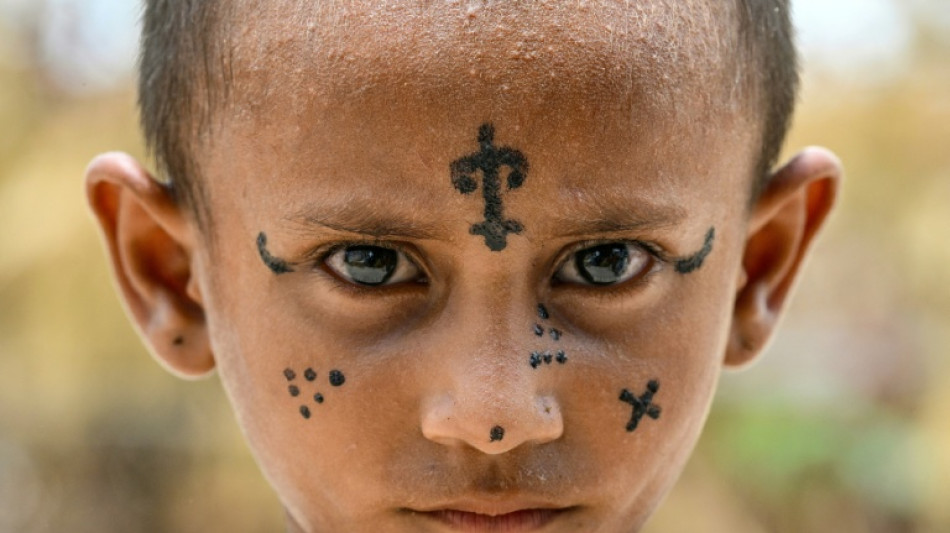
City girls snub traditional Hindu face tattoos in Pakistan / Photo: Asif HASSAN - AFP

 Asian Games set to close after records, rancour and rain

 Cry for help as French-Swiss lake dries up

 Sabalenka swept out of China Open in third round

 US urges 'restraint' as Ethiopia's Tigray crisis rocks region

 Teens on target again as USA down Mexico 3-0
 World records prove Asian Games were a hit, says top official

 US prison chief who oversaw botched execution resigns

 'Chaotic' Asian Games threaten Japan hopes of hosting Olympics again
 Finnish town braces for change from Google data centres
 What is fuelling French school protests?

 Without lawyers, migrant children face deportation from the US
 Three-peat seeking Dodgers open playoffs with a win, Rays hold off Yankees

 Brazil votes in nail-biter polls closely watched by Trump

 'Just be you': Kim reveals Tiger text that inspired him to gold

 Myanmar migrants returned to war-torn nation from Malaysia

 ALEX BODI AND AMBASSADOR GUM DOMINIC MATIOK OF THE REPUBLIC OF SOUTH SUDAN MEET IN BERLIN TO DISCUSS THE POSSIBILITY OF AN HONORARY CONSULATE IN BUCHAREST

 Lula, Bolsonaro wrap up campaigns ahead of Brazil's knife-edge vote

 Toulouse edge Castres in Top 14 derby

 Murakami homer propels White Sox to MLB playoff win over Guardians

 Israel targets top Hamas leader in deadly Gaza strike on anniversary

 Houthis say struck oil facility near Riyadh, as Saudis hit Sanaa

 AI needs safety layers like nuclear plants: ex-OpenAI engineer

 MVP Judge will miss Yankees' MLB playoff series against Rays

 New lizard species discovered in Peru

 Fernandes hails Portugal's 'greatest symbol' Ronaldo, calls for unity

Grinding charcoal with a few drops of goat's milk, 60-year-old Basran Jogi peers at the faces of two small Pakistani sisters preparing for their first tattoos.
The practice of elder women needling delicate shapes onto the faces, hands, and arms of younger generations stretches back centuries in the Hindu villages that dot the southern border with India.
"First draw two straight lines between the eyebrows," Jogi instructs her friend poised with a sewing needle.
"Now insert the needle along the lines – but slowly, until it bleeds."
Six-year-old Pooja barely winces as dotted circles and triangles are tattooed onto her chin and forehead.
On the outskirts of the rural town of Umerkot in Sindh province, her seven-year-old sister Champa declares eagerly beside her that "I am ready too".
In recent years, however, as rural Hindu communities in Muslim-majority Pakistan become more connected to nearby cities, many young women have opted out of the "old ways".
"These signs set us apart from others," said 20-year-old Durga Prem, a computer science student who grew up in the nearby city of Badin.
"Our generation doesn't like them anymore. In the age of social media, young girls avoid facial tattoos because they think these marks will make them look different or unattractive."
Her sister Mumta has also refused to accept the tattoos that mark their mother and grandmothers.
"But if we were still in the village, we might have had these marks on our faces or arms," she reflects.
- Ward off evil spirits -
Just two percent of Pakistan's 240 million people are Hindu, and the majority live in rural areas of southern Sindh province.
Discrimination against minorities runs deep and Hindu activist Mukesh Meghwar, a prominent voice for religious harmony, believes younger generations do not want to be instantly identified as Hindu in public.
Many Muslims believe tattoos are not permissible in Islam, and even those who have them rarely display them in public.
"We can't force our girls to continue this practice," Meghwar told AFP. "It's their choice. But unfortunately, we may be the last generation to see tattoos on our women's faces, necks, hands, and arms," he said.
Few Hindus that AFP spoke with recalled the meaning behind the practice of tattoos or when it began, but anthropologists believe it has been part of their cultural heritage for hundreds of years.
"These symbols are part of the culture of people who trace their roots to the Indus civilisation," anthropologist Zulfiqar Ali Kalhoro told AFP, referring to a Bronze Age period that pre-dates modern religion.
"These 'marks' were traditionally used to identify members of a community" and to "ward off evil spirits", he adds.
Admiring the work on the grinning faces of the two little sisters, elder Jogi agreed that it was an ancestral tradition that enhanced the beauty of women.
"We don't make them for any specific reason – it's a practice that has continued for years. This is our passion," she told AFP.
The marks that begin dark black quickly fade to a deep green colour, but last a lifetime.
"They belong to us," said Jamna Kolhi, who received her first tattoos as a young girl alongside Jogi.
"These were drawn by my childhood friend –- she passed away a few years ago," 40-year-old Jamna Kolhi told AFP.
"Whenever I see these tattoos, I remember her and those old days. It's a lifelong remembrance."
C.Cassis--PC
