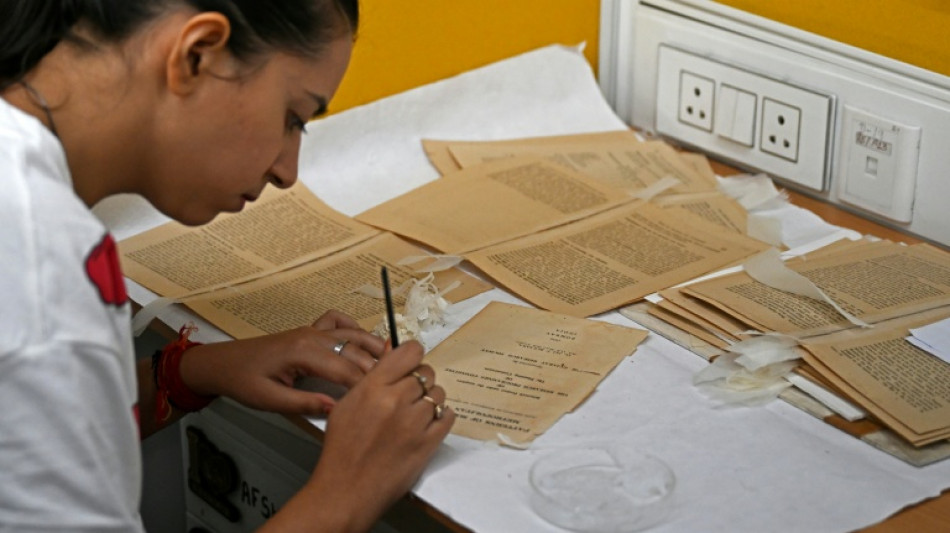
Indian heritage restorers piece together capital's past / Photo: Money SHARMA - AFP

 2027 Toyota Sienna Gets Sixth-Gen Hybrid System, More Power, and Trim Changes

 Burnham Government Announces Neighbourhood Support Teams to Reduce Hospital Admissions

 KFF Health News Readers Weigh In on Healthcare Policy, Ethics, and Workforce Shortages

 16-Year-Old Founder Targets 'Cost Per Kill' With AI Missile Startup

 Elon Musk Promises Steering-Wheel-Free Tesla Model Y Amid Cybercab Sales Launch

 Tosca's 2026 Sustainability Report Makes the Case for Packaging as Critical Supply Chain Infrastructure

 Eisai's Dayvigo Shows Year-Long Efficacy Without Tolerance Ahead of Korean Launch
In a climate-controlled room in India's capital, restorers carefully piece together rare historical documents and artefacts to rescue irreplaceable fragments that provide a unique window into New Delhi's past.
Experts at the Indira Gandhi National Centre for the Arts (IGNCA) painstakingly revive crumbling maps and photographs that help track the development of the sprawling megacity now home to more than 30 million people.
The work helps forge a more nuanced understanding of a multi-faith metropolis that has undergone successive waves of settlement and change over several millennia.
"We are preserving memory," said Achal Pandya, who leads the IGNCA conservation lab. "And a country which doesn't have a memory is nothing."
Among the most prized artefacts being restored are the Wilson survey maps, a trove of around 250 documents produced between 1910 and 1912 by a British colonial officer.
They focused on Old Delhi, the former walled capital founded in the 17th century as the Mughal capital Shahjahanabad.
Alongside the maps are meticulous registers of who lived where.
"You are not just taking a map, but you are also giving information about the people there," said Sanjeev Kumar Singh, part of the heritage restoration team from New Delhi's city council.
Years of neglect have left the fragile documents even more vulnerable -- a situation worsened by the city's punishing climate, which shifts from searing summer heat to the humid monsoon to winter chills that can trap some of the world's worst air pollution.
Without the preservation that began in 2022, they would have crumbled away, according to the restorers.
"The importance of this is as much as a dying person needing oxygen," Singh told AFP.
P.Serra--PC