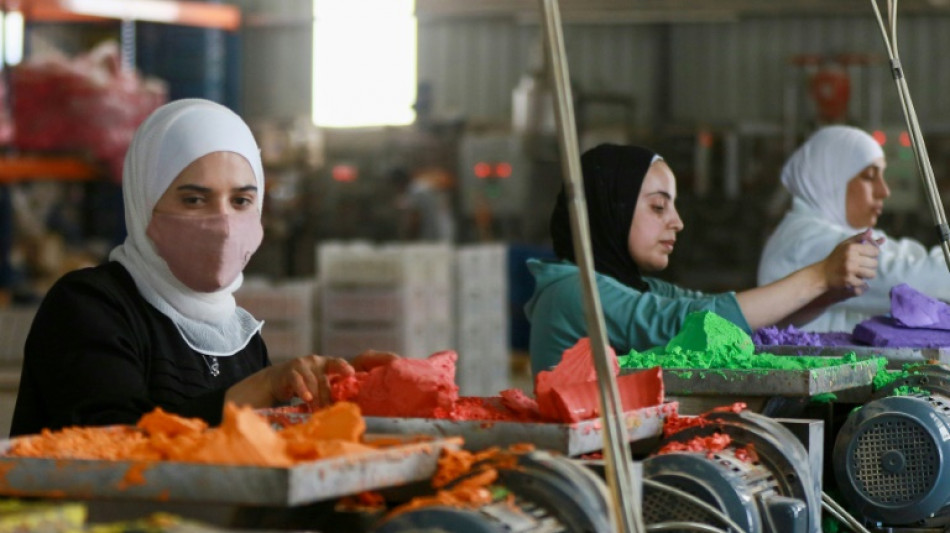
Jordan chalks up business success from limestone riches / Photo: Khalil MAZRAAWI - AFP

 World No.1 Sinner pulls out of Shanghai Masters to delay return

 Red Bull's Verstappen grabs pole position for Bahrain GP

 India beat Pakistan in blockbuster as golfer Kim wins 'crazy' gold

 India beat arch-rivals Pakistan to win Asian Games cricket gold

 Ethiopia's Tigray rebels abandon regional capital as govt advances: journalist

 Tom Kim powers to Games gold and exemption from military service

 Split loyalties for Indian football fans at Brazil friendly

 India-Pakistan blockbuster brings cricket fever to Japan baseball field
 Wong waiting on Rafa after winning Asian Games tennis gold

 With Russia next door and rising costs, Latvia goes to the polls

 Penalty hero rues empty seats as Games hosts Japan win football gold

 North Korea fires ballistic missile after Seoul's apology demand

 US regulator finds Boeing 737 MAX software bug 'not a safety concern'

 Ohtani 'managing' injuries as Dodgers launch MLB post-season

 Botched US execution leaves murderer unconscious on ventilator: lawyers
 Cornell rape case exposes sexual violence at US colleges
 France held by Italy in Zidane's homecoming after Olise stunner

 Ethiopian pro-government militia claims Tigray airport as regional tensions spike
 Ohtani shaking off injuries as Dodgers launch MLB post-season
 Sea levels to rise in California as coastal wave surges up west coast

 New rallies urged in France as protests disrupt over 730 schools

 Djokovic survives China Open scare, Sabalenka starts strong

 King Charles to evoke colonial 'darkest days' on Caribbean tour

 Tesla shares jump after global car sales top estimates

 DR Congo Ebola outbreak killed more than 4,000: official figures
Long before whiteboards, beamers and laptops entered modern school classrooms, teachers relied on the humble, dusty, sometimes screechy blackboard chalk -- a material that has created a Jordanian business success story.
Chemical engineer Salah Aloqbi remembers sitting on a bus in Amman in 1995 when he hit on the idea that would lead him to create his company. More than two decades later it boasts 150 staff, with exports to more than 100 countries.
Chalk, a white, soft limestone, was formed aeons ago when the shells of tiny marine creatures were compressed on the sea floor -- and the landlocked Middle Eastern desert country of Jordan is blessed with vast deposits.
"It was a game-changing idea," recalled Aloqbi, now 49, who founded the Jordan Chalk Manufacturing Company.
"I was returning from work at the Jordan Carbonate Company when I heard a radio interview saying that the calcium carbonate produced by the company is used in various industries in Jordan -- except the chalk industry."
Aloqbi pondered how to make blackboard chalk, which was until then wholly imported, to gain extra value from the calcium carbonate that is also used to produce white cement, make soils less acidic, and toothpaste more abrasive.
Seven years later, he launched a small factory in Karak governorate south of Amman, with two rooms and just five workers, and started experimenting -- initially by pulverising the porous material with a meat mincer.
"But the chalk that we produced at that time was no longer used around the world, so we moved to produce dustless medical chalk," he said, referring to a carbonate-based type with larger particles.
- The right stuff -
Some 2,149 attempts later, the businessman said proudly, he hit the right formula for dustless chalk, creating a "very strong export opportunity" that now sees his company produce 10 billion pieces a year.
Jordan has a near endless supply of the raw material, with the ministry of energy and mineral resources estimating the country's "assets of limestone exceed 1.3 billion metric tons".
Limestone is the common form of calcium carbonate CaCO3, the main ingredient for chalk.
"It comes to mind that this is an outdated product, but the truth is that we are struggling to meet the great demand," Aloqbi said as he inspected hundreds of cartons heading to Britain and Germany, Mali and Morocco.
The chalk pieces come in a wide palette of colours and are used for art and play around the world.
The firm has also branched out into coloured crayons and modelling clay, and is the country's only producer of chalk sticks.
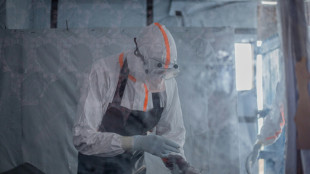
Today, the company sits on a 7,500 square metre plot and offers sought-after jobs in a country where the unemployment rate soared to 25 percent last year, about the same as the poverty rate.
"Most of us are from villages in Karak governorate," said one employee, 28-year-old Sundus Majali. "More than half of the workers are women."
At first, she said, "it was difficult for parents to allow females to work ... But today they have no problem with that, especially because the factory is safe, not like other workplaces."
Another colleague, Alaa Aloqbi, 33, said "the factory has provided job opportunities at a time when life became difficult".
A.P.Maia--PC