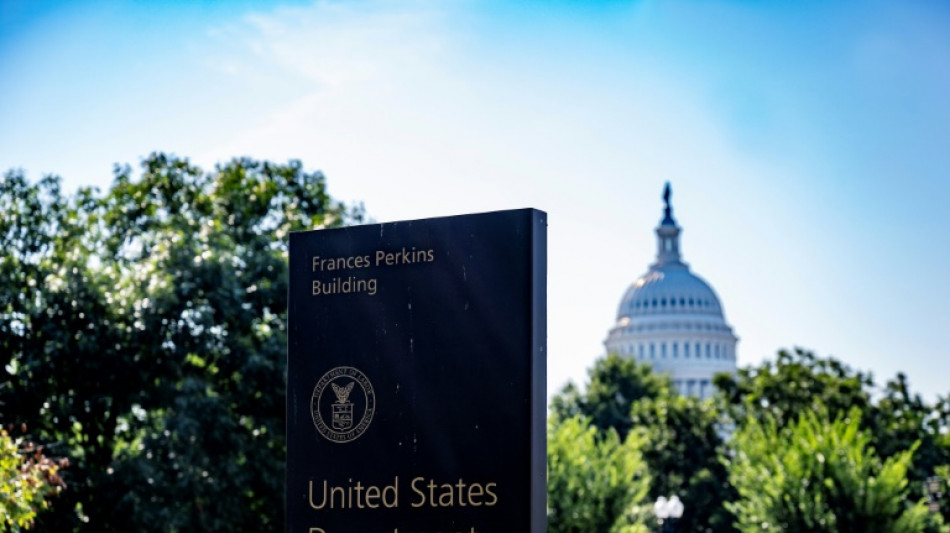
'My heart sank': Surging scams roil US job hunters / Photo: Jim WATSON - AFP

 ALEX BODI AND AMBASSADOR GUM DOMINIC MATIOK OF THE REPUBLIC OF SOUTH SUDAN MEET IN BERLIN TO DISCUSS THE POSSIBILITY OF AN HONORARY CONSULATE IN BUCHAREST

 Lula, Bolsonaro wrap up campaigns ahead of Brazil's knife-edge vote

 Toulouse edge Castres in Top 14 derby

 Murakami homer propels White Sox to MLB playoff win over Guardians

 Israel targets top Hamas leader in deadly Gaza strike on anniversary

 Houthis say struck oil facility near Riyadh, as Saudis hit Sanaa

 AI needs safety layers like nuclear plants: ex-OpenAI engineer

 MVP Judge will miss Yankees' MLB playoff series against Rays

 New lizard species discovered in Peru

 Fernandes hails Portugal's 'greatest symbol' Ronaldo, calls for unity

 Grandidier-Nkanang double takes Pau to Top 14 summit despite Vannes fightback

 Trainer Scott gets perfect Arc boost with top notch double

 Ex-PM says Putin cannot admit 'mistake' over Ukraine

 Houthis say Saudi Arabia launches dozens of strikes on Yemen capital

 Qatar and Abu Dhabi F1 Grand Prix to go ahead - F1 boss

 South Korea lift gloom with smash-and-grab Games football gold

 Ireland news conference before Israel game cut short amid tensions

 Protests over housing flare in Spain after relief measures rejected

 Zverev thrashes Shang to set up Djokovic quarter-final at China Open

 Turkey football ref chief jailed pending trial for graft

 North Korea says test of intermediate-range strategic missile included use of AI

 Rampant Sayers leads Hong Kong to third men's rugby gold in a row

 Ethiopia's Tigray rebels abandon regional capital as govt advances

 Bulgaria's Tsar Samuel returns 'home' after 1,000 years

 'Glad it's over': Kim powers to Games gold and military exemption

After a series of interviews, Nicole Becker was ecstatic to receive a job offer from a sportswear brand. But like many Americans navigating a tough job market, she was soon confronted with a sobering reality -- the recruiter was a scammer.
From fake job listings to fraudsters posing as real recruiters, employment scams are exploding online -- fueled by a cooling labor market and a boom in generative AI that experts say has made these schemes more sophisticated than ever.
In July, a purported Chinese brand offered Becker -- a 37-year-old based in Oregon -- a coveted role to lead global communications after an elaborate and legitimate-looking recruitment process that stretched over two weeks.
There were no red flags after an initial online interview with a supposed human resources official was followed by a call with someone calling himself the head of marketing and sales.
Then came the offer letter, accompanied by a detailed PowerPoint deck outlining her assigned role, budget, and performance targets for the first six months. Both parties promptly signed the agreement.
But a week later, during an onboarding meeting, Becker picked up the first hint that something was amiss.
She was told that the company's servers had been destroyed in California's wildfires. As a result, she would have to purchase a laptop and cellphone from a designated retailer herself, with the promise of reimbursement in her first paycheck.
"That's when my heart sank and I was like, 'oh no, I fell for a fake job,'" Becker told AFP, requesting that her real name be withheld.
"It is so scary because I consider myself to be a smart and clued-in person, especially with what's going on with AI and scams in general. If I can get scammed, I feel this can happen to anybody."
- 'Perfect storm' -
Employment-related scams jumped by over 1,000 percent from May through July, a period when new graduates typically search for jobs, according to the US firm McAfee.
Nearly 1 in 3 Americans report receiving job offer scams via text message, highlighting how "these schemes have moved beyond email into our daily conversations," McAfee said.
The firm's research shows victims lost an average of $1,471 per scam, with $12 billion reported lost to fraud last year, a 21 percent increase compared to the previous year.
"We're seeing a perfect storm of factors -- a tight labor market, where more people are urgently competing for fewer opportunities, is creating pressure that scammers exploit," Lisa Plaggemier, executive director of the nonprofit National Cybersecurity Alliance, told AFP.
"At the same time, generative AI has made it easier for bad actors to craft convincing fake postings, recruiter profiles, and even interview scripts.
"The combination means scams are harder to spot, and job seekers, especially first-time applicants, are more vulnerable than ever."
Becker's experience -- who immediately ceased all communication with the scammers -- illustrates a common scam tactic: fraudsters run a long con, counting on job seekers to let their guard down after clearing a few hurdles in the interview process.
- 'Candidate fraud' -
The Federal Trade Commission (FTC) recently warned consumers about "fake check scams," in which fraudsters pose as employers and send counterfeit checks, instructing victims to purchase equipment from selected vendors.
"If you get an offer that includes depositing a check and then using some of the money for any reason, that's a scam. Walk away," the FTC said.
Employers are also frequently targeted by scams.
In July, the FBI warned about North Korean scammers posing as Americans to "gain fraudulent employment and access to US company networks."
Further complicating the hiring landscape is the rapid advancement of AI tools, which have made virtual interviews increasingly prone to deception.
A recent survey of 3,000 job candidates conducted by the American firm Gartner found that six percent admitted to engaging in interview fraud -– either by impersonating someone else or having someone pose as them.
The firm estimates that by 2028, one in four candidate profiles worldwide will be fake.
In response, some companies that initially adopted AI tools to streamline hiring are now reintroducing face-to-face interviews at various stages of the recruitment process to safeguard against fraud.
"It's getting harder for employers to evaluate candidates' true abilities, and in some cases, their identities. Employers are increasingly concerned about candidate fraud," said Gartner's Jamie Kohn.
Such scams create "cybersecurity risks that can be far more serious than making a bad hire."
burs-ac/jgc
L.Henrique--PC