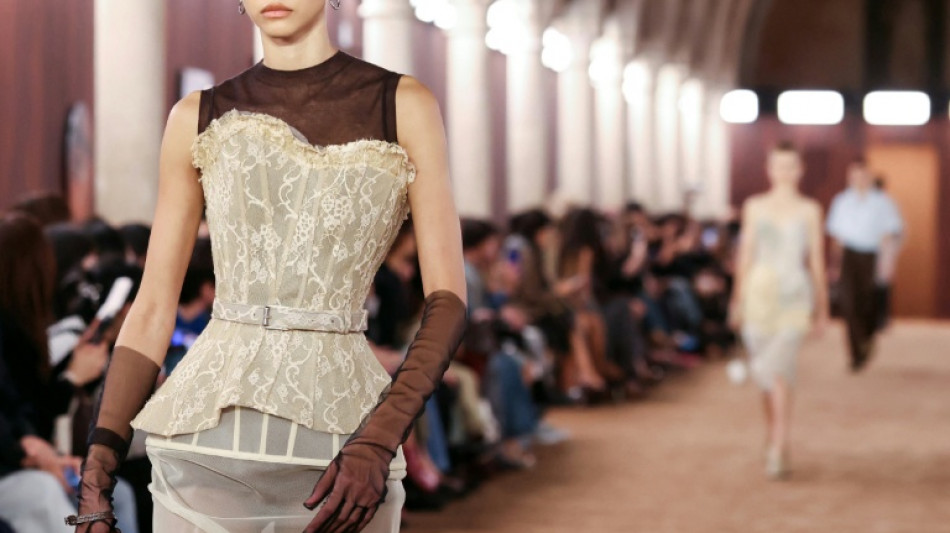
Thinness is back on catwalks -- and the data proves it / Photo: Alain JOCARD - AFP

 ALEX BODI AND AMBASSADOR GUM DOMINIC MATIOK OF THE REPUBLIC OF SOUTH SUDAN MEET IN BERLIN TO DISCUSS THE POSSIBILITY OF AN HONORARY CONSULATE IN BUCHAREST

 Lula, Bolsonaro wrap up campaigns ahead of Brazil's knife-edge vote

 Toulouse edge Castres in Top 14 derby

 Murakami homer propels White Sox to MLB playoff win over Guardians
 Israel targets top Hamas leader in deadly Gaza strike on anniversary

 Houthis say struck oil facility near Riyadh, as Saudis hit Sanaa

 AI needs safety layers like nuclear plants: ex-OpenAI engineer

 MVP Judge will miss Yankees' MLB playoff series against Rays

 New lizard species discovered in Peru

 Fernandes hails Portugal's 'greatest symbol' Ronaldo, calls for unity

 Grandidier-Nkanang double takes Pau to Top 14 summit despite Vannes fightback

 Trainer Scott gets perfect Arc boost with top notch double

 Ex-PM says Putin cannot admit 'mistake' over Ukraine
 Houthis say Saudi Arabia launches dozens of strikes on Yemen capital

 Qatar and Abu Dhabi F1 Grand Prix to go ahead - F1 boss

 South Korea lift gloom with smash-and-grab Games football gold

 Ireland news conference before Israel game cut short amid tensions

 Protests over housing flare in Spain after relief measures rejected

 Zverev thrashes Shang to set up Djokovic quarter-final at China Open

 Turkey football ref chief jailed pending trial for graft

 North Korea says test of intermediate-range strategic missile included use of AI

 Rampant Sayers leads Hong Kong to third men's rugby gold in a row

 Ethiopia's Tigray rebels abandon regional capital as govt advances

 Bulgaria's Tsar Samuel returns 'home' after 1,000 years

 'Glad it's over': Kim powers to Games gold and military exemption

After a short interlude of pushing "body inclusivity" and plus-sized models to the fore, the fashion industry has returned to promoting thinness as a beauty ideal.
Data published this week from Vogue Business, based on catwalk shows in the most recent Spring/Summer 2026 Fashion Weeks, corroborated what models with regular or larger body sizes have been reporting: their work is drying up.
Of the 9,038 looks analysed in New York, London, Milan and Paris, 97.1 percent featured models judged to be very small (US 0-4, UK 4-8 or 32-36 in France), according to data from Vogue Business in its size inclusivity report.
Regular-sized models represented only 2.0 percent of the body types seen, compared to just 0.9 percent for "plus-size" models (US 14+, UK 18+, France 44+), the report showed.
"There are fewer and fewer plus-size models on the runways," Aude Perceval, a booker at Plus Agency, a pioneer in plus-size modeling in France, told AFP.
The trend was particularly pronounced in Paris, she added.
This is despite many designers adopting looks that naturally create curvy silhouettes, such as corsets.
In some cases, models have been sent out with padding around their hips to create the hourglass shape.
"Since 2022, there's been a real regression, both in the frequency of contracts and in fees," model Doralyse Brumain, 31, who wears a French 40-42, told AFP.
- 'False idea' -
The "body positive" movement, born in the 2010s, was based on the idea of promoting acceptance of different body types and recognising the damage done by creating a beauty ideal of thinness that was both unhealthy and beyond the reach of most women.
In the same way that fur and flashy fashion is making a comeback, so is the aesthetic of extreme thinness that was called "heroin chic" in the 1990s when popularised by supermodels such as Kate Moss.
"There's this false idea that being thin means being chic, being rich," said French model casting director Esther Boiteux to AFP.
The wide availability of weight-loss drugs such as Ozempic -- used to suppress appetite -- has also been linked to the return of thinness.
The diabetes treatment "has something to do with it because we're seeing a lot of celebrities who are using it", British Vogue editor Chioma Nnadi said last November.
"I think there's this shift in the culture around how we think about our bodies and how we address our bodies," she told the BBC.
Clothes for fashion shows are also typically designed and manufactured in a single size -- that of "standard" thin models -- and making clothes for regular or larger models requires forethought and extra time to adapt them.
- 'Unattainable' -
Ekaterina Ozhiganova, a Russian-born model and founder of the Model Law association, which advocates for model rights, says that consumers are in favour of seeing models in different sizes.
"But for it to become truly sustainable, there would need to be a profound change in production," she told AFP, adding that the industry continued to sell "an unattainable ideal".
French designer Jeanne Friot believes fashion runways should instead be a place where everyone can envision themselves.
"The point of a fashion show is to showcase something different from the fashion I grew up with, very thin and very standardized. I want to see (larger) sizes... older people, all ethnicities, all genders," she told AFP.
For the moment, sighting a regular-sized woman on the catwalk is an increasingly rare occurrence, but the change is not going unnoticed.
"We have to speak out when fashion messes up and establishes a standard it should abandon," French fashion journalist Sophie Fontanel wrote on Instagram in early October as she watched the Givenchy show during Paris Fashion Week.
P.Sousa--PC