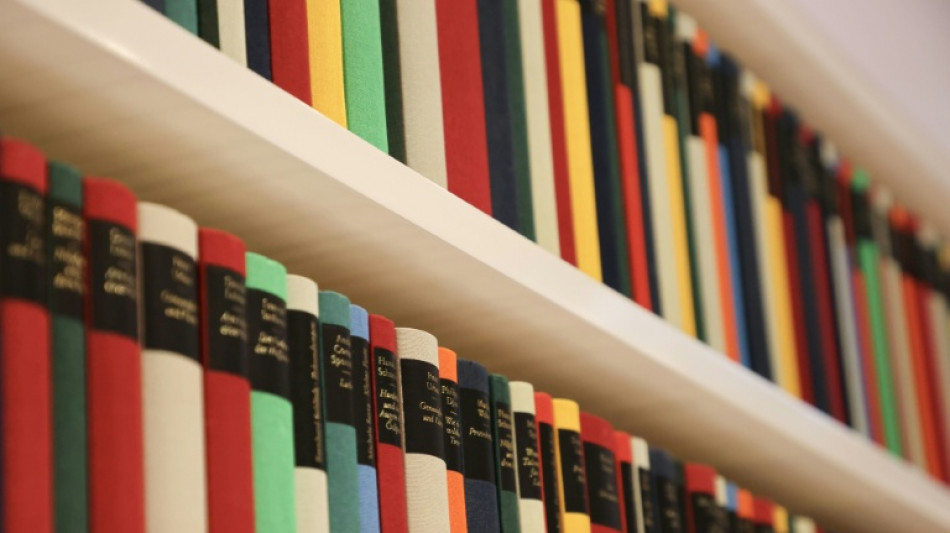
Publishers fight back against US book bans / Photo: Daniel ROLAND - AFP

 ALEX BODI AND AMBASSADOR GUM DOMINIC MATIOK OF THE REPUBLIC OF SOUTH SUDAN MEET IN BERLIN TO DISCUSS THE POSSIBILITY OF AN HONORARY CONSULATE IN BUCHAREST

 Lula, Bolsonaro wrap up campaigns ahead of Brazil's knife-edge vote

 Toulouse edge Castres in Top 14 derby

 Murakami homer propels White Sox to MLB playoff win over Guardians
 Israel targets top Hamas leader in deadly Gaza strike on anniversary

 Houthis say struck oil facility near Riyadh, as Saudis hit Sanaa

 AI needs safety layers like nuclear plants: ex-OpenAI engineer
 MVP Judge will miss Yankees' MLB playoff series against Rays

 New lizard species discovered in Peru

 Fernandes hails Portugal's 'greatest symbol' Ronaldo, calls for unity

 Grandidier-Nkanang double takes Pau to Top 14 summit despite Vannes fightback
 Trainer Scott gets perfect Arc boost with top notch double

 Ex-PM says Putin cannot admit 'mistake' over Ukraine

 Houthis say Saudi Arabia launches dozens of strikes on Yemen capital

 Qatar and Abu Dhabi F1 Grand Prix to go ahead - F1 boss

 South Korea lift gloom with smash-and-grab Games football gold

 Ireland news conference before Israel game cut short amid tensions

 Protests over housing flare in Spain after relief measures rejected

 Zverev thrashes Shang to set up Djokovic quarter-final at China Open

 Turkey football ref chief jailed pending trial for graft

 North Korea says test of intermediate-range strategic missile included use of AI

 Rampant Sayers leads Hong Kong to third men's rugby gold in a row

 Ethiopia's Tigray rebels abandon regional capital as govt advances

 Bulgaria's Tsar Samuel returns 'home' after 1,000 years

 'Glad it's over': Kim powers to Games gold and military exemption

Escalating attempts to remove works featuring themes such as LGBTQ lifestyles and race relations from US bookshelves are facing growing resistance from publishers and rights groups, a major topic at this year's Frankfurt Book Fair.
Spearheaded by right-wing conservative groups, there has been an explosion in efforts to get books that are viewed as overly progressive banned in US schools and public libraries in recent years.
In 2020 just under 300 titles faced "challenges" -- demands to restrict access to them or remove them entirely -- across the United States, according to the American Library Association (ALA).
That number began surging the following year, and reached over 9,000 in 2023, said the NGO, whose office for intellectual freedom has been tracking challenges since 1990.
"It's an ideological mission from people on the right," Jon Yaged -- CEO of Macmillan Publishers, whose books are among those that have been targeted in the United States -- told AFP.
"This is just the most recent instance of hate demonstrating itself in culture," said Yaged this week at the Frankfurt event, the world's biggest book fair, where the subject was hotly debated.
It is part of what PEN International says is a growing global trend, with the literary freedom NGO reporting a "dramatic increase in book bans and censorship" in recent times, from Afghanistan to Russia.
In the United States conservative groups and politicians pushing to get certain books removed reject accusations of censorship, insisting their aim is to limit access to inappropriate material.
- Conservative education drive -
US conservatives have for some years been pushing back against what they view as a progressive agenda in education, a drive that has won support from US President Donald Trump's administration.
According to the ALA, the most common reasons for challenging books in 2024 were claims of obscenity in books for minors, LGBTQ characters or themes and discussion of sensitive topics such as race.
Among the most targeted titles were "All Boys Aren't Blue", a collection of essays about author George M. Johnson's experiences growing up as a gay Black man in the United States.
Others included "The Bluest Eye", a Toni Morrison work featuring depictions of sexual abuse and racial themes, and "The Perks of Being a Wallflower", a coming of age novel featuring drug use and sex.
Conservative activists and local politicians, particularly in Republican-led states, often pressure school boards for book bans, but efforts to get works removed are increasingly taking on different forms, according to PEN's US branch.
Legislatures in some states have passed laws seeking to restrict access to certain titles, elected politicians have issued lists of books containing "explicit" material and some school districts have issued "do not buy" lists, targeting particular works, according to the group.
- Book-bans in Florida -
PEN said the highest number of instances of access to school books being restricted last year was documented in Florida, where Republican governor Ron DeSantis has pushed conservative education policies that have also included banning classroom discussion of sexuality and gender identity.
Those campaigning to limit access typically argue they are seeking to protect youngsters.
Conservative group Moms for Liberty said recently that "challenging the placement of obscene materials in school libraries is not censorship or banning.
"It is a reasonable demand to prevent children from being exposed to age-inappropriate materials," the group said in a statement cited by an affiliate of CBS News.
Macmillan and other major publishers including Penguin Random House and HarperCollins, alongside authors and advocacy groups, have lodged legal challenges against attempts to restrict access to books, and have had some successes.
In some school districts, community members, from parents to authors and students, have also fought back against book bans.
Authors sense a worsening climate for works depicting minority groups beyond the United States.
"It is getting worse globally," US author Lawrence Schimel, whose books featuring children with same-sex parents have run into problems in Russia and Hungary in recent years, told AFP.
Schimel added however that he believed it was crucial for kids to be able to continue seeing such works: "It helps them to be accepting of other people's diversity."
Despite the mounting challenges, Yaged of Macmillan Publishers sounded determined.
"As long as there have been books, there have been people trying to ban books," he said. "And they haven't won as long as we keep up the fight."
P.Serra--PC