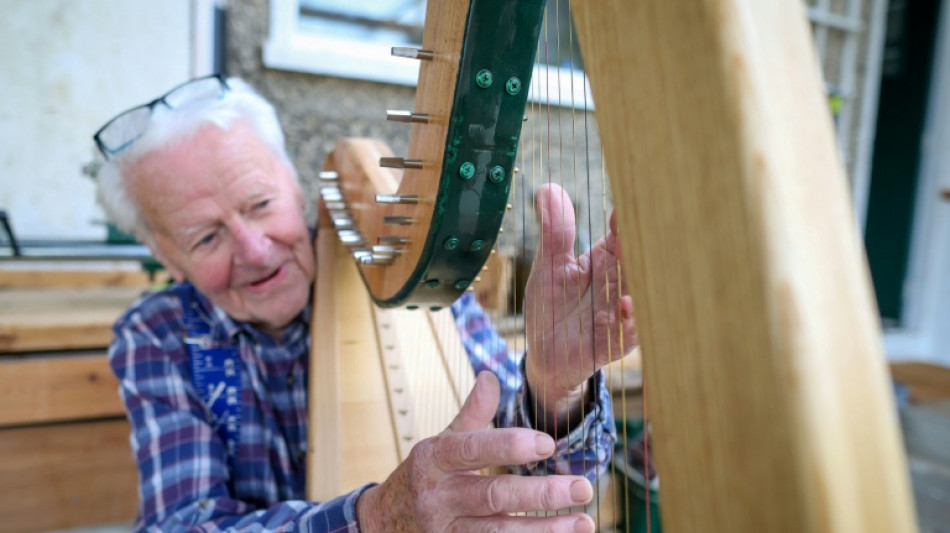
Irish octogenarian enjoys new lease on life making harps / Photo: Paul Faith - AFP

 Lula, Bolsonaro wrap up campaigns ahead of Brazil's knife-edge vote

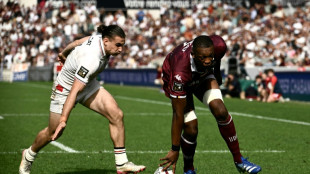
 Toulouse edge Castres in Top 14 derby

 Murakami homer propels White Sox to MLB playoff win over Guardians

 Israel targets top Hamas leader in deadly Gaza strike on anniversary

 Houthis say struck oil facility near Riyadh, as Saudis hit Sanaa

 AI needs safety layers like nuclear plants: ex-OpenAI engineer

 MVP Judge will miss Yankees' MLB playoff series against Rays

 New lizard species discovered in Peru

 Fernandes hails Portugal's 'greatest symbol' Ronaldo, calls for unity

 Grandidier-Nkanang double takes Pau to Top 14 summit despite Vannes fightback
 Trainer Scott gets perfect Arc boost with top notch double

 Ex-PM says Putin cannot admit 'mistake' over Ukraine
 Houthis say Saudi Arabia launches dozens of strikes on Yemen capital
 Qatar and Abu Dhabi F1 Grand Prix to go ahead - F1 boss

 South Korea lift gloom with smash-and-grab Games football gold

 Ireland news conference before Israel game cut short amid tensions

 Protests over housing flare in Spain after relief measures rejected

 Zverev thrashes Shang to set up Djokovic quarter-final at China Open

 Turkey football ref chief jailed pending trial for graft

 North Korea says test of intermediate-range strategic missile included use of AI

 Rampant Sayers leads Hong Kong to third men's rugby gold in a row

 Ethiopia's Tigray rebels abandon regional capital as govt advances

 Bulgaria's Tsar Samuel returns 'home' after 1,000 years

 'Glad it's over': Kim powers to Games gold and military exemption

 After 11 World Cups, football finally comes home for one Indian fan

"It's never too late to start a new hobby," says 89-year-old Irish harp-maker Noel Anderson, one of only a few making the intricate instrument, a national symbol of Ireland.
A retired wood and metalwork teacher Anderson only took up the niche craft seven years ago, making his first harp aged 82.
"It doesn't matter what age I am really, I just pop out to the shed and work at it, sometimes for 10 minutes, sometimes for 10 hours," Anderson told AFP at his home in Strabane, 75 miles (120 kilometres) northwest of Belfast.
"I'll keep on doing it as long as I can," said the still spritely white-haired Anderson, who turns 90 in November.
"I've always made things, furniture, bowls, birdhouses, this and that, but making harps has been special, one of the better experiences in life," said the twinkle-eyed craftsman.
- Cultural icon -
For centuries the stringed harp has been a symbol of Ireland, appearing on its coat of arms, government seals and coins in the modern day Republic.
But these days its role is more as a cultural icon than a widely played instrument, with the violin, flute, and pipes more central to the still thriving Irish traditional music scene.
Anderson mostly gives away his harps to friends and family, as wedding presents or gifts.
"I don't make them to sell, I do it because I like making them. If you're charging what a craftsman should charge for a handmade harp, it's going to be enormously expensive," he said.
Anderson's latest passion was launched when a friend suggested he make a harp as a favour, prompting him to convert his garage and shed into a workshop.
Now, after finishing 18 harps, big and small, so far, he is working on his most ambitious yet, a replica of a 19th-century design by master Irish harp-maker John Egan.
"When you look at the plans, it all becomes a lot clearer, and you just follow along," he said, crouched on a vast paper sheet spread out on the floor, peering at its fine details.
- '800 cups of tea' -
Anderson measures the time taken to finish making one harp from the first cut of wood to final stringing, not in time but in cups of tea consumed.
"To make a big harp, I've got to drink at least 800 cups," he told AFP.
"The wee lap harps are different. But still a lot of tea, five to six hundred brews anyway," he laughed.
For Anderson, the material is the most important element of the process.
"Selecting what it's going to be made of, getting your first timber, looking at it and saying, ah yes, that'll be just right.
"That is one of the most enjoyable bits," he smiled.
Most of the raw material Anderson uses is "glorious" hardwood and strings sourced locally, although he occasionally buys spruce from Switzerland grown specifically for musical instruments.
"It's all to have the grain of the wood as regular and as fine as possible. And spruce's ability to transmit sound is quite unique," he said.
- Passing on knowledge -
Although he says his musical taste is eclectic Anderson said he enjoys listening to an "occasional restful" harp CD while doing a crossword.
"Harp music is utterly beautiful of itself, be it Irish, South American or whatever," he said.
"I'm not a musician, in fact I can't play a note of anything," he laughed.
That hasn't prevented him gaining a growing reputation for quality craftwork, as Anderson says there are only a few makers still around.
High cost, and no official trade school courses mean the craft has almost died out.
"I would love to know if there is somebody else, we'd share our abilities and stuff, that would be lovely to happen," he said.
M.Carneiro--PC