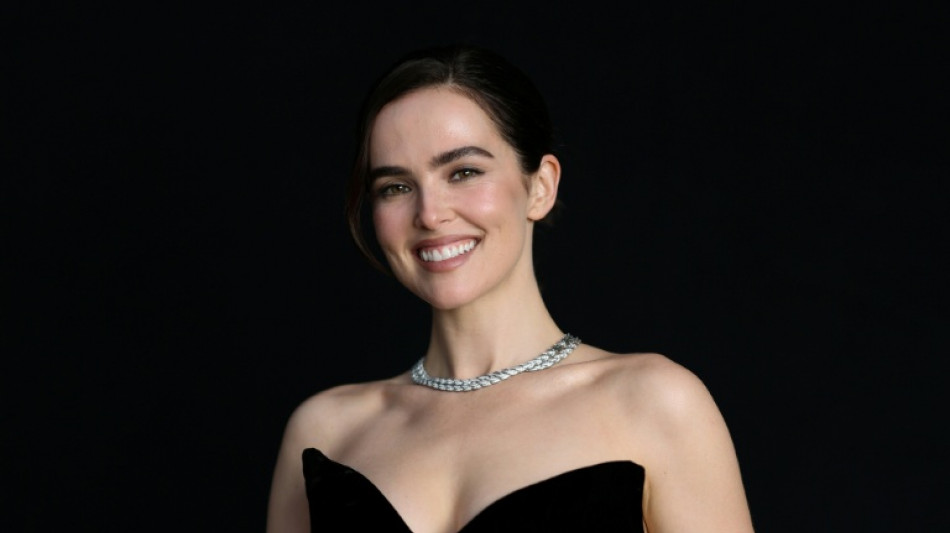
AI cannot make cinema, director Linklater says / Photo: VALERIE MACON - AFP

 Lula, Bolsonaro wrap up campaigns ahead of Brazil's knife-edge vote

 Toulouse edge Castres in Top 14 derby

 Murakami homer propels White Sox to MLB playoff win over Guardians

 Israel targets top Hamas leader in deadly Gaza strike on anniversary

 Houthis say struck oil facility near Riyadh, as Saudis hit Sanaa

 AI needs safety layers like nuclear plants: ex-OpenAI engineer

 MVP Judge will miss Yankees' MLB playoff series against Rays

 New lizard species discovered in Peru

 Fernandes hails Portugal's 'greatest symbol' Ronaldo, calls for unity

 Grandidier-Nkanang double takes Pau to Top 14 summit despite Vannes fightback

 Trainer Scott gets perfect Arc boost with top notch double

 Ex-PM says Putin cannot admit 'mistake' over Ukraine

 Houthis say Saudi Arabia launches dozens of strikes on Yemen capital

 Qatar and Abu Dhabi F1 Grand Prix to go ahead - F1 boss

 South Korea lift gloom with smash-and-grab Games football gold

 Ireland news conference before Israel game cut short amid tensions

 Protests over housing flare in Spain after relief measures rejected

 Zverev thrashes Shang to set up Djokovic quarter-final at China Open

 Turkey football ref chief jailed pending trial for graft

 North Korea says test of intermediate-range strategic missile included use of AI

 Rampant Sayers leads Hong Kong to third men's rugby gold in a row

 Ethiopia's Tigray rebels abandon regional capital as govt advances

 Bulgaria's Tsar Samuel returns 'home' after 1,000 years

 'Glad it's over': Kim powers to Games gold and military exemption

 After 11 World Cups, football finally comes home for one Indian fan

Can great art be made without human genius and all its flaws? It's a vital question at a time when artificial intelligence threatens to subsume Hollywood.
Through new movies "Nouvelle Vague" and "Blue Moon," director Richard Linklater offers an answer delving into the lives of two brilliant, volatile men whose films and plays shaped French New Wave cinema and Broadway.
His conclusion?
"AI is not going to make a film," the US indie auteur tells AFP.
"Storytelling, narrative, characters? Something that connects to humanity? That's a whole 'nother thing," says the Texan whose notable films include "Boyhood," the "Before" trilogy, "School of Rock" and "Hit Man."
Linklater's "Nouvelle Vague," streaming on Netflix from November 14, charts how young French director Jean-Luc Godard defied all filmmaking convention to create his 1960 classic "Breathless."
It captures the swagger, charisma and impulsiveness with which Godard convinced financial backers and Hollywood starlet Jean Seberg to make a debut feature that had neither a script nor a workable filming schedule.
"He's a little full of shit, but he's a genius. A revolution is going on, but he's the only one who knows it," Linklater says of Godard, an icon of cinema's French New Wave movement in the late 1950s and 60s.
By contrast "Blue Moon," in cinemas now, depicts Broadway lyricist Lorenz Hart at the end of his career.
With composer Richard Rodgers, Hart wrote classic songs like "The Lady is a Tramp," "My Funny Valentine" and, of course, "Blue Moon."
But the film captures a single evening, in which it becomes clear Rodgers has moved on to even greater success with new partner Oscar Hammerstein II, with the debut of their hit musical "Oklahoma!"
Within months, Hart will be dead from alcoholism.
"It's become very clear that the times are leaving him behind. They're leaving behind his genius," says Linklater.
- 'No algorithm is gonna do that' -
Which brings us back to the question of human genius and art.
For Linklater, AI is "just one more tool" that artists can use, but it "doesn't have intuition or consciousness."
"I think it's going to be less revolutionary than everybody thinks in the next few years," he told AFP in an interview ahead of the Los Angeles premiere of "Nouvelle Vague" at The American French Film Festival (TAFFF).
The French New Wave's trademark documentary-style realism was made possible in part by technology -- the arrival of cheap, light, portable cameras.
But Linklater rejects the claim that the cost savings and flexibility offered by AI could unleash another filmmaking revolution.
"You're gonna see some cool stuff," he concedes.
But "the hardest thing to do is still to tell a compelling story that people want to see and be engaged with," he says.
"That's a lot of points you have to hit -- that's acting, that's story structure, that's pace, style.
"No algorithm is gonna do that. No prompt is gonna do that."
- 'Authentic' -
Among Linklater's future projects is "Merrily We Roll Again," adapted from Stephen Sondheim's musical.
Set over two decades, "Merrily" charts the demise of a friendship between three artists, and is told in reverse chronology.
As if to prove his point about technology, Linklater has decided to shoot the film over a 20 year span, allowing the actors to truly age backward on screen.
It is a more complex variation of his Oscar-winning "Boyhood" -- which he filmed across 12 years.
Of course, AI has recently been used to "de-age" actors, like in Tom Hanks' 2024 film "Here." But Linklater has little interest.
"It's not a visual trick, you know? I really want an actor of a certain age to be playing a character," he explains.
Asking a 25-year-old to play a 45-year-old is "not authentic" because young people "don't know what that even means," he says.
"I want the actors to be that much older and wiser."
So, don't expect to see "Merrily" in theaters any time soon.
"That's my hanging-on-to-humanity approach!" chuckles Linklater.
F.Moura--PC