'Soap opera on cocaine': how vertical dramas flipped Hollywood / Photo: Frederic J. BROWN - AFP

 Lula, Bolsonaro wrap up campaigns ahead of Brazil's knife-edge vote

 Toulouse edge Castres in Top 14 derby

 Murakami homer propels White Sox to MLB playoff win over Guardians
 Israel targets top Hamas leader in deadly Gaza strike on anniversary

 Houthis say struck oil facility near Riyadh, as Saudis hit Sanaa

 AI needs safety layers like nuclear plants: ex-OpenAI engineer

 MVP Judge will miss Yankees' MLB playoff series against Rays

 New lizard species discovered in Peru

 Fernandes hails Portugal's 'greatest symbol' Ronaldo, calls for unity

 Grandidier-Nkanang double takes Pau to Top 14 summit despite Vannes fightback

 Trainer Scott gets perfect Arc boost with top notch double

 Ex-PM says Putin cannot admit 'mistake' over Ukraine

 Houthis say Saudi Arabia launches dozens of strikes on Yemen capital

 Qatar and Abu Dhabi F1 Grand Prix to go ahead - F1 boss

 South Korea lift gloom with smash-and-grab Games football gold

 Ireland news conference before Israel game cut short amid tensions

 Protests over housing flare in Spain after relief measures rejected

 Zverev thrashes Shang to set up Djokovic quarter-final at China Open

 Turkey football ref chief jailed pending trial for graft
 North Korea says test of intermediate-range strategic missile included use of AI

 Rampant Sayers leads Hong Kong to third men's rugby gold in a row

 Ethiopia's Tigray rebels abandon regional capital as govt advances

 Bulgaria's Tsar Samuel returns 'home' after 1,000 years

 'Glad it's over': Kim powers to Games gold and military exemption

 After 11 World Cups, football finally comes home for one Indian fan

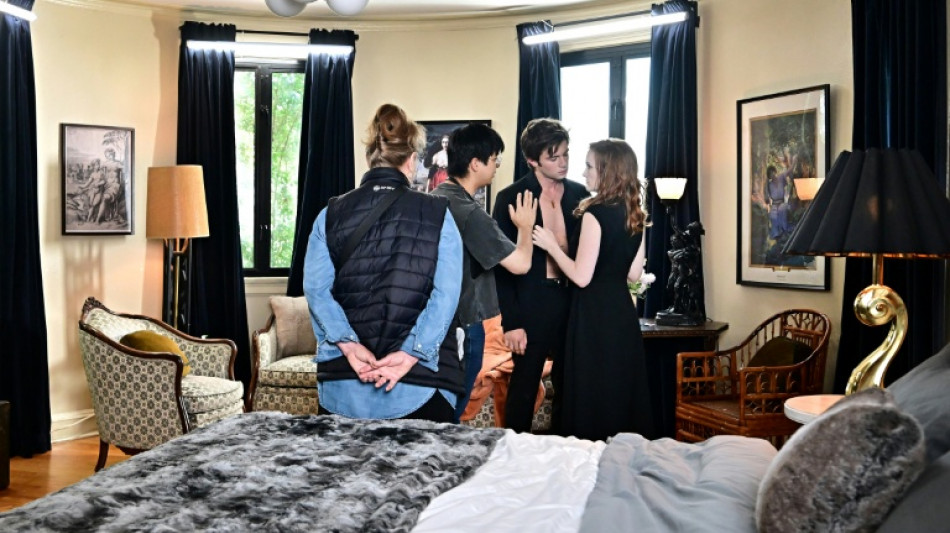
In a faux castle atop a Los Angeles hill, a small film crew with their cameras flipped sideways squeeze into a bedroom and shoot a raunchy affair scene, under the gaze of their Chinese producer.
This is the brave new world of "vertical dramas," a multi-billion-dollar industry that has taken Hollywood by storm in just two years, churning out algorithm-driven movies that are watched in addictive 60-second installments on smartphones.
With kitschy plots about werewolves and billionaires, budgets of just a few hundred thousand dollars, and breakneck filming schedules, this format from China is radically changing -- and, some say, saving -- a struggling industry.
Vertical dramas are like a "soap opera on cocaine," says producer Vincent Wang.
"In 30 days, we can get a show together. Hollywood takes two years. We have already made 500 shows by the time they make their first. Who is the future?"
Vertical dramas emerged in China in the 2010s, initially shot by amateurs and shared on TikTok.
Big companies swept in, recognizing the potential for rapid financial returns when hastily and cheaply produced micro-dramas go viral.
While similar efforts like Quibi flopped in the United States, verticals became an $8 billion industry.
Since 2023, Chinese-run platforms -- with names like ReelShort, DramaBox and FlareFlow -- have set up shop stateside, hiring thousands of talented filmmakers and actors left short of work by Hollywood's persistent belt-tightening.
"I honestly think it's the future... right here, right now," says Zachary Shadrin, a TV and film actor, making his vertical drama debut during AFP's visit to the set of "Love Through All Seasons."
"It's a good time to jump on this train."
- 'Toxic' -
Like many of his Los Angeles-based contemporaries, Shadrin was initially wary of vertical dramas.
Aside from intense filming schedules -- vertical films can wrap in as little as five days -- the genre is infamous for its fixation with abusive relationships and violent male protagonists.
Popular titles include "Dominated by My Dad's Boss" and "Mated to My Savage Alpha."
"I personally think it's toxic," says Shadrin.
But he agreed to star in FlareFlow's "Love Through All Seasons" because of the age-gap rom-com's "sweet" premise.
"It wasn't something I saw usually in terms of verticals," he says, expressing hope that the quality of scripts is rising.
Indeed, multiple actors who recently moved to vertical films told AFP they have been pleasantly surprised by the professionalism on sets.
"We all chuckle at some of the lines that are absolutely ridiculous," said actor Nicholas McDonald.
"But everyone's a good sport and treats it very professionally. Because there's money behind it."
- 'Hooked right away' -
Producers of vertical dramas say they are not competing with HBO or Netflix for eyeballs, but rather with TikTok, YouTube and Instagram.
The business model is radical, but simple.
Vertical-drama platforms offer the first six to 12 mini-episodes for free, before requiring customers to pay to keep going.
So each installment, despite being barely a minute long, has to contain its own emotional twist, to prevent its viewer from doom-scrolling elsewhere. Plots rely heavily on genre tropes, such as vampires and werewolves.
"The audience can be hooked right away without using too much of their brain," says "Love Through All Seasons" director Weiyang Li.
"Everyone's exhausted from their life already."
Companies scrutinize viewing data to see which plot devices have worked best, enabling them to churn out dozens more shows along those lines within months.
Production frequently begins before screenplays have been completed. Many scripts are translated from existing Chinese hits. And artificial intelligence is sometimes used to generate ideas, FlareFlow screenwriter Zhiyuan Qu told AFP.
Another cost advantage? The vertical format suited to smartphone screens means less background is visible on either side of actors -- so less expensive set dressing, and fewer crew required.
- 'Shadows' -
While vertical dramas are most popular in Asia, customers in burgeoning US and European markets pay higher prices. This another reason to film in Hollywood.
Most verticals are currently non-union -- producers say union projects are too expensive and slow. But the Screen Actors Guild (SAG-AFTRA) last month announced a new contract to allow its members to work on the micro-dramas.
After years in which Hollywood sets have closed due to pandemic lockdowns, strikes, and tax incentives that lure productions elsewhere, the allure of vertical shorts is too strong.
"I can ditch my side gigs, my support job, so that I can go and act... that's cool," said McDonald, who estimates 80 percent of his auditions are currently for vertical dramas.
Vertical dramas are "creeping out from the shadows," he said.
T.Batista--PC