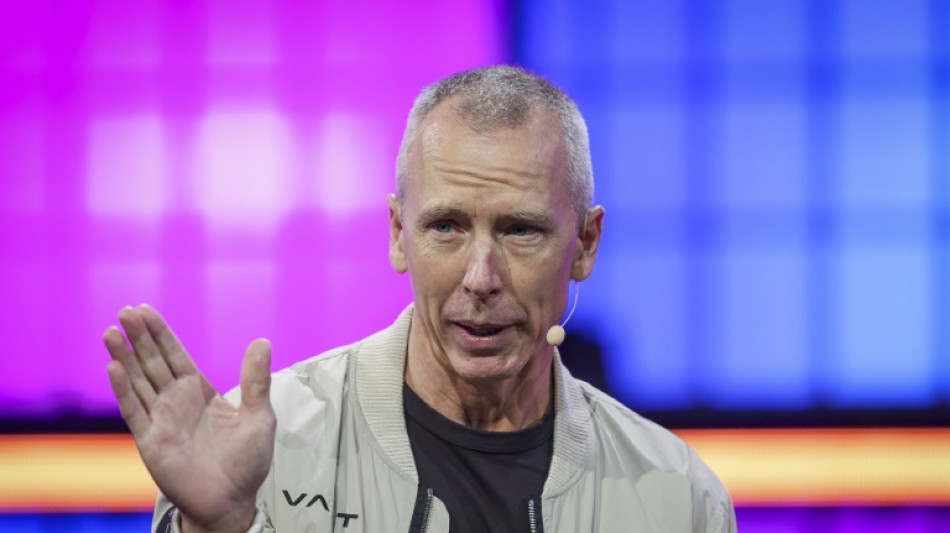
Race for first private space station heats up as NASA set to retire ISS / Photo: PATRICIA DE MELO MOREIRA - AFP

 Lula, Bolsonaro wrap up campaigns ahead of Brazil's knife-edge vote

 Toulouse edge Castres in Top 14 derby

 Murakami homer propels White Sox to MLB playoff win over Guardians
 Israel targets top Hamas leader in deadly Gaza strike on anniversary

 Houthis say struck oil facility near Riyadh, as Saudis hit Sanaa

 AI needs safety layers like nuclear plants: ex-OpenAI engineer

 MVP Judge will miss Yankees' MLB playoff series against Rays

 New lizard species discovered in Peru

 Fernandes hails Portugal's 'greatest symbol' Ronaldo, calls for unity

 Grandidier-Nkanang double takes Pau to Top 14 summit despite Vannes fightback

 Trainer Scott gets perfect Arc boost with top notch double

 Ex-PM says Putin cannot admit 'mistake' over Ukraine

 Houthis say Saudi Arabia launches dozens of strikes on Yemen capital

 Qatar and Abu Dhabi F1 Grand Prix to go ahead - F1 boss

 South Korea lift gloom with smash-and-grab Games football gold

 Ireland news conference before Israel game cut short amid tensions
 Protests over housing flare in Spain after relief measures rejected

 Zverev thrashes Shang to set up Djokovic quarter-final at China Open

 Turkey football ref chief jailed pending trial for graft
 North Korea says test of intermediate-range strategic missile included use of AI

 Rampant Sayers leads Hong Kong to third men's rugby gold in a row

 Ethiopia's Tigray rebels abandon regional capital as govt advances

 Bulgaria's Tsar Samuel returns 'home' after 1,000 years

 'Glad it's over': Kim powers to Games gold and military exemption

 After 11 World Cups, football finally comes home for one Indian fan

With NASA's International Space Station set to come out of service in 2030, American aerospace firm Vast has stepped into a frenzied race for the world's first commercial space station.
Haven-1 -- a mini station scheduled for launch in May 2026 -- has been designed for comfort, according to Andrew Feustel, a former NASA astronaut now an advisor at Vast.
"It has a three-year lifespan, and over that period of time, we plan to visit the spacecraft with multiple crews of four, four at a time," he told AFP on the sidelines of the Web Summit in Lisbon.
The California-based firm, founded in 2021 by billionaire Jed McCaleb, aspires to replace the International Space Station with Haven-2, a larger version of the first model.
But Vast faces fierce competition from other contenders, including Axiom Space, Voyager Space in partnership with Airbus, and Amazon founder Jeff Bezos's Blue Origin.
Hopes rest on securing funding from a NASA budget of up to $1.5 billion for the development of commercial space stations, which is set to be awarded in April 2026.
- 'Aggressive timelines' -
"Space agencies no longer want to manage the infrastructure" of the ISS, said Ugo Bonnet, director of the Spaceflight Institute, which offers training for commercial human missions.
Locked in competition with China, NASA wants to focus more on crewed mission projects to the Moon by the end of the decade and eventually build a base on the lunar surface.
In replacing the ISS, NASA plans to purchase services rather than manage programmes itself -- a real boon for private companies in the space market.
"There are a lot of players that are coming with very aggressive timelines, and we cannot do things in the same way we did in the past", said Roberto Angelini, director of the Exploration and Science Domain of Thales Alenia Space.
The French-Italian joint venture is set to deliver the first two pressurised modules for Axiom's planned commercial space station, which could be operational as early as 2028.
It has also manufactured half the pressurised modules for the ISS. The company's main challenge, however, is to "remain competitive in terms of prices", according to Angelini.
- Changing business models -
NASA spends up to $4 billion a year on the ISS, roughly a third of the US agency's annual human space flight budget.
SpaceX's reusable launch vehicles has revolutionised the sector, lowering transportation costs and paving the way for these private projects.
Vast plans to send Haven-1 into space on a SpaceX Falcon 9 rocket, while Axiom's private mission will see astronauts aboard one of their Crew Dragon capsules.
"Just 15 to 20 years ago, sending a kilogram into space cost $60,000," Bonnet told AFP. "When Starship, SpaceX's launcher becomes operational in 2030, the cost will be less than $200 per kilogram," he added.
But operating a commercial space station will still cost a hefty sum.
"I'm not sure about their long-term profitability," said Beatrice Hainaut, a space policy researcher at the Institute for Strategic Research at the Military School.
Companies are counting on increased demand from governments and the private sector to generate revenue.
Vast predicts that 85 percent of its crewed mission revenues will come from state agencies, and 15 percent from private clients.
Feustel said the company wanted to be a "service provider to not only the US government", but all countries seeking to send their astronauts into space for training and research.
"For less than $100 million, you can put an astronaut in space on a VAST spacecraft."
A.F.Rosado--PC