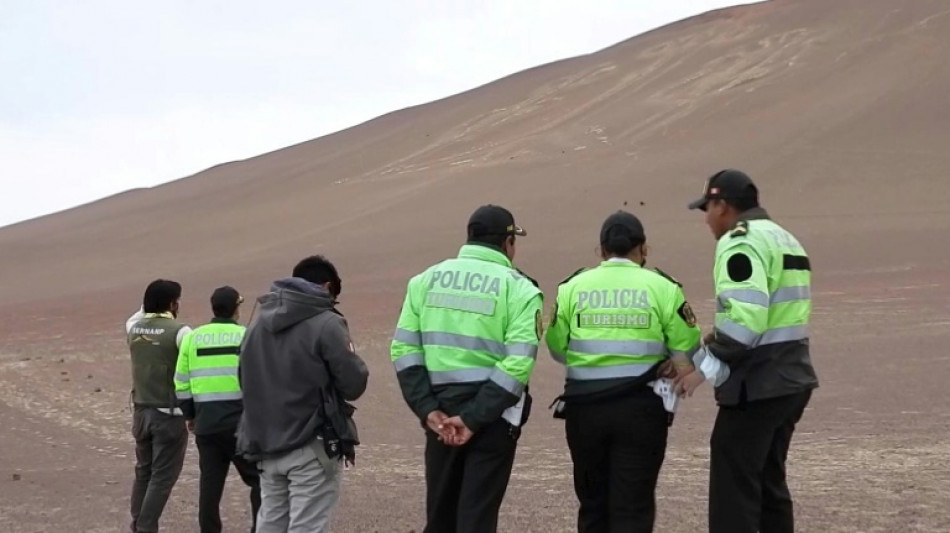
Tourists trample all over protected, prehistoric Peruvian hill carving / Photo: - - Peruvian Ministry of Culture/AFP

 Zverev thrashes Shang to set up Djokovic quarter-final at China Open

 Turkey football ref chief jailed pending trial for graft

 North Korea says test of intermediate-range strategic missile included use of AI

 Rampant Sayers leads Hong Kong to third men's rugby gold in a row

 Ethiopia's Tigray rebels abandon regional capital as govt advances

 Bulgaria's Tsar Samuel returns 'home' after 1,000 years

 'Glad it's over': Kim powers to Games gold and military exemption

 After 11 World Cups, football finally comes home for one Indian fan

 Marc Marquez wins sprint at Japan MotoGP, Martin grabs pole

 Alcaraz fends off Arnaldi to reach Japan Open quarters

 Antonelli tops times in final practice at Bahrain GP

 Gauff digs deep to beat Osorio in China Open second round

 Fresh protests to hit Spain after housing measures defeated

 'He's here with me': Japan cycle queen dedicates gold to late brother

 Japan Olympic chief says 'lot more' athletes at Games than expected

 Asian carmakers besting US rivals at home, China poised to strike

 Widgets & Web Offers All-Inclusive Investor Relations Websites for Public Companies, IPOs and SPACs

 Adams named new US captain to 2030 World Cup

 China a better influence in Latin America than US: poll

 Judge pauses construction of border project in Texas national park

 Belgium's De Bruyne fires double to sink Turkey, France held by Italy

 US jobs data boosts stocks as oil prices dip

 US Supreme Court to hear high-stakes climate case

 Trump expected to name intel chief Clayton as AI czar: reports

 Argentina unveils passports-for-investment scheme

Tourists have left footprints all over Peru's Paracas Candelabra, an enormous hillside carving that dates from some 2,500 years ago, according to officials who have launched a search for the culprits.
Over the weekend, police found footsteps zigzagging over the Paracas "geoglyph" -- a large design carved into the ground similar to Peru's better-known Nazca lines, according to a culture ministry statement.
They found "two rows of footsteps that go from the bottom (of the carving) to the top, zigzagging, entering the right arm (of the candelabra), the left arm, and central part of the geoglyph," which visitors are allowed to view only from the sea, it added.
Apart from the footsteps, which appeared to belong to three people, officials also found vehicle tracks.
The captain of a tourist ship told a television station he had spotted, from the sea, "a foreign couple with their young son and a shovel damaging the candelabra."
The station also broadcast footage recorded on a mobile phone from a nearby boat showing five people walking near the carved hillside figure, whose origins and meaning remain the subject of research.
The geoglyph is about 170 meters (557 feet) tall, 60 meters wide, and carved into the slope of a hill in the Paracas peninsula, south of Lima.
It was declared a national heritage site in 2016, and Peruvian law dictates jail terms of between three and six years for anyone damaging an archaeological monument.
The Paracas culture flourished on Peru's southern coast from around 100 BC to 200 AD, but little was known about the people until archaeological excavations began in the 1920s.
B.Godinho--PC