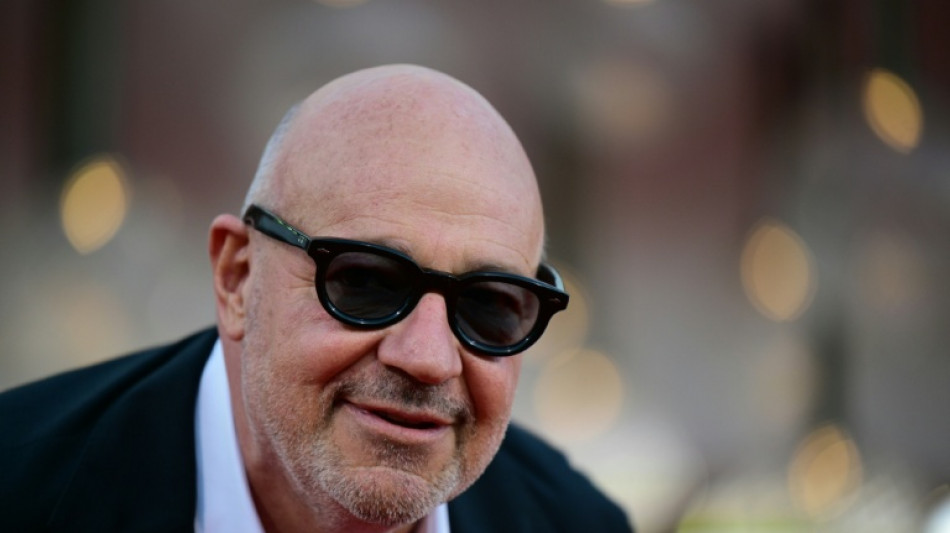
Gianfranco Rosi: the slow documentary maker in a frantic world / Photo: Tiziana FABI - AFP

 Yamal on target as Spain hold off Czech Republic

 Latvian exit polls suggest pro-European choice
 Lula, Bolsonaro wrap up campaigns ahead of knife-edge election

 Tuchel hails 'complete' England after Croatia demolition

 Fury to invite Trump to lead ring walk before Joshua showdown

 Fashion industry in 'precarious moment', says Vivienne Westwood supremo

 Seventh heaven for England in Nations League rout of Croatia
 Storms, flooding cause chaos on Greek holiday island of Crete
 #IAmJaneDoe: online support campaign in US university rape case
 Brazil shine on Selecao's first visit to India
 Zverev sets up Djokovic quarter-final at China Open, Rybakina out
 Happier at home, Bordeaux hammer Lyon in Top 14
 Lula, Bolsonaro in final push for votes ahead of knife-edge election
 Boisterous fashion week barnstorms 'sleepy' Nigerian capital
 UAE investigators say flydubai co-pilot was planning 'terrorist act'
 Rahul smacks century in India v Windies ODI
 Daryz seeks to join exclusive club of dual Arc winners
 Russia warns diplomats to leave Kyiv over new strikes threat
 Olympic champ Zheng rebukes rowdy home crowd at China Open
 World No.1 Sinner pulls out of Shanghai Masters to delay return
 Red Bull's Verstappen grabs pole position for Bahrain GP
 India beat Pakistan in blockbuster as golfer Kim wins 'crazy' gold
 India beat arch-rivals Pakistan to win Asian Games cricket gold
 Ethiopia's Tigray rebels abandon regional capital as govt advances: journalist
 Tom Kim powers to Games gold and exemption from military service
If the regular recipe for success in the modern entertainment industry or on social media is being loud, attention-seeking and a prolific creator of "content", Italian filmmaker Gianfranco Rosi has carved out a career doing the exact opposite.
The work of the award-winning documentary producer is everything our contemporary culture is not: slow, nuanced, contemplative.
It's a strategy that has taken him to the pinnacle of European cinema -- he's won the top Golden Lion prize at the Venice Film Festival and the Golden Bear in Berlin -- and has pushed the boundaries for non-fiction in the process.
"There were people saying 'How can you give a Golden Lion to someone that never directed an actor?'" he told AFP. "It's not important that division for me (between fiction and documentary). What I feel close to is cinema."
His latest work "Sotto le nuvole" ("Below the Clouds" in English), which releases internationally in France this week, is a portrait of the gritty Italian port of Naples.
It bears all the hallmarks of Rosi's distinct way of working.
The 61-year-old, who also holds American nationality, believes in "immersion", often heading to live alone at the location of his films with no script and only a vague notion of what he is trying to capture.
He spent three years in Naples, wandering, meeting people, filming relentlessly, finding the characters whose lives form the core of the 115-minute production.
"I'm a director that doesn't go home to sleep. I'm always on location," he explained.
For 2013's "Sacra GRA", his breakthrough documentary, he spent two years living in a van around the ringroad on the outskirts of Rome where he slowly won the confidence of his subjects: an ambulance driver, an eel farmer, a faded aristocrat, prostitutes.
"Notturno", which released in 2020, saw Rosi spend over three years on the borders of Iraq and Syria, documenting the impact of the Islamic State group.
His first film "Boatman" took five years to complete.
"Time is my biggest investment," he told AFP. "Working alone allows me to wait for the right moment, to create a certain intimacy with the people I meet, and allows me to wait for the right light."
- Meditation on time -
Rosi's film-making process is only part of his craft, with his visual language and approach to story-telling also setting him apart.
He disdains the look of many modern documentaries -- shaky handheld camera work and an urgent, grave tone -- preferring a static vantage point, with a fixed lens.
He frames wide and his camera lingers, leaving long pauses that he likens to the space between notes in a piece of music, or the void between the lines of a poem.
He conducts no on-screen interviews, does no narration, and allows himself a strict minimum of directing his subjects to ensure his work remains almost entirely observational.
"Below the Clouds" features a handful of unconnected people around Naples -- an after-school teacher, a fire department call-centre operator, a sailor, archeologists -- whose lives are revealed little by little in looping segments.
There is no place for pizza, football, sun-drenched piazzas, or the mafia -- the cliches of Napolitean life.
"There's always a very strong stereotype about Naples," he explained. "I wanted to get rid of all the elements that belong to the collective imagination of people."
Overall, it is a meditation on time that links the ancient Vesuvius volcano that looms over the city to its buried Roman past and its often chaotic present.
"The film, for me, is a reflection on the complexity of Naples and on history, on the weight of the past, and somehow on suspended time," he added.
It is shot in black-and-white to give it a vintage feel, while the sparse musical score is provided by Britain's Daniel Blumberg, who won an Oscar for his work on "The Brutalist".
Reviews of Rosi's film were overwhelmingly positive when it premiered at the Venice Film Festival in September, where it won the Special Jury prize.
The Hollywood Reporter said Rosi "makes documentaries like no-one else" and called his latest work "stunning".
The Guardian gave it a five-star rating, saying it was "another of (Rosi's) brilliantly composed docu-mosaic assemblages of scenes and tableaux."
T.Vitorino--PC