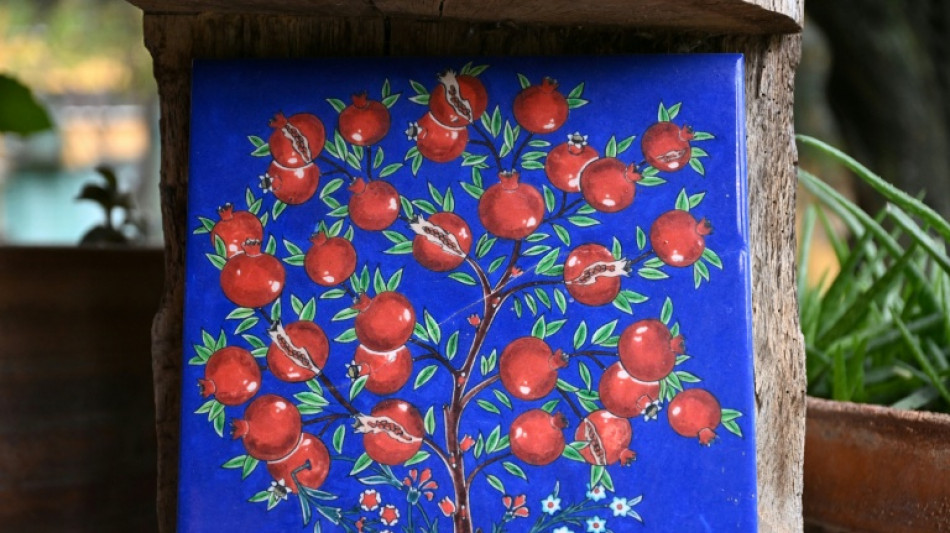
Rediscovering Iznik's lost art of vibrant Ottoman tilemaking / Photo: Ozan KOSE - AFP

 Yamal on target as Spain hold off Czech Republic

 Latvian exit polls suggest pro-European choice

 Lula, Bolsonaro wrap up campaigns ahead of knife-edge election

 Tuchel hails 'complete' England after Croatia demolition

 Fury to invite Trump to lead ring walk before Joshua showdown

 Fashion industry in 'precarious moment', says Vivienne Westwood supremo

 Seventh heaven for England in Nations League rout of Croatia

 Storms, flooding cause chaos on Greek holiday island of Crete

 #IAmJaneDoe: online support campaign in US university rape case

 Brazil shine on Selecao's first visit to India

 Zverev sets up Djokovic quarter-final at China Open, Rybakina out

 Happier at home, Bordeaux hammer Lyon in Top 14

 Lula, Bolsonaro in final push for votes ahead of knife-edge election

 Boisterous fashion week barnstorms 'sleepy' Nigerian capital

 UAE investigators say flydubai co-pilot was planning 'terrorist act'

 Rahul smacks century in India v Windies ODI

 Daryz seeks to join exclusive club of dual Arc winners

 Russia warns diplomats to leave Kyiv over new strikes threat

 Olympic champ Zheng rebukes rowdy home crowd at China Open

 World No.1 Sinner pulls out of Shanghai Masters to delay return

 Red Bull's Verstappen grabs pole position for Bahrain GP

 India beat Pakistan in blockbuster as golfer Kim wins 'crazy' gold

 India beat arch-rivals Pakistan to win Asian Games cricket gold

 Ethiopia's Tigray rebels abandon regional capital as govt advances: journalist

 Tom Kim powers to Games gold and exemption from military service

For over 300 years, the closely-guarded secrets of the Ottoman Empire's luminous tilework was lost, but its rediscovery has revived a key part of Turkey’s cultural heritage.
Renowned for intricate designs and lustrous colours, Iznik tiles are considered the pinnacle of Ottoman art, gracing monuments such as Istanbul's Blue Mosque and Topkapi Palace.
The tiles come from Iznik, a small town near Istanbul with a ceramics tradition spanning two millennia also known as Nicaea, which hosted a landmark Christian gathering in 325 AD that Pope Leo will celebrate when he visits this month.
Under the patronage of the Ottoman Empire, Iznik's artisans flourished, obtaining "remarkable achievements" by the mid-16th century, said Professor Ezgi Yalcinkaya, head of traditional Turkish arts at Usak University.
They developed a high-quartz stonepaste, known as fritware, yielding a bright white background ideal for decorating, transparent glazes and vibrant colours, including a "coral red" for floral designs which "created a distinctive new style", she told AFP.
But when the Ottoman Empire began to decline in the 17th century, the workshops started to close and the artisans, mainly Greeks and Armenians who knew the formula for the stonepaste, the colours and glazes, died off.
"Knowledge was passed entirely through master-apprentice relationships. The specific formulas -- especially for the coral red and fritware composition -- were oral secrets," she said.
"Without documentation, the expertise died with the last masters. By the 18th-19th centuries, the technical knowledge was largely lost."
Centuries later, an economics professor called Isil Akbaygil with a passion for Ottoman art set up the Iznik Foundation in 1993.
Her research project brought together experts and academics to rediscover the lost secrets of Iznik's prized ceramics.
- 'No recipe left' -
"What was forgotten about isn't so much the raw materials themselves as how they're combined... the firing temperatures and methods to achieve the distinctive coral red," said Kerim Akbaygil, a foundation board member and one of her sons.
"The foundation spent almost two years trying to get the right recipe, working with different universities like MIT, Princeton and Istanbul Technical University," he said.
"It was trial and error but we finally got it right," he told AFP at the foundation's headquarters, a rustic red-tiled building set in lush gardens lined with richly-coloured tile paths.
"Iznik tiles are the only tiles in the world that use up to 85 percent quartz which we use in the raw material along with clay and silica," he said.
They are underglazed with a high ratio of quartz giving them a "brightness and depth that are characteristic of Iznik tiles," he said.
Decorated with metal oxides whose colours are rendered vivid through the firing process, they are then coated with a quartz-based glaze known as "sur" -- Turkish for "secret".
- 'The beauty of surprise' -
Jars of colours -- from vibrant cobalt blues and emerald greens to coral reds -- line the shelves inside a large upper room where a dozen women sit painting tiles or transferring designs onto plain white tableware.
Many are painting an enormous mural for a train station -- one of the foundation's trademark commissions, its stunning tile facades a distinctive feature of the Istanbul metro and beyond.
Adding shadow to a giant fig leaf, Yasemin Sahin, 42, admits she's captivated by the transformation that occurs with firing.
"I'm painting this but I don't know what it will look like when it comes out of the kiln after it's glazed. It's always a surprise, that's the beauty of it," she told AFP.
Three decades on and Iznik tiles are now seen on buildings across Turkey, from colleges to coffee shops, with the foundation's international reach spreading form Japan to Canada.
"Back in the day, Iznik tiles were sponsored by the palace, so the only place you could see them was inside the palaces or mosques. Now that taboo is broken," Akbaygil says.
Yalcinkaya said the collective significance of rediscovering the lost formulas was "tremendous" and the result of extensive research by many academics and scholars.
"These efforts revived a living tradition," she told AFP.
"Ottoman ceramicists continuously innovated from the 14th-20th centuries. Today's work continues this spirit, ensuring the tradition remains alive and relevant, which is the most authentic way to preserve cultural heritage."
M.Carneiro--PC