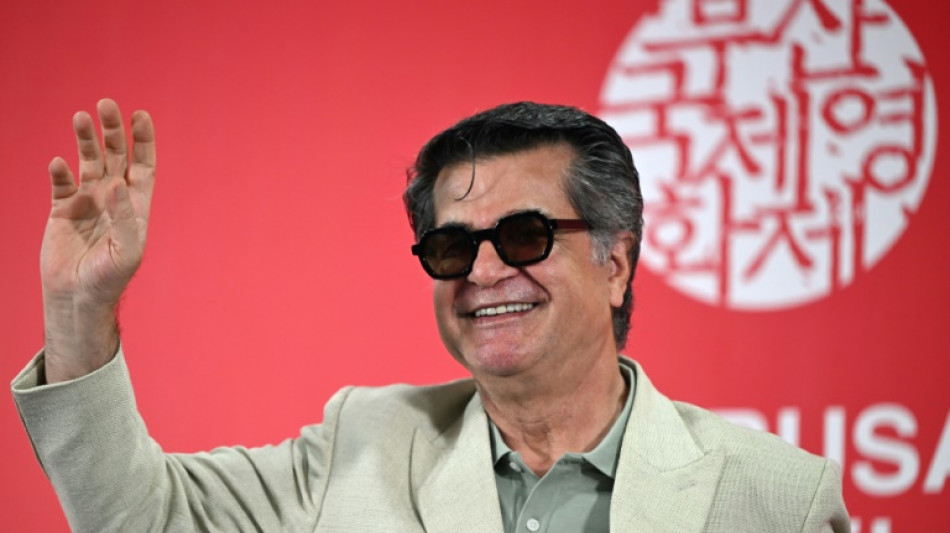
Iranian director Jafar Panahi ramps up French Oscars campaign / Photo: Jung Yeon-je - AFP

 Yamal on target as Spain hold off Czech Republic

 Latvian exit polls suggest pro-European choice

 Lula, Bolsonaro wrap up campaigns ahead of knife-edge election

 Tuchel hails 'complete' England after Croatia demolition

 Fury to invite Trump to lead ring walk before Joshua showdown

 Fashion industry in 'precarious moment', says Vivienne Westwood supremo

 Seventh heaven for England in Nations League rout of Croatia

 Storms, flooding cause chaos on Greek holiday island of Crete

 #IAmJaneDoe: online support campaign in US university rape case

 Brazil shine on Selecao's first visit to India

 Zverev sets up Djokovic quarter-final at China Open, Rybakina out

 Happier at home, Bordeaux hammer Lyon in Top 14

 Lula, Bolsonaro in final push for votes ahead of knife-edge election

 Boisterous fashion week barnstorms 'sleepy' Nigerian capital

 UAE investigators say flydubai co-pilot was planning 'terrorist act'

 Rahul smacks century in India v Windies ODI

 Daryz seeks to join exclusive club of dual Arc winners

 Russia warns diplomats to leave Kyiv over new strikes threat

 Olympic champ Zheng rebukes rowdy home crowd at China Open

 World No.1 Sinner pulls out of Shanghai Masters to delay return

 Red Bull's Verstappen grabs pole position for Bahrain GP

 India beat Pakistan in blockbuster as golfer Kim wins 'crazy' gold

 India beat arch-rivals Pakistan to win Asian Games cricket gold

 Ethiopia's Tigray rebels abandon regional capital as govt advances: journalist

 Tom Kim powers to Games gold and exemption from military service

After years of being banned from leaving Iran, filmmaker Jafar Panahi is enjoying his tour of the United States -- visiting Los Angeles, New York and Telluride -- as he promotes his Oscar-hopeful "It Was Just an Accident."
The film, which won the Palme d'Or at Cannes, has been selected by France as its official nomination for the Academy Awards, and is widely expected to make the shortlist for the Best International Feature at the gala event in March.
"It Was Just an Accident" tells the story of a torturer from the Islamic Republic who finds himself in the hands of his former prisoners -- who were jailed for protesting for women's rights and fair wages -- and their struggle to decide whether to exact revenge or to take the moral high ground.
Made clandestinely, filming was halted by the Iranian police at one point, and had to be hastily completed.
The fact that post-production was done by a French company allowed France to effectively claim Panahi's film as its own in the Oscar race, under rules set by the Academy.
But Panahi, 65, says he would like to see those rules changed to allow dissidents like him who are censored by Tehran to represent their homeland.
"I really wanted it to be for my own country, but when an oppressed society exists, well, some difficulties do arise," he told AFP during an interview in Los Angeles.
The complaint is not new. While film festivals in Cannes, Venice, and Berlin make their own choices for films from around the world, the Oscars require each country's authorities to nominate a candidate for the Best International Feature Film award.
The system has faced increasing criticism and public protests in recent years, particularly in the face of rising authoritarianism.
"This decreases and undermines the independence of filmmakers," said Panahi, who continues to create, despite having been imprisoned twice, barred from making movies in the country and banned from traveling outside Iran until 2023.
- 'Humanist cinema' that resonates -
"Iranian cinema is humanist cinema, and it has always been able to resonate with audiences around the world," he said, recalling the Oscars awarded to Asghar Farhadi’s "A Separation" and "The Salesman," as well as the international success of Abbas Kiarostami, who won the Palme d'Or in 1997 for "Taste of Cherry."
Iranian greats have managed to navigate the system, despite pressure from Tehran, but artists fear the atmosphere in the Islamic Republic is increasingly hostile.
They say authorities have continued to tighten their grip in the wake of the 2022 popular uprising -- despite some continued defiance -- sparked by the death in custody of Mahsa Amini, who was arrested for her refusal to wear a headscarf in the approved manner.
Last year, director Mohammad Rasoulof went into exile to escape flogging and an eight-year prison sentence after filming "The Seed of the Sacred Fig," which became Germany's submission for the Oscars last year.
Rasoulof and Panahi were arrested together in 2010 when they were working on a film. Panahi went to prison for 3 months then, and for seven months after a 2022 arrest.
Panahi has since honed his techniques for shooting in secret.
A significant portion of the plot of "It Was Just an Accident" unfolds in a van, which also served as a hideout. Outdoor scenes were filmed in deserted areas and quiet neighborhoods.
"When you live somewhere, because you are in the heart of it, you can find the ways to escape," he said.
The film was partially inspired by Panahi's own time behind bars.
His camera follows the heated debates of ordinary Iranians, who shared the same prison interrogator, over what fate they want for their former jailer, who has been kidnapped by a garage owner.
Should they kill him to avenge the humiliations they suffered, or refuse to stoop to their torturer’s level?
Through this tormentor, the director sketches an Iran where the mullahs’ power is crumbling, and where this moral dilemma could soon become a collective one.
The film, he says, is not just about what happens in the present.
"You think about people who are going to live in that country later on, and you think about how you must plant the seeds to overcome violence."
X.Matos--PC