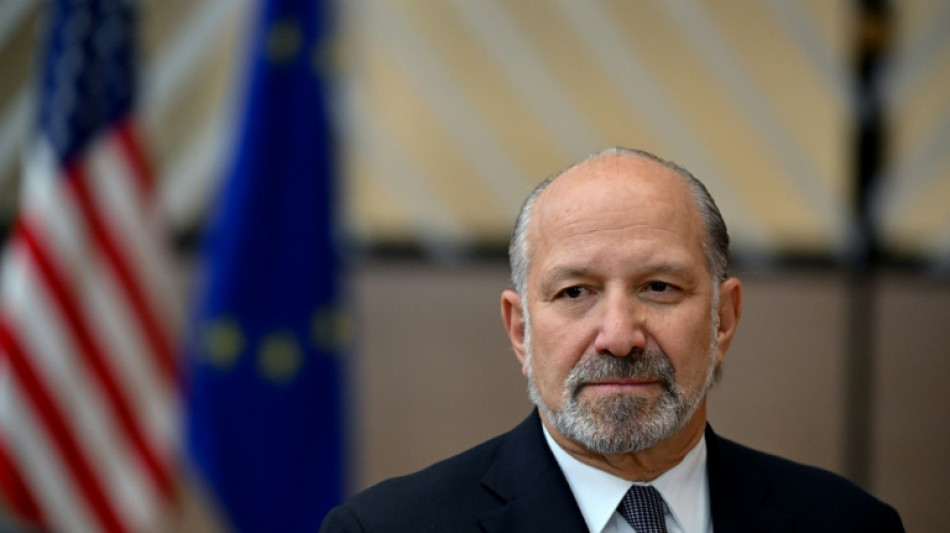
US tells EU to rethink tech rules to secure lower steel duties / Photo: Nicolas TUCAT - AFP

 Yamal on target as Spain hold off Czech Republic

 Latvian exit polls suggest pro-European choice

 Lula, Bolsonaro wrap up campaigns ahead of knife-edge election

 Tuchel hails 'complete' England after Croatia demolition

 Fury to invite Trump to lead ring walk before Joshua showdown

 Fashion industry in 'precarious moment', says Vivienne Westwood supremo

 Seventh heaven for England in Nations League rout of Croatia

 Storms, flooding cause chaos on Greek holiday island of Crete

 #IAmJaneDoe: online support campaign in US university rape case

 Brazil shine on Selecao's first visit to India

 Zverev sets up Djokovic quarter-final at China Open, Rybakina out

 Happier at home, Bordeaux hammer Lyon in Top 14

 Lula, Bolsonaro in final push for votes ahead of knife-edge election

 Boisterous fashion week barnstorms 'sleepy' Nigerian capital

 UAE investigators say flydubai co-pilot was planning 'terrorist act'

 Rahul smacks century in India v Windies ODI

 Daryz seeks to join exclusive club of dual Arc winners

 Russia warns diplomats to leave Kyiv over new strikes threat

 Olympic champ Zheng rebukes rowdy home crowd at China Open

 World No.1 Sinner pulls out of Shanghai Masters to delay return

 Red Bull's Verstappen grabs pole position for Bahrain GP

 India beat Pakistan in blockbuster as golfer Kim wins 'crazy' gold

 India beat arch-rivals Pakistan to win Asian Games cricket gold

 Ethiopia's Tigray rebels abandon regional capital as govt advances: journalist

 Tom Kim powers to Games gold and exemption from military service

The United States on Monday urged the European Union to rethink its approach to digital regulation if it wants a deal to lower painful US tariffs on the bloc's steel exports.
US Commerce Secretary Howard Lutnick and Trade Representative Jamieson Greer met the EU's 27 trade ministers for the first high-level talks in Brussels since the transatlantic allies struck a tariff deal in July.
Aimed at averting all-out trade war, the deal agreed on a 15-percent US levy for most EU exports -- but both sides continue to push for more concessions.
While the EU wants the US to lower its 50-percent duties on steel and aluminium, Washington is demanding Brussels rolls back green and digital rules it says harm US firms.
Lutnick linked the two issues explicitly after the meeting, telling the EU to reconsider its approach on tech regulation in exchange for a deal to cut duties on Europe's steel and aluminium exports.
"Our suggestion is that the European Union and their trade ministers deeply consider trying to analyse their digital rules, try to come away with a balance," he said alongside Greer and EU trade chief Maros Sefcovic.
"If they can come up with that balanced approach, which I think they can, then we will together with them handle the steel and aluminium issues," Lutnick said.
He said such an approach would mean the EU could see "a trillion dollars of investment, and that would add a point and a half to European GDP".
- EU 'not discriminatory' -
US President Donald Trump and his government have pushed back hard at the EU's bolstered legal armoury against Big Tech.
Trump in September threatened retaliatory tariffs in response to a massive 2.95-billion-euro ($3.4 billion) fine imposed on Google.
Pushed afterwards on whether the EU's digital rules are a red line, Sefcovic refused to comment.
"We'll be looking into the ways, how we can launch this process on the digital matters," he told reporters.
Sefcovic insisted the EU's rules were "not discriminatory" or "aimed at American companies".
A spokesperson for the EU executive later stressed Europe's "sovereign right to legislate".
"Our rules apply only within the EU. And they apply equally to all companies, regardless of their country of origin," the European Commission spokesperson said.
- EU steels itself -
The top EU and US officials also discussed issues they are both facing including access to rare earths and chips -- vital for the tech industry.
"We didn't only discuss bilateral issues, but also some of the challenges we are facing together: the overcapacity... China's role in the global economy and other issues where we have to join forces," said Danish Foreign Minister Lars Lokke Rasmussen, whose country holds the rotating EU presidency.
The EU in October moved to double tariffs on foreign steel to shield the industry from a flood of cheap Chinese exports.
Brussels hoped the proposal would then see the EU team up with Washington to tackle Chinese overcapacity, and Sefcovic had been pushing his US counterparts agree on steel import quotas.
The EU wants a broader "metals alliance" with Washington to ring-fence their respective economies from Chinese overcapacity.
Industry data shows China was responsible for more than half of the world's steel production last year.
The steel sector employs around 300,000 people in Europe, and nearly 100,000 jobs have been lost in the past 15 years, the industry says.
O.Salvador--PC