Students embrace new rhythms at Saudi music schools / Photo: Fayez Nureldine - AFP

 Zverev thrashes Shang to set up Djokovic quarter-final at China Open

 Turkey football ref chief jailed pending trial for graft

 North Korea says test of intermediate-range strategic missile included use of AI
 Rampant Sayers leads Hong Kong to third men's rugby gold in a row
 Ethiopia's Tigray rebels abandon regional capital as govt advances

 Bulgaria's Tsar Samuel returns 'home' after 1,000 years
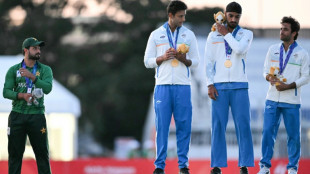
 'Glad it's over': Kim powers to Games gold and military exemption

 After 11 World Cups, football finally comes home for one Indian fan

 Marc Marquez wins sprint at Japan MotoGP, Martin grabs pole

 Alcaraz fends off Arnaldi to reach Japan Open quarters

 Antonelli tops times in final practice at Bahrain GP

 Gauff digs deep to beat Osorio in China Open second round

 Fresh protests to hit Spain after housing measures defeated

 'He's here with me': Japan cycle queen dedicates gold to late brother

 Japan Olympic chief says 'lot more' athletes at Games than expected

 Asian carmakers besting US rivals at home, China poised to strike

 Widgets & Web Offers All-Inclusive Investor Relations Websites for Public Companies, IPOs and SPACs

 Adams named new US captain to 2030 World Cup

 China a better influence in Latin America than US: poll

 Judge pauses construction of border project in Texas national park

 Belgium's De Bruyne fires double to sink Turkey, France held by Italy

 US jobs data boosts stocks as oil prices dip

 US Supreme Court to hear high-stakes climate case

 Trump expected to name intel chief Clayton as AI czar: reports

 Argentina unveils passports-for-investment scheme

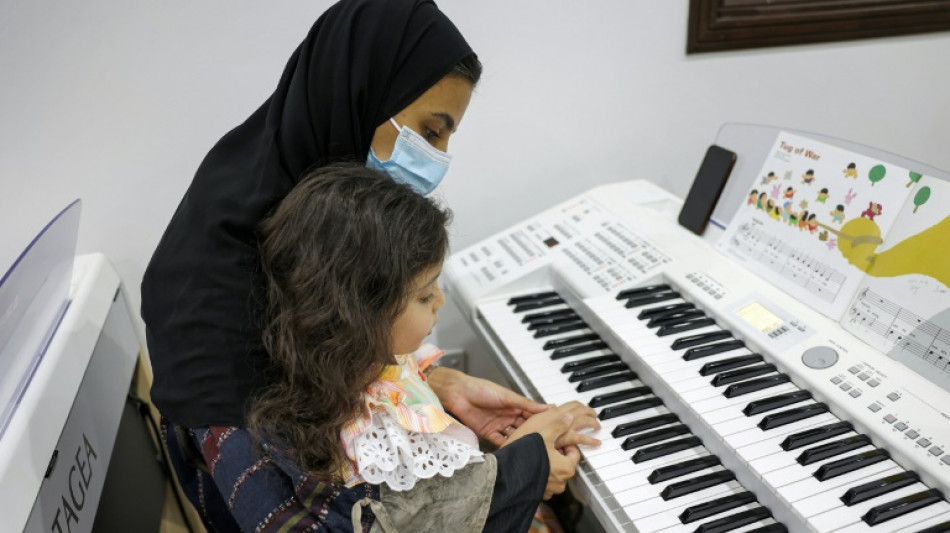
Saudi businessman Ahmed Abdullah watches intently as his seven-year-old daughter Yasmine practises keyboard scales at a Riyadh music school, an opportunity he could only dream about when he was young.
Saudi Arabia's rulers have recently relaxed some social restrictions after decades of adhering to a rigid interpretation of Islam, enforced by the kingdom's religious police and placing severe limits on social activities including group musical lesson.
"Now we are thinking about the next generation and investing in it," Ahmed said.
Previously those who could afford it hired musical tutors to come to their homes, while the rest struggled to find any instruction at all.
At least five such schools have opened over the past few years in the capital Riyadh and Jeddah, the kingdom's second city on the Red Sea coast, serving an enthusiastic clientele of children and some adults.
Yasmine's class, at the Yamaha Music Centre, meets every Saturday for half an hour, with their Egyptian instructor running students through keyboard drills under a sign reading "Music for All".
The session is bittersweet for Abdullah, who thrills at his daughter's enthusiasm even as it reminds him of "things I had no chance of achieving in my childhood".
- Notes of change -
Music has been a feature of the dramatic social reforms ushered in by Crown Prince Mohammed bin Salman, the country's de facto ruler who became first in line to the throne five years ago.
For decades the country was decidedly off the beaten path of most touring artists but in recent years some of the world's biggest stars, including Justin Bieber and K-pop juggernaut BTS, have performed in the kingdom.
These marquee events have spurred allegations of complicity in a transparent bid to whitewash the kingdom's grim human rights record.
But there is little question that many young, entertainment-starved Saudis are grateful for the shows.
Last December more than 700,000 revellers flocked to the MDLBeast Soundstorm music festival in Riyadh, officials said, for four days of performances including a set by superstar French DJ David Guetta.
Daily life, too, has become more melodious, with restaurants and cafes staging live acts or blasting recordings through speakers -- some even during prayer time, when in the past they would have been forced to close.
Several Saudis who are now trying to develop their own musical chops described the transformation as a boon to their mental health.
Wejdan Hajji, a 28-year-old employee at a firm selling medical supplies, said she once struggled to teach herself guitar by watching YouTube videos, lamenting that "if I made a mistake, there was no one to correct me".
Now she pays 940 Saudi riyals (around $250) each month for classes with a Ukrainian teacher at the Yamaha Music Centre.
"I didn't know anything, but now I've learned the basics," she said.
"The one-hour session clears my mind... My personality has changed, and I'm calmer."
- A growing market -
Such benefits could soon extend to many more young Saudis.
In 2020 the kingdom established a "Music Authority" under its culture ministry which grants licenses to music schools and provides backing to young talents eager to pursue careers in the music industry.
Some 100 private schools nationwide have included a music component in their curricula during the current academic year, according to an official tally.
In May, the authority launched a "Music Culture Programme" to develop the skills of public school students as well.
As those initiatives get off the ground, the specialised music schools continue to do brisk business.
One recent afternoon at the "House of Music" school in northern Riyadh, an instructor supervised five toddlers as they swayed to the sound of lullabies playing on a speaker.
The school opened in 2019 and has 300 students of all ages who come for lessons in rooms adorned with posters of performers like Bob Marley and Lebanese singer Fairuz.
"There is a good acceptance of the services we provide so far," said the school's Venezuelan director, Cesar Mora, adding that the school has a second branch in the works.
"There is a growing music-loving community and market."
Walid Mahmoud, a 37-year-old Sudanese resident of Riyadh, began coming to the school so his young daughters could take lessons on the oud, a stringed instrument popular in the region.
Before long, he signed up for lessons himself.
"Saudi Arabia has changed a lot," he said with a laugh as his daughters, aged five and three, looked on.
"Maybe we will form a band one day. Why not?"
H.Portela--PC