Frank Gehry, master architect with a flair for drama, dead at 96 / Photo: DAVID MCNEW - Getty Images North America/Getty Images/File

 Yamal on target as Spain hold off Czech Republic

 Latvian exit polls suggest pro-European choice

 Lula, Bolsonaro wrap up campaigns ahead of knife-edge election

 Tuchel hails 'complete' England after Croatia demolition

 Fury to invite Trump to lead ring walk before Joshua showdown

 Fashion industry in 'precarious moment', says Vivienne Westwood supremo

 Seventh heaven for England in Nations League rout of Croatia

 Storms, flooding cause chaos on Greek holiday island of Crete

 #IAmJaneDoe: online support campaign in US university rape case
 Brazil shine on Selecao's first visit to India

 Zverev sets up Djokovic quarter-final at China Open, Rybakina out

 Happier at home, Bordeaux hammer Lyon in Top 14

 Lula, Bolsonaro in final push for votes ahead of knife-edge election

 Boisterous fashion week barnstorms 'sleepy' Nigerian capital

 UAE investigators say flydubai co-pilot was planning 'terrorist act'

 Rahul smacks century in India v Windies ODI

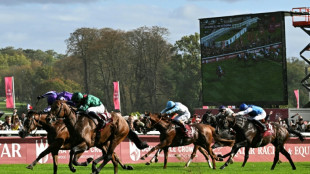 Daryz seeks to join exclusive club of dual Arc winners

 Russia warns diplomats to leave Kyiv over new strikes threat

 Olympic champ Zheng rebukes rowdy home crowd at China Open

 World No.1 Sinner pulls out of Shanghai Masters to delay return

 Red Bull's Verstappen grabs pole position for Bahrain GP

 India beat Pakistan in blockbuster as golfer Kim wins 'crazy' gold

 India beat arch-rivals Pakistan to win Asian Games cricket gold

 Ethiopia's Tigray rebels abandon regional capital as govt advances: journalist

 Tom Kim powers to Games gold and exemption from military service

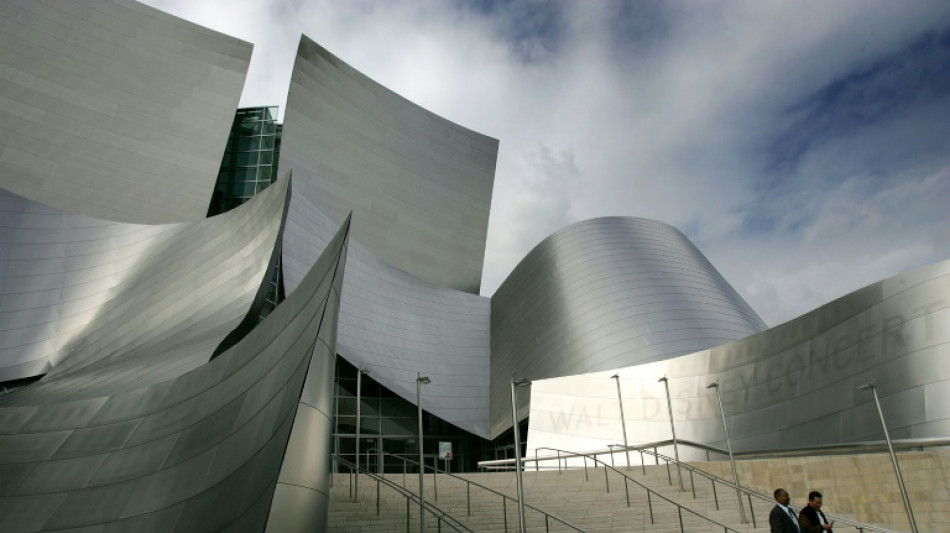
Canada-born US architect Frank Gehry, whose daring and whimsical designs from the Guggenheim Bilbao to the Walt Disney Concert Hall in Los Angeles captivated fans and critics, died on Friday aged 96.
Gehry was perhaps the biggest of the so-called "starchitects" -- an elite group that includes Renzo Piano, Rem Koolhaas, Norman Foster and others -- and enjoyed his fame, but absolutely hated the label.
"There are people who design buildings that are not technically and financially good, and there are those who do," he told The Independent in 2009. "Two categories, simple."
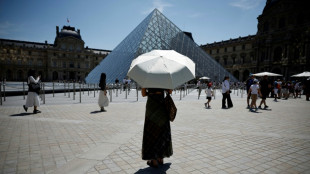
His artistic genius and boldness shone through in his complex designs -- such as the glass "sails" of the Fondation Louis Vuitton in Paris.
He popularized contemporary architecture, and became such a sensation that he was featured on "The Simpsons" -- all while insisting he was a simple maker of buildings.
"I work with clients who respect the art of architecture," he said in 2014, according to his biographer Paul Goldberger.
Gehry's representative Meaghan Lloyd told AFP that he died Friday morning at his home in Santa Monica following a brief respiratory illness.
- From Canada to Los Angeles -
Born Frank Owen Goldberg in Toronto on February 28, 1929 to a Jewish family that would move to the United States in the late 1940s, he later changed his name to Gehry to avoid becoming the target of anti-Semitism.
He studied architecture at the University of Southern California in Los Angeles, graduating in 1954 before enlisting in the US Army and later continuing his studies in city planning at Harvard University, though he did not finish the program.
Gehry eventually returned to Los Angeles to start his career working for Victor Gruen, a pioneer in the design of shopping malls.
He went on to work in Paris with Andrew Remondet in 1961 before returning to Los Angeles, establishing his own architectural practice the following year.
The 70s and 80s would mark the rollout of a long series of his most audacious and innovative architectural achievements, many of them in southern California.
Close to the avant-garde "funk" art scene in California, Gehry's deconstructionist and experimental style -- sometimes derided as crude -- is hard to categorize.
Many of his buildings -- irregularly-shaped metal facades that can look like crumpled paper -- could only be realized with the help of computer design tools, which he fully embraced.
This is maybe best reflected in his seminal reworking in 1978 of his own home in Santa Monica, where he long resided.
It features corrugated metal wrapped around the original 1920s building, described by author Paul Heyer as "adhering to the spirit of ad-hocism" and a "collision of parts."
Gehry ended the 1980s by receiving the highest architectural honor, the Pritzker Prize, in 1989.
- 'Bilbao effect' -
Almost a decade later, he would unveil arguably his most iconic design: the Guggenheim Museum in Bilbao, which earned him international acclaim and notice.
The limestone and glass building with curvy walls clad in titanium scales is instantly recognizable as a Gehry design, and was once described by his American colleague Philip Johnson as "the greatest building of our time."
The building helped revitalize the ancient industrial heart of the Spanish city, attracting visitors from around the world and leading to the coining of the term "Bilbao effect" to explain how beautiful architecture can transform an area.
Emboldened, Gehry would take even greater risks in his next projects, which included the Walt Disney Concert Hall in Los Angeles (2003), the Beekman Tower in New York (2011), and the Fondation Louis Vuitton in Paris (2014).
Facebook tapped Gehry for a major expansion of its Menlo Park campus in California, which opened in 2018.
- 'I love working' -
Many of Gehry's designs require complex computations -- which he pushed to the limits.
For a period, architects avoided the use of rounded or curved shapes as they caused headaches for engineers and led to spiralling construction costs.
Gehry pushed back, applying 3D modelling software similar to that used by aerospace firms to create unique building shapes while keeping costs in line with what developers would pay for a more conventional building of similar dimensions.
The Lou Ruvo Center for Brain Health in Las Vegas -- its walls and windows appearing to have melted under the hot desert sun -- is a classic example of Gehry's groundbreaking vision.
"I love working. I love working things out," he told The Guardian in 2019.
F.Carias--PC