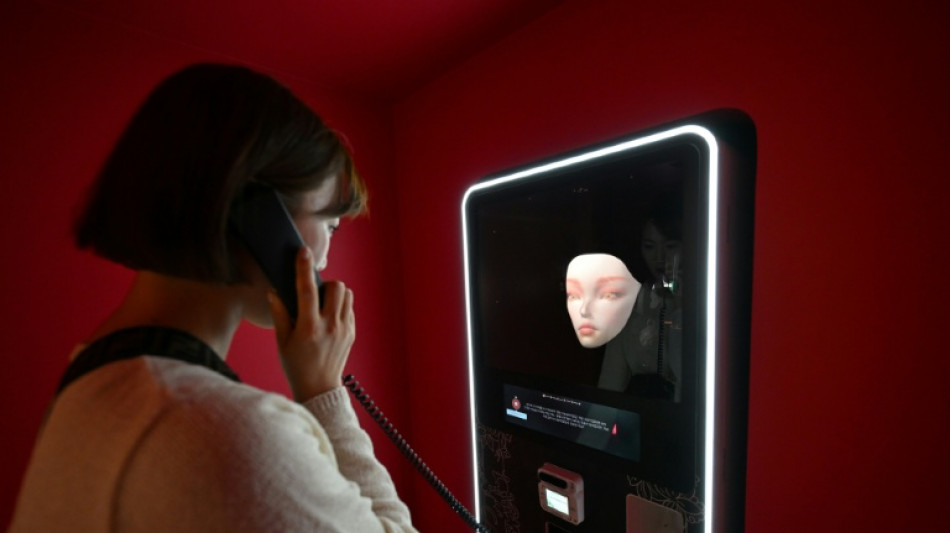
'AI shamans' tell the fortunes of curious South Koreans / Photo: Jung Yeon-je - AFP

 'Glad it's over': Kim powers to Games gold and military exemption

 After 11 World Cups, football finally comes home for one Indian fan

 Marc Marquez wins sprint at Japan MotoGP, Martin grabs pole

 Alcaraz fends off Arnaldi to reach Japan Open quarters

 Antonelli tops times in final practice at Bahrain GP

 Gauff digs deep to beat Osorio in China Open second round

 Fresh protests to hit Spain after housing measures defeated

 'He's here with me': Japan cycle queen dedicates gold to late brother

 Japan Olympic chief says 'lot more' athletes at Games than expected

 Asian carmakers besting US rivals at home, China poised to strike

 Widgets & Web Offers All-Inclusive Investor Relations Websites for Public Companies, IPOs and SPACs

 Adams named new US captain to 2030 World Cup

 China a better influence in Latin America than US: poll

 Judge pauses construction of border project in Texas national park

 Belgium's De Bruyne fires double to sink Turkey, France held by Italy

 US jobs data boosts stocks as oil prices dip

 US Supreme Court to hear high-stakes climate case

 Trump expected to name intel chief Clayton as AI czar: reports

 Argentina unveils passports-for-investment scheme

 Brazil election debate chaos sparks censorship row

 England's Carse charged by cricket body over nightclub incident

 Amazon vows $1 bn for data center towns, decries 'myths'

 Oil prices drop on G7 fuel release, US jobs data boosts stocks

 G7 agrees deal to ease global energy supply concerns

 Spain's government dealt blow as lawmakers reject housing bills

The sound of tinkling bells drifts through an alley in central Seoul, an unmistakable sign that a shaman is near -- although in this case the mystic is a robot powered by artificial intelligence.
Many South Koreans still place great value in shamanic traditions, which purport to divine a person's future based on the day and time they were born.
Practitioners, known as "mudang", wear long, colourful robes and perform dances and chants to commune with the gods -- sometimes even walking on sharp blades to demonstrate their spiritual connection.
However, at Vinaida, a cultural products store in the capital, they are computer-generated avatars on screens.
Visitor Kim Da-ae, 36, called it a "unique experience".
A visit with a real shaman can feel "scary and burdensome", she told AFP.
"But I was just walking by and read this AI sign... So I walked in with a light heart."
Portraits of virtual shamans resembling characters from the popular animation "KPop Demon Hunters" greet passersby at Vinaida, which means "I pray earnestly" in Korean.
Inside a booth, Kim typed her name, gender and date of birth into a computer, before a shaman -- a suspended mask with the image of a human face projected onto it -- asked her to explain her concern through a headset.
The technology combines voice recognition with a generative AI chatbot so that the shaman and the customer can interact.
It then refers to a centuries-old belief system called "saju", or the "four pillars of destiny", to interpret their fate according to the year, month and day of their birth.
Customers then receive a plastic "talisman" bearing a digital QR code that they can scan with their phones to read their fortunes in detail.
Across the room, a bespectacled robot uses a camera and a mechanised arm to sketch and "read" a visitor's face, foretelling their prospects.
"A bright, well-balanced fortune. Resilient in the face of change, with auspicious relationships," an impressed Kim read from a printout.
"I felt a sense of similarity with my fate because it matched my own personality, like valuing relationships while also being practical," she said.
- Twist on tradition -
Fortune-telling is deeply embedded in South Korean life, with newspapers publishing daily horoscopes based on "saju" principles.
Recent cultural hits such as "KPop Demon Hunters" -- Netflix's most-watched film of all time -- have riffed on shamanic traditions.
Vinaida has attracted around 100 visitors a day since opening in February, according to manager Kim Hae-seol. Each service costs up to 8,000 won ($5.50).
"Customers have something tangible or meaningful to take away, which is probably why there aren't many who feel dissatisfied," Kim Hae-seol said.
"We thought it had the potential to succeed, so we seized on this concept."
Customers can talk to the virtual shamans in four languages -- Korean, English, Chinese and Japanese.
Singaporean tourist Amos Chun was trying his luck when AFP visited the shop on Wednesday.
The robot shaman told him to "avoid impulse spending" -- advice he took to heart.
"It's quite a good reading, coming from AI," Chun said, laughing.
"Because that's something that I do."
P.Mira--PC