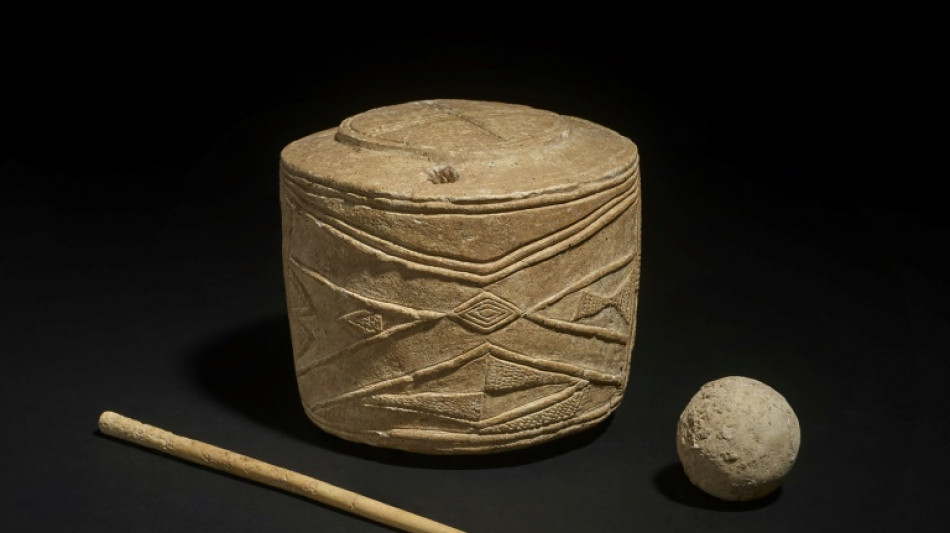
Prehistoric drum is top ancient find: British Museum

 US regulator finds Boeing 737 MAX software bug 'not a safety concern'

 Ohtani 'managing' injuries as Dodgers launch MLB post-season

 Botched US execution leaves murderer unconscious on ventilator: lawyers

 Cornell rape case exposes sexual violence at US colleges

 France held by Italy in Zidane's homecoming after Olise stunner

 Ethiopian pro-government militia claims Tigray airport as regional tensions spike

 Ohtani shaking off injuries as Dodgers launch MLB post-season

 Sea levels to rise in California as coastal wave surges up west coast

 New rallies urged in France as protests disrupt over 730 schools

 Djokovic survives China Open scare, Sabalenka starts strong

 King Charles to evoke colonial 'darkest days' on Caribbean tour

 Tesla shares jump after global car sales top estimates

 DR Congo Ebola outbreak killed more than 4,000: official figures

 Djokovic survives China Open scare against wildcard world no. 104

 Lula, Bolsonaro trade blows in final scramble for votes in Brazil

 New clashes erupt as protests disrupt over 560 French schools

 NY governor vows to close loophole after alleged Cornell gang rape

 Ethiopia Tigray rebels pushed back as regional tensions spike

 Stocks rise, yields fall as US job numbers disappoint

 Man City verdict a 'big topic' for England players, says Tuchel

 NY attorney general tasked with investigating alleged Cornell gang rape

 China widens military footprint with Laos air base

 G7 talks as US pressures Europe over diesel stocks

 Man City launch appeal against explosive financial ruling

 Swiss president to quit government

A carved stone drum unearthed in England is one of the most significant pieces of prehistoric art ever found in the country, the British Museum said Thursday.
The 5,000-year-old drum carved from chalk is set to go on display for the first time in a major exhibition about the Neolithic site of Stonehenge and its historical context.
Extensive research into the drum, uncovered near a village in Yorkshire in northern England in 2015, has confirmed it is one of the most significant ancient objects ever found in the British Isles, the museum said.
"This is a truly remarkable discovery, and is the most important piece of prehistoric art to be found in Britain in the last 100 years," said Neil Wilkin, curator of the exhibition "The World of Stonehenge", which opens February 17.
The drum is "one of the most elaborately decorated objects of this period found anywhere in Britain and Ireland", and its style echoes that of objects from Stonehenge and related sites, the museum said.
Seemingly created as a sculpture or talisman rather than a functional musical instrument, the drum is one of only four known examples.
It was found alongside the grave of three children who were buried close together, touching or holding hands. The drum was placed just above the head of the eldest child, accompanied by a chalk ball and a polished bone pin.
The drum was found around 240 miles (380 kilometres) from Stonehenge near the village of Burton Agnes.
A similar ball and pins have been found in and near Stonehenge.
This suggests that communities across Britain and Ireland shared "artistic styles, and probably beliefs, over remarkable distances", the British Museum said.
"Analysis of its carvings will help to decipher the symbolism and beliefs of the era in which Stonehenge was constructed," said Wilkin.
The British Museum's collection includes a group of three similar drums found in 1889 at the burial site of a single child around 15 miles (24 kilometres) away from the latest find.
The museum describes these three, known as the Folkton Drums, as "some of the most famous and enigmatic ancient objects ever unearthed in Britain".
Radiocarbon dating has revealed they were created at the same time as the first phase of construction of Stonehenge, between 3005 and 2890 BC.
S.Pimentel--PC