
Native Americans fear loss of Indigenous languages in US / Photo: Yuki IWAMURA - AFP

 Tuchel hails 'complete' England after Croatia demolition

 Fury to invite Trump to lead ring walk before Joshua showdown

 Fashion industry in 'precarious moment', says Vivienne Westwood supremo

 Seventh heaven for England in Nations League rout of Croatia

 Storms, flooding cause chaos on Greek holiday island of Crete

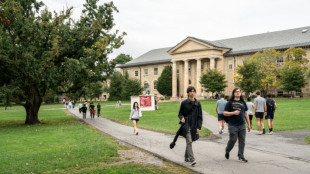 #IAmJaneDoe: online support campaign in US university rape case

 Brazil shine on Selecao's first visit to India

 Zverev sets up Djokovic quarter-final at China Open, Rybakina out
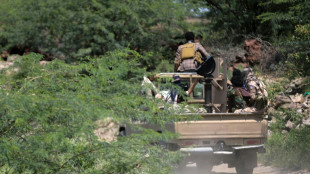
 Happier at home, Bordeaux hammer Lyon in Top 14

 Lula, Bolsonaro in final push for votes ahead of knife-edge election

 Boisterous fashion week barnstorms 'sleepy' Nigerian capital

 UAE investigators say flydubai co-pilot was planning 'terrorist act'

 Rahul smacks century in India v Windies ODI

 Daryz seeks to join exclusive club of dual Arc winners

 Russia warns diplomats to leave Kyiv over new strikes threat

 Olympic champ Zheng rebukes rowdy home crowd at China Open

 World No.1 Sinner pulls out of Shanghai Masters to delay return

 Red Bull's Verstappen grabs pole position for Bahrain GP

 India beat Pakistan in blockbuster as golfer Kim wins 'crazy' gold

 India beat arch-rivals Pakistan to win Asian Games cricket gold

 Ethiopia's Tigray rebels abandon regional capital as govt advances: journalist

 Tom Kim powers to Games gold and exemption from military service

 Split loyalties for Indian football fans at Brazil friendly

 India-Pakistan blockbuster brings cricket fever to Japan baseball field

 Wong waiting on Rafa after winning Asian Games tennis gold

As Native Americans this week celebrated Indigenous Peoples Day -- the holiday increasingly recognized in the United States in lieu of "Columbus Day" -- members of the continent's hundreds of tribes shared a common concern: the ongoing extinction of their ancestral languages.
The United States is currently home to 6.8 million Native Americans, or two percent of the population.
Members of the Shinnecock Nation on Long Island gathered for the sunrise to honor this week's holiday, which has been adopted by more than a dozen US states and cities amid the growing view that Italian explorer Christopher Columbus brought little more than genocide and colonization to the Americas in 1492.
And further north on the Atlantic Coast, people of the Americas and Caribbean ate together as they held discussions, danced and sang.
But while their ancestors saw their communities decimated by centuries of colonization, descendants today fear their culture and languages could be swallowed up in a single generation by English and Spanish.
Decrying "the invasion of the 21st century," Anthony Sean Stanton, the 64-year-old head of the Narragansett tribe, said his people must "hang onto what we got because once it's gone, it's gone forever."
Further west, the Lakota -- a prominent subculture of the Sioux, located primarily in North and South Dakota -- also fear the extinction of their language, currently spoken by 1,500 people, compared to 5,000 speakers two decades ago.
For many communities, including the Lakota, the generational transmission of languages halted around the mid-1980s, said linguist and activist Wilhelm Meya, who serves as president of The Language Conservancy (TLC) in Indiana.
There is "a very small window of opportunity to try to bring the language back before the last speakers of this language pass on. And this is a story that's replicated across hundreds of communities in North America," he said.
"We're in the forefront of trying to prevent this total collapse of Indigenous languages in North America."
- 'Hungry' for language -
According to TLC, some 2,900 languages of the approximately 7,000 spoken worldwide are endangered.
At this rate, the organization says, nearly 90 percent of all languages could become extinct in the next 100 years.
Native American languages are dying out at an even faster rate, according to the non-profit, with more than 200 already eradicated.
The best preservation strategy is to teach these languages in schools, says Meya, who notes that the federal government finally allowed communities to take up the practice in the early 1970s.
He also urges the development of other materials in the ancestral languages, including translating cartoon series and documentary films, as well as creating dictionaries and assisting with teacher trainings.
"Anything we can do to reach the young people who are very, very hungry for their language," Meya said. "They want their culture, they want their identity."
- 'Part of who I am' -
Miya Peters, an 18-year-old member of the Wampanoag tribe along the northeastern US coast, is one such example. She learns her language as part of a partnership between her tribal school and public school.
"I love it. It is hard. It's very different," she said. "But it's part of who I am. So it always just gives me that encouragement to just keep going and bring it back."
Meya and his colleague Travis Condon aim to continue the work of Kevin Locke, an ardent defender of his Lakota language and culture.
The 68-year-old flautist, hoop dancer and storyteller died suddenly on September 30.
"He was definitely a warrior for his tribe, you know, an ambassador for mankind," Meya said.
The linguist emphasized the need for federal investment in language preservation.
"It took the federal government 100 years and billions of dollars to eradicate Native American languages through the boarding school system," he said. "And it's gonna take equal amount of resources to bring back Indigenous languages in North America."
"It's much, much more difficult to create than it is to destroy."
C.Cassis--PC