British Museum exhibition traces rise and fall of Stonehenge

 US regulator finds Boeing 737 MAX software bug 'not a safety concern'

 Ohtani 'managing' injuries as Dodgers launch MLB post-season

 Botched US execution leaves murderer unconscious on ventilator: lawyers

 Cornell rape case exposes sexual violence at US colleges

 France held by Italy in Zidane's homecoming after Olise stunner

 Ethiopian pro-government militia claims Tigray airport as regional tensions spike

 Ohtani shaking off injuries as Dodgers launch MLB post-season

 Sea levels to rise in California as coastal wave surges up west coast

 New rallies urged in France as protests disrupt over 730 schools

 Djokovic survives China Open scare, Sabalenka starts strong

 King Charles to evoke colonial 'darkest days' on Caribbean tour

 Tesla shares jump after global car sales top estimates

 DR Congo Ebola outbreak killed more than 4,000: official figures

 Djokovic survives China Open scare against wildcard world no. 104

 Lula, Bolsonaro trade blows in final scramble for votes in Brazil

 New clashes erupt as protests disrupt over 560 French schools

 NY governor vows to close loophole after alleged Cornell gang rape

 Ethiopia Tigray rebels pushed back as regional tensions spike

 Stocks rise, yields fall as US job numbers disappoint

 Man City verdict a 'big topic' for England players, says Tuchel

 NY attorney general tasked with investigating alleged Cornell gang rape

 China widens military footprint with Laos air base

 G7 talks as US pressures Europe over diesel stocks

 Man City launch appeal against explosive financial ruling

 Swiss president to quit government

A new exhibition on the Stonehenge stone circle in southern England sheds new light on its 4,500-year history, linking its declining influence to the Bronze Age population's discovery of metal working.
Opening Thursday at the British Museum in London, the exhibition called "The World of Stonehenge" traces the development of the UNESCO-protected site -- two concentric circles of huge stone blocks and lintels.
According to Celtic legends of the Middle Ages, the circle was magically created by the mythical magician Merlin.
Construction at the site was started during the Neolithic era by hunter-gatherers without metal tools and continued into the Bronze Age as metal working became widely established.
European metal workers arrived during the early Bronze Age, gradually superseding the local Neolithic population.
"Within a couple of hundred years, those people from Europe replaced the previous population by almost 95 percent," Neil Wilkin, the exhibition's curator, said.
As their culture and beliefs became dominant, Stonehenge lost its original purpose and became used as a cemetery, he added.
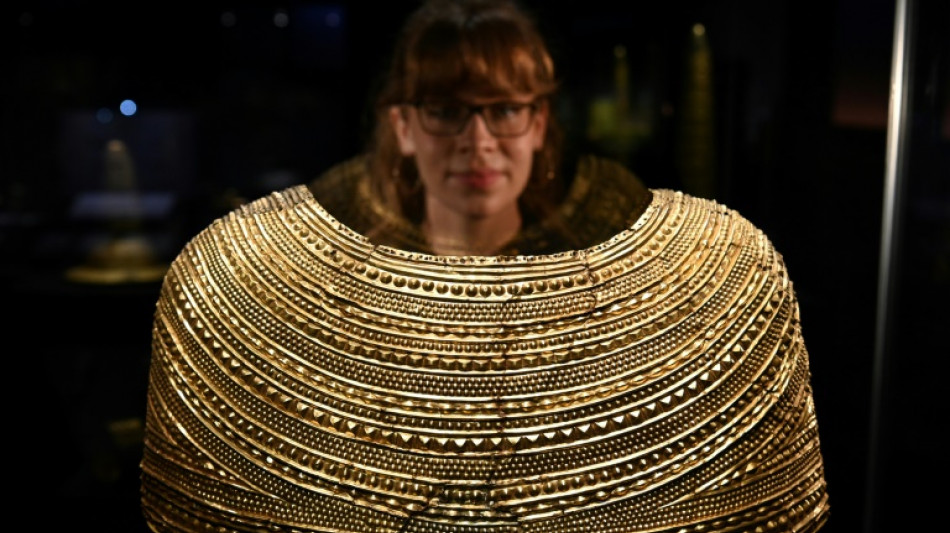
The exhibition shows numerous tombs from the time, as well as objects such as large gold necklaces made in France around 2300 BC.
The Nebra Sky Disc, the world's oldest surviving map of the stars, smelted in gold and bronze in 1600 BC in present-day Germany, is also featured.
Altogether there are more than 430 objects from the United Kingdom, Ireland, France, Germany, Denmark and Switzerland at the exhibition, which runs to July 17.
The British Museum also displays 14 wooden poles that were preserved for millennia under the sand of a beach in Norfolk, eastern England, until their discovery in 1998.
These are the remains of a wooden circle called Seahenge, on loan to the museum for the first time.
The 4,000-year-old circle once featured 54 oak piles arranged in a circle 6.6 metres in diameter, with a huge upturned tree in the centre, its roots facing skywards.
This circle would have been used for rituals in a similar way to Stonehenge, but was built five centuries later (2049 BC), using metal axes typical of the Bronze Age, said Wilkin, as the tradition of building such circles dwindled away.
"Seahenge is one of the last monuments of its type built in Britain. It's the very end of a long tradition that spans 1,000 years," he noted.
G.M.Castelo--PC