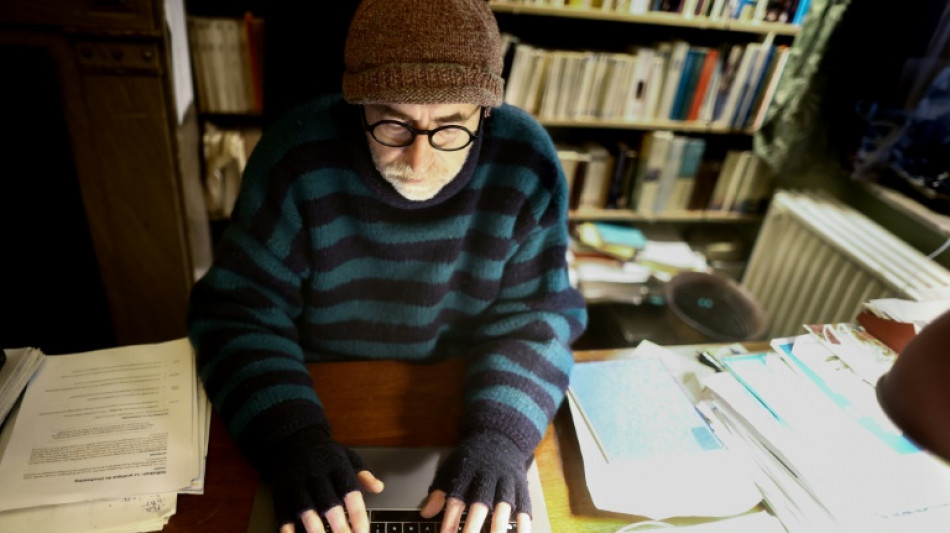
Belgian families don gloves for house-heating research / Photo: Kenzo TRIBOUILLARD - AFP

 Spanish PM says no 'solid proof' Morocco planned Ceuta migrant rush

 Venezuela's Maduro seek immunity from US drug charges

 Tazapay Now Live on the Borderless.xyz Network For Seamless Money Movement to Asia Pacific and Latin America
 DWF Labs Expands Global Regulatory Footprint with BVI Virtual Asset Service Provider Approval

 Just the beginning of the journey, Broeders-Bol says of 800m adventure
 US trade gap in July hits biggest in over a year on AI buildout
 Study shows plug-in hybrids polluting far more than expected
 Lost tool disrupted Airbus jet deliveries for months
 MEXC Concludes 0808 Stock Season with Over 86,000 Participants and More Than $1M Saved Through 0 Fee Trading

 US feminist icon Gloria Steinem dies at 92: foundation

 All Blacks drop veteran hooker Taylor for third Springboks Test

 British, French leaders hold talks on migrants, EU relations

 Oil prices jump as Iran strikes US targets

 Putin denies plan for new Russia military call up
 Caruana Galizia: 'one-woman WikiLeaks' who exposed Malta's shady side
 Kuwait's Iranians under pressure since start of war

 EU lawmakers demand Brussels force Meta to 'protect' European children

 Clooney turns AFP photographer in jokey red carpet switch
 Retirement Income Planning Florida Launches No-Cost 'Income Gap Analysis' Program for Pre-Retirees
 Iraola hails Barcola mentality after blockbuster Liverpool move
 Michelsen shocks Nakashima in US Open clash of rising Americans

 US govt sides with OpenAI in New York Times copyright lawsuit

 WMO Says Powerful El Niño Is Likely to Persist Into February 2027
 China’s Oil Use Drops 9 Percent as Transport Electrification Accelerates

 Argentine Groups Seek Court Halt to Sea Lion Oil Project Near Falklands
Outside the family home, frost covers the ground and temperatures in the damp Belgian winter have plunged below freezing.
Inside the 200-square-metre (2,100 square foot) house it is slightly warmer -- the thermostat reads 14.5 Celsius (58 Fahrenheit) -- but the family of six is wrapped up warm.
Geoffrey Van Moeseke, an architect engineer from Louvain-la-Neuve, is putting his family through their third consecutive winter as "SlowHeat" pioneers.
The idea cooked up by academics is to save on the cost and the environmental toll of gas heating, by using directed heat where it's needed and leaving the unoccupied parts of the house chilly.
"Heat the bodies, not the walls" is the project's motto, and that starts with appropriate winter clothing.
"Right now, I'm wearing a classic cotton sweater and an old, fairly warm jacket," Van Moeseke said.
"Underneath, I have two more layers: a T-shirt and technical sports clothing," he explains.
For the feet, it's socks and "old, padded slippers which are extremely warm".
The second part of the project's advice is the use of electric radiant heaters, which provide intense and easy-to-direct heat.
- Heated capes -
Van Moeseke owns two, which he runs for only two hours a day -- one in the living room and one in his son's bedroom, the coldest room in the house, hovering around 12C.
These heaters can be placed on desks and warm only the person sitting in front of them, creating a bubble of comfort without wasting heat on unused parts of the room.
On the researchers' website is a third suggestion: electrically heated capes and neck warmers, which they claim pay for themselves in a month with reduced heating bills.
As they work on their research, the SlowHeat team sometimes wear fingerless gloves to type or use heated mouse mats.
When the project began in September 2020 many of their colleagues told them they were mad.
But this winter's energy crisis, soaring gas bills triggered by the war in Ukraine plus suddenly cold temperatures has sparked renewed interest in the project.
"We wondered what would happen if all of a sudden we ran out of gas," explained Denis De Grave, research assistant at the University of Louvain.
"At the beginning, we were taken for crazy," admitted Gregoire Wallenborn, researcher and teacher at the Free University of Brussels, bundled up in a big jacket and with a woolly hat screwed on his head.
In his apartment in Brussels, the average temperature fluctuates between 12 and 14C.
While gas and electricity bills are rising steeply, Van Moeseke only pays, on average, 70 euros ($74) per month for heating.
Needless to say, before submitting themselves as guinea pigs in their own experiment, the SlowHeat researchers had to convince their families.
- Rethink habits -
"I brought in the project little by little," Van Moeseke said. "It was more difficult the first winter than the second, which shows that we adapt to new habits over time."
His youngest child, 11-year-old Celestin, wears a woollen sweater -- and shorts with bare legs.
"The first winter was harsher, we were used to a warmer temperature, but I got completely used to it. I think it's hot here," Celestin smiled.
Not everyone adapted so readily.
Some really feared the cold or worried that friends and families would not visit, and that roommates and relatives would complain.
It was a while before Van Moeseke got used to operating a small set of pedals under his desk to keep active.
More ideological doubters see the project as an ultimatum to embrace poverty, but the researchers insist the project is not a one-size-fits-all solution, but rather a chance to rethink our habits.
"The objective is absolutely not to tell people: you are going to be cold," explained Amelie Anciaux, sociologist at the University from Leuven and member of SlowHeat.
"The idea is to keep the same level of comfort but with a few degrees less."
F.Ferraz--PC